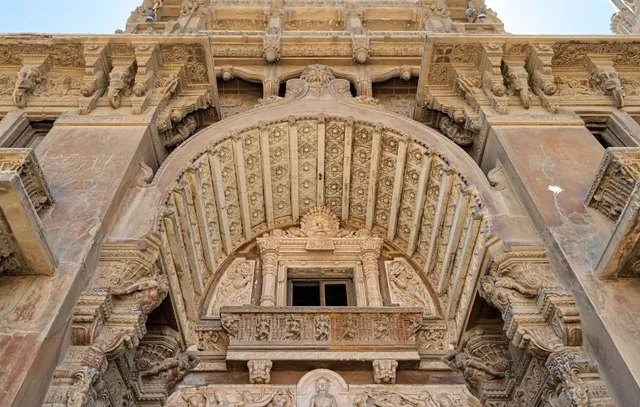
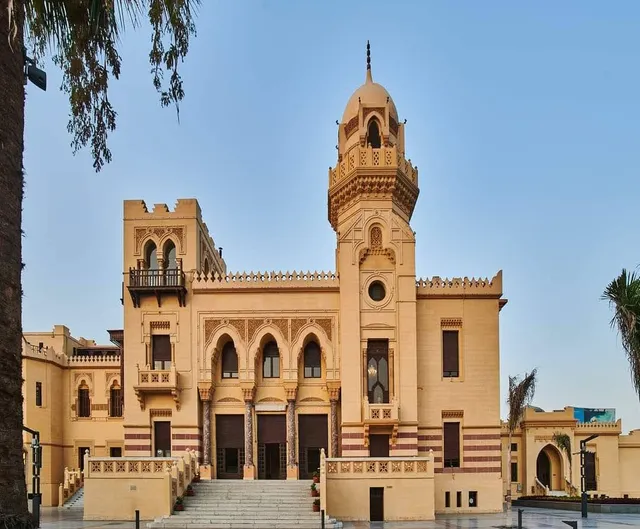
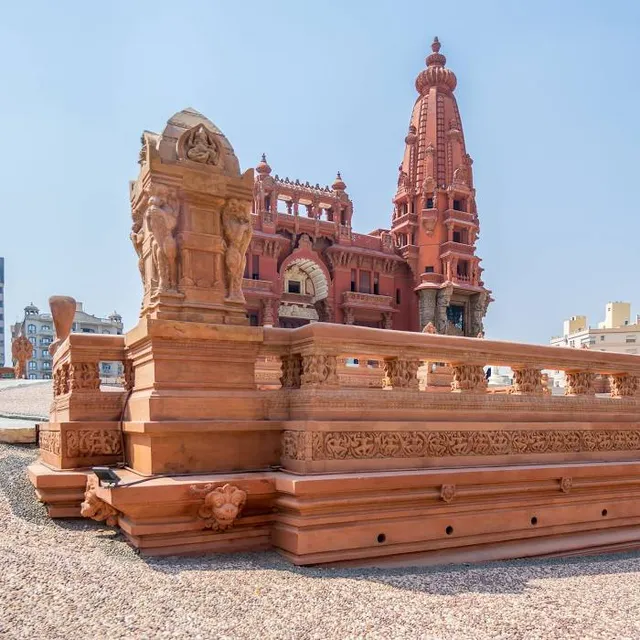
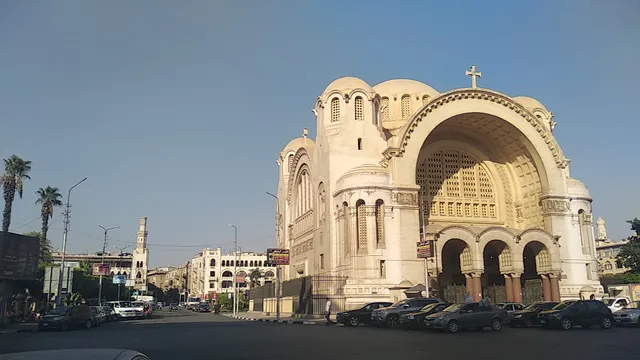
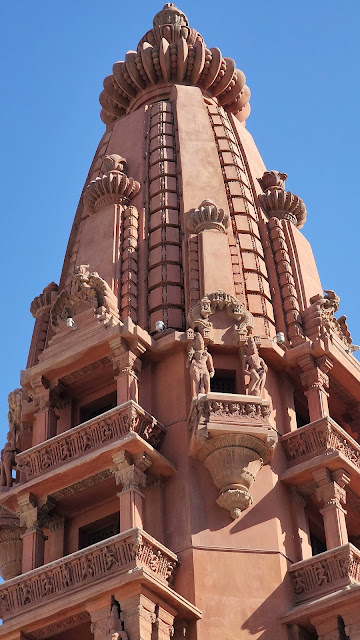
The Baron Empire Palace, also known as the Empain Palace, is a distinctive and historic Hindu temple-inspired mansion in Heliopolis, a suburb northeast of central Cairo, Egypt. It was designed by French architect Alexandre Marcel and decorated by Georges-Louis Claude, and was built between 1907 and 1911 for Belgian industrialist Édouard Louis Joseph Empain, the founder of the Heliopolis suburb.
The palace is a unique blend of European and Middle Eastern architectural styles, with Hindu and Egyptian motifs. It is built of pink sandstone and has a lavishly decorated interior, with intricate carvings, mosaics, and stained glass windows. The palace is surrounded by a lush garden with fountains and statues.
Architecture
The Baron Empire Palace is a remarkable example of eclectic architecture, combining elements of European, Middle Eastern, and Hindu design. The palace's exterior is dominated by its pink sandstone facade, which is decorated with intricate carvings and mosaics. The palace's central dome is inspired by Hindu temple architecture, while its towers and turrets are reminiscent of European castles.
The palace's interior is just as impressive as its exterior. The palace's main hall is decorated with a massive stained glass window and a series of murals depicting scenes from Egyptian mythology. The palace's other rooms are also lavishly decorated, with intricate carvings, mosaics, and inlaid floors. Gardens
The Baron Empire Palace is surrounded by a lush garden with fountains and statues. The garden is a popular spot for visitors to relax and take in the palace's beauty. The garden is also home to a variety of plants and flowers, including palm trees, bougainvillea, and roses.
Touring the Palace
The Baron Empire Palace is open to the public for guided tours. Visitors can explore the palace's interior and gardens, and learn about its history and architecture. Tours are available in English and Arabic.
Overall Review
The Baron Empire Palace is a unique and fascinating place to visit. It is a beautiful example of eclectic architecture, and its gardens are a great place to relax and take in the view. The palace's guided tours are informative and...
Read moreBaron Empain's palace, with its Indian style, and its tower stands out in the desert landscape, is distinct from the rest of the city. The palace reflects the high status of its owner and marks a major milestone in the urban landscape of Heliopolis. Baron Empain's palace is the most prominent Monuments in the capital, its unique and innovative image attracting crowds of pedestrians on the road.
It was founded by Edward Louis Joseph Empain between 1907 and 1911. He was a Belgian businessman who was awarded the title "Baron" by the King of Belgium, on account of his economic contributions. The French architect Alexander Marcel was tasked with building this masterpiece.
The interior design of the palace consists of three floors topped by a roof. The palace is surrounded by a large garden from all sides. As for the basement, it contained a residence for the palace's servants, and consisted of a group of rooms connected by corridors and doors. The palace building is surrounded by a spiral staircase and an elevator that connects all the palace floors with a basement. The ground floor consists of a reception room, a dining room, and a billiard room. As for the first floor, it houses four rooms, each with its own balcony and bathroom. Finally, the roof of the palace comes as an open space on one of the sides of the tower, characteristic of the Baron Palace.
Tickets FOREIGNERS: Adult: EGP 100 / Student: EGP 50 EGYPTIANS/ARABS: Adult: EGP 20 / Student: EGP 10
The Roof Foreigners: EGP 50 Egyptians: EGP 20 -Photo shot tickets (by camera ) : Camera:EGP 50 \ Camera Stand: EGP 20 Photo Session:EGP 800 Gallery Show More One of the facade statues during restoration One of the facade statues during rest ... The interior of the palace during the restoratio The interior of the palace during the ... Announcement Baron Empain's palace, Heliopolis A unique structure ornamenting the neighbourhood's urban landscape. It is one of the most architecturally exquisite buildings in Egypt, and one of its historical and touristic landmarks. The building's original colour and shine was...
Read more20th This extraordinary building embodies the personality of a man whose vision and determination created the city of Heliopolis that emerged in the desert during the early century. This city combined a revival of the Islamic architecture of Cairo with the latest developments in construction technology and in town-planning. These developments resulted in the original dynamic urban model known as 'Heliopolis', representing a remarkable fusion and inter cultural dialogue. The palace itself blends the Beaux Arts architecture that draws on centuries of European tradition with an astonishing Indian/Khmer design.
Welcome to the palace of Baron Édouard Empain.
See how a group of talented individuals turned barren desert into a veritable oasis, then meet the people who made it happen. Immerse yourself in the mood and spirit of the Belle Époque. Three generations of Empains lived in the Baron's palace. After the founder Édouard Empain, his bon vivant son Jean, who was usually seen cruising the boulevards of Heliopolis in his Rolls-Royce Phantom II, resided in the palace. Following Jean's death in 1946, his daughters Janine and Huguette made the palace their home. The building and its contents were sold in the 1950s. None of the new owners' plans for developing the palace were realised and the building eventually deteriorated.
The palace was declared a registered monument in 1993. By 2005 the Ministry of Housing acquired the building, compensating the owners with land in New Cairo, and then entrusted it to the Ministry of Culture, which was responsible for antiquities at that time.
The garden that had withered was re-estab lished and rented out for social gatherings, but the palace remained abandoned and neglected. Between 2017 and beginning of 2020, a long awaited comprehensive restoration was carried out under the supervision of the Historic Cairo administration of the Ministry of Tourism and Antiquities. Harnessing its experience in the conservation of more than 100 historic build-ings since 1989, this agency was ready to take on such a...
Read more