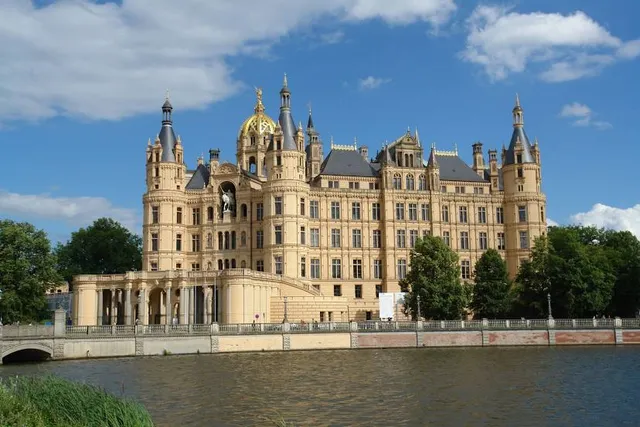
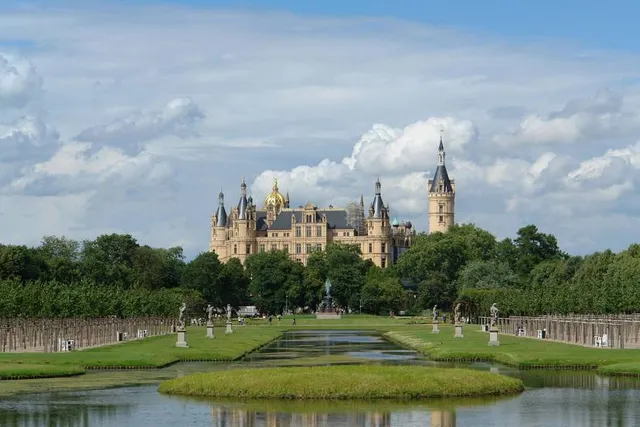
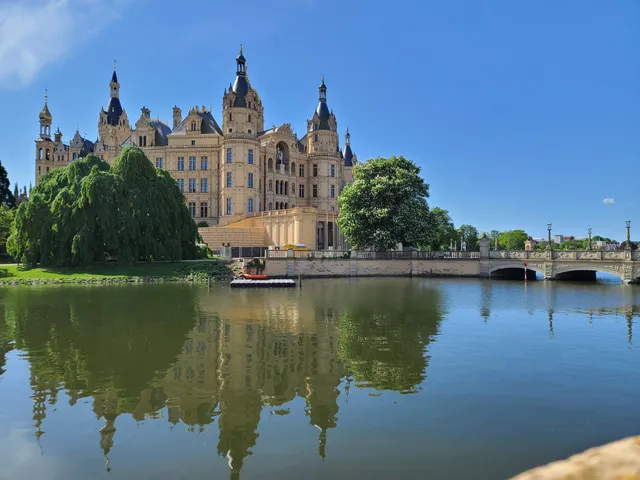
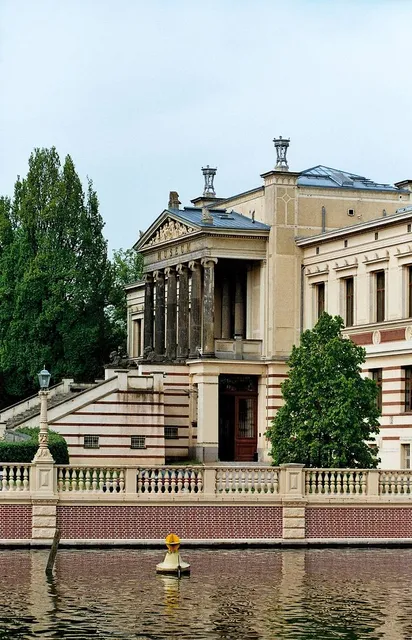
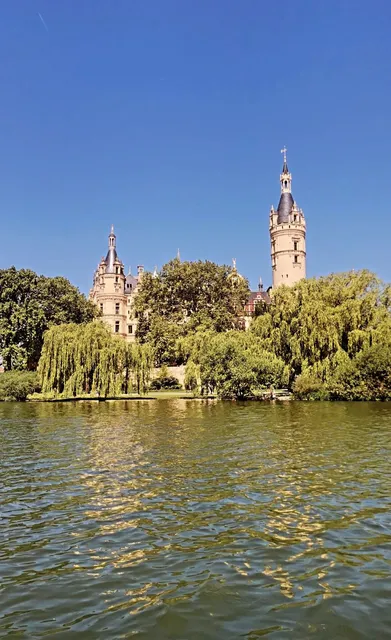
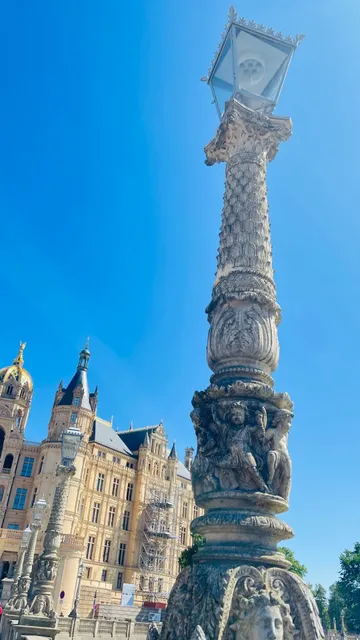
The Schwerin Palace is a palatial schloss located in the city of Schwerin, the capital of Mecklenburg-Vorpommern state, Germany. It is situated on an island in the city's main lake, the Lake Schwerin. For centuries the palace was the home of the dukes and grand dukes of Mecklenburg and later Mecklenburg-Schwerin. Today it serves as the residence of the Mecklenburg-Vorpommern state parliament (German: Landtag).
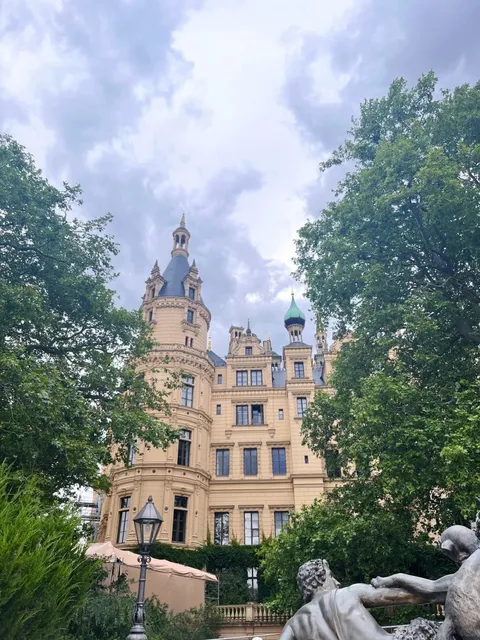
Major parts of the current palace were built between 1845 and 1857, as a cooperation of the renowned historicist architects Gottfried Semper, Friedrich August Stüler, Georg Adolf Demmler and Ernst Friedrich Zwirner. The castle is regarded as one of the most important works of romantic Historicism in Europe and is designated to become a World Heritage Site. It is nicknamed "Neuschwanstein of the North".
In 1837, the ducal residence moved back to Schwerin, but the building was in a relatively bad condition, and the Grand Duke disliked the individual buildings' incongruent origins and architectural styles. Grand Duke Friedrich (1800–1842) instructed his architect Georg Adolph Demmler (1804–1886) to remodel the palace. However a few months later, construction was halted by his successor, Friedrich Franz II (1823–1883), who wanted a complete reconstruction of the historic site. Only some parts of the building dating from the 16th and 17th century were retained.
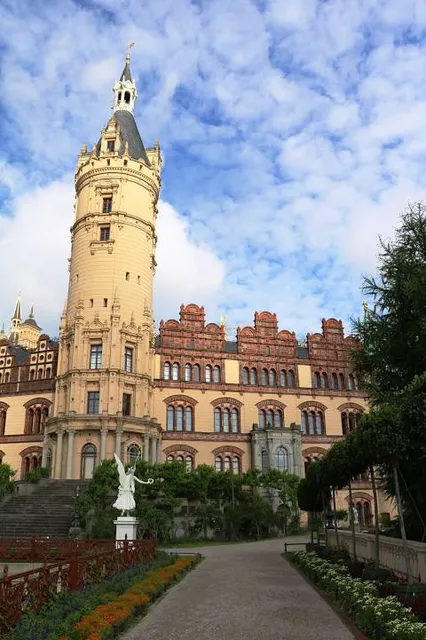
Dresden architect Gottfried Semper (1803–1879) and Berlin architect Friedrich August Stüler (1800–1865) could not convince the Grand Duke of their plans. Instead, Demmler included elements of both of them into his plan, but found inspiration in French Renaissance castles. The castle became the most admired masterpiece of the student of Karl Friedrich Schinkel. He also planned a government building in 1825-1826 located at Schlossstraße (today the State Chancellery). Renaissance châteaux of the Loire Valley (such as Chambord) also inspired him and contributed to the construction from 1843 until 1851. His successor Stüler again made a few alterations, and included an equestrian statue of Niklot and the cupola.
Heinrich Strack (1805–1880) from Berlin was chosen for the interior design. Most of the work was carried out by craftsmen from Schwerin and Berlin. A fire destroyed about a third of the palace in December 1913. Only the exterior reconstruction had been completed when the revolution in 1918 resulted in the abdication of the Grand Duke. The castle later became a museum and in 1948 the seat of the state parliament. The German Democratic Republic used the palace as a college for kindergarten teachers from 1952 to 1981. Then it was a museum again until 1993. The Orangerie had been a technical museum since 1961. From 1974 on, some renovated rooms were used as an art museum.
Since late 1990, it is once again a seat of government, as the seat of the Landtag (the state assembly of the State of Mecklenburg-Vorpommern). Since then there have been massive preservation and renovation efforts. Most of these were...
Read more🇩🇪 🇩🇪 🇩🇪 🇪🇺🇪🇺🇪🇺 Schwerin Castle is a historic edifice located in the city of Schwerin, the capital of the German state of Mecklenburg-Vorpommern. It's renowned for its breathtaking beauty and a design that appears to float on the vast Lake Schwerin, earning it the moniker "Neuschwanstein of the North." Historical Overview Early Origins (10th Century) The earliest records of a structure on this site date back to 973 AD, when it served as a fortress for the Polabian Slavic Obotrite tribe on an island in Lake Schwerin. German Acquisition (12th Century) In 1160, the fortress became a target for German nobles, led by Henry the Lion (1129-1195), who sought to expand their territories eastward. The site was conquered, and in 1160, the fortress was rebuilt, forming the foundation of the current Schwerin Castle. Ducal Residence (14th Century Onwards) In 1358, the County of Schwerin was acquired by the descendants of Niklot, who had been elevated to Dukes of Mecklenburg in 1348. They relocated to Schwerin, and the castle became the residence for the Dukes and Grand Dukes of Mecklenburg for several centuries. The castle underwent numerous modifications and expansions during this period. Major 19th-Century Transformation The castle's current appearance largely dates back to the 19th century. Between 1845 and 1857, Grand Duke Frederick Franz II commissioned the transformation of the castle into a magnificent neo-Renaissance palace, inspired by French châteaux like the Château de Chambord on the Loire. Several prominent architects, including Gottfried Semper, Friedrich August Stüler, Georg Adolf Demmler, and Ernst Friedrich Zwirner, contributed to this grand renovation. 20th Century to Present In December 1913, approximately one-third of the castle was destroyed by fire. With the abdication of the Grand Duke in 1918, the castle became state property. Since then, it has served various purposes, including a museum, a college for kindergarten teachers, and at times, a hospital. Since 1948, the castle has been the seat of the Mecklenburg-Vorpommern state parliament, and it continues to be an important political and cultural center, with a portion remaining open to the public as a museum. Today, Schwerin Castle stands as one of the most significant examples of Romantic Historicism in Europe, attracting numerous visitors who come to admire its architectural splendor, opulent rooms, and magnificent...
Read moreSchwerin Castle, located in the northern German state of Mecklenburg-Vorpommern, is a masterpiece of historicist architecture and a symbol of regal grandeur. This Castle is located on an island in Lake Schwerin, the castle's picturesque setting and fairytale like appearance make it one of Germany's most iconic landmarks.
Its construction, completed in 1857, was a collaborative effort by renowned architects Gottfried Semper, Friedrich August Stüler, Georg Adolf Demmler, and Ernst Friedrich Zwirner, resulting in a harmonious blend of Gothic, Renaissance, and Neo-Romantic styles.
The castle's history dates back to the 10th century when it served as a Slavic fortress. Over centuries, it evolved through various phases of destruction and reconstruction, reflecting the changing architectural tastes and historical influences.
In 1160, Henry the Lion established the first Germanic fortification on the site after conquering the region. By the Renaissance period in the 16th century, under Duke John Albert I, the castle transitioned into a palace with decorative elements replacing its defensive features. The chapel within the castle became Mecklenburg's first Protestant church during this time.
In the 19th century, Grand Duke Friedrich Franz II commissioned significant renovations that gave Schwerin Castle its Romantic appearance. This transformation included ornate towers with golden domes, gables, and intricate stonework that underscore its royal heritage.
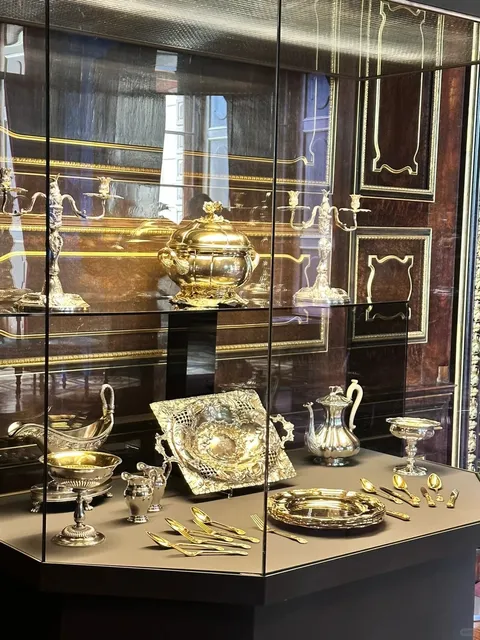
The interior is equally magnificent, featuring luxurious rooms like the throne room adorned with gilded ornamentation and the sculpture hall showcasing artistic mastery.
Today, Schwerin Castle serves multiple purposes. It houses the Mecklenburg-Vorpommern state parliament while also functioning as a museum and cultural venue for exhibitions and events.
Its gardens are a visual delight, including the Rose Garden with over 500 varieties of roses. Visitors can explore its grand ballroom, chapel, library, and art gallery or enjoy guided tours that delve into its rich history.
Recognized for its historical significance and architectural brilliance, Schwerin Castle was added to the UNESCO World Heritage List in 2023.
It remains a must-visit destination for those seeking to immerse themselves in Germany's cultural and historical legacy amidst breathtaking...
Read more