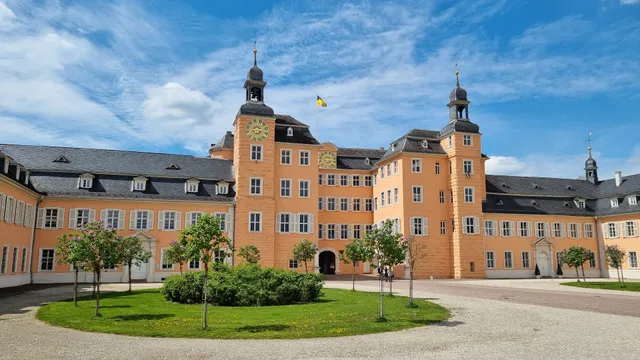
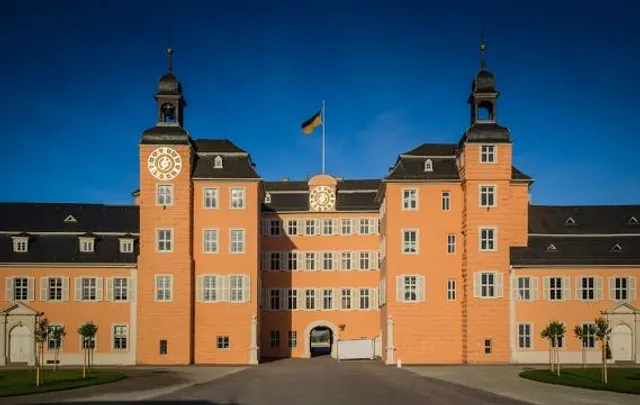
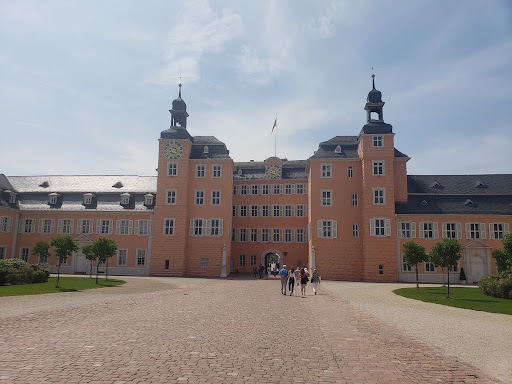
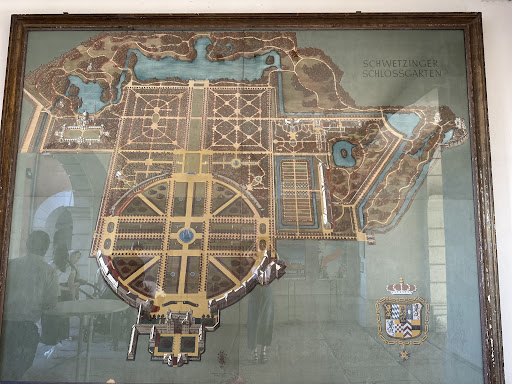
Schwetzingen Palace is a schloss in the German state of Baden-Württemberg. Schwetzingen was the summer residence of the Electors Palatine Charles III Philip and Charles IV Theodore (of the House of Wittelsbach). It is situated in Schwetzingen, roughly equidistant from the electors' seats at Heidelberg and Mannheim, and is most notable for its spacious and ornate gardens. Other than these exceptionally well preserved gardens and the palace proper, the compound also features the Schlosstheater Schwetzingen, the principal venue for the annual Schwetzingen Festival. The main building replaces a 17th-century hunting lodge built on the foundations of an older moated castle of which it also retains some foundations and walling (hence the slightly irregular layout). It was built in its current form in several building campaigns between 1700 and 1750, in part to plans of the Heidelberg architect, Johann Adam Breunig. Construction began in the reign of Johann Wilhelm von der Pfalz, for whom the palace was not yet to be an official summer residence, but a simple hunting lodge. However, an ornate, if comparatively modestly scaled first garden was laid out at the same time, which was retained and embellished by Karl Philip. When the new, greatly expanded gardens of Charles Theodore began to take shape in the 1750s and 60s, plans were commissioned from the court architect, Nicolas de Pigage, for a new palace that would have been of a scale on a par with its surroundings. However, mostly due to concurrent projects that siphoned off funds (the completion of the gigantic new residential palace at Mannheim and the reconstruction of Schloss Benrath), nothing came of these plans. As a result, the modest building as it stands today is completely overwhelmed by the garden's sheer size and magnificence. It would, therefore, be more appropriate to call it "the gardens and palace of Schwetzingen", and not the reverse. Much of the original interior decoration and furnishings survive. Following a major restoration effort in the late 20th century, several of the electoral and ducal apartments are now back in the state their previous occupants would have known. These rooms may not have the supreme splendour found elsewhere in German princely dwellings, but they do convey a particularly vivid image of the court's everyday life. The building was too small to also accommodate the reception rooms required for the gatherings of the court. These - comprising two large halls and the theater- were instead incorporated into the two symmetrical curved outbuildings (the Zirkelbauten) on the garden front, initially intended to serve only as orangeries. During the second half of the 18th century, when the current Schwetzingen garden was created, the "French" formal garden was gradually being supplanted by the "English" landscape garden as the prevalent style of gardening. The numerous princely estates in the Holy Roman Empire were quick to pick up the change, often remodelling older gardens according to the new taste. The Schwetzingen garden perhaps uniquely reflects this fundamental change in attitude, as its creators actually sought to reconcile the two conflicting styles. Accordingly, while the oldest portions are strictly formal, the newer ones subsequently introduced more "natural" features. However, great care was taken so that the finished work would still form a coherent whole. As a result, Schwetzingen is sometimes described as the principal surviving example of an intermediary style, the "anglo-chinese" garden, but in its diversity actually transcends the boundaries of that particular - and short-lived - style. The first plan, devised by the gardener Petrie of Zweibrücken, introduced one highly unusual motive, namely the layout of the main parterre as a full circle. This remains unchanged and is a prominent feature that distinguishes Schwetzingen from most...
Read moreOne of the most stunning gardens I have visited. Period.
The enormous size, the meticulous eye for detail, the intriguing sculptures and monuments, the symmetry of the French section and the freedom of the English park - this all makes this place a truly unique masterpiece of garden design!
The Schwetzinger palace and gardens are located only 10 minutes walking distance from the train station, making this mode of transport quite convenient for a visit. I purchased an 8 EUR ticket (paid by card) to enter the gardens (it entitles visitors to re-entry on the same day if needed). Right after the ticket checkpoint - at the passage under the castle - maps and brochures are available in multiple languages. Grab one, you'll need it in the gigantic gardens!
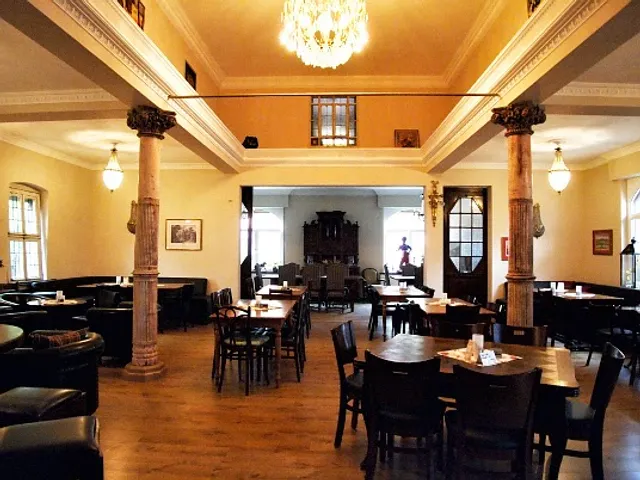
All the social amenities are located at the proximity of the palace - a cafe/restaurant on the right side, the toilets on the left side. There is nothing else within the gardens (no restrooms, no vending machines, no cafes, so be aware!). A detailed explanation of the garden's history and its features and sites is up for a visit in one of the adjacent buildings of the palace, however the explanations are only in German.
I spent more than 3 hours here and I could do more, the entire day if possible. Afterall I have seen many people and families with picnic blankets just enjoying themselves. During my time I visited the most important parts and I would recommend touring them all:
The Orangerie - eventhoug not possible to visit inside, there are sculptures and statues displayed within its proximity around the park
The Apollo temple - small temple with a water feature, great photo opportunity, possible to visit up close
The Bath house - beautifully decorated house built like an Italian villa with a possibility of entry and exploration of its nicely furnished lounges
The "Volieren" - stunning bird like water feature with bird cages displaying animals mainly from Australia
The "End of the world" - unfortunately closed for renovation in July 2022
The Temple of Mercury - a romantic ruin at the very end of the park overlooking a pond and the Mosque
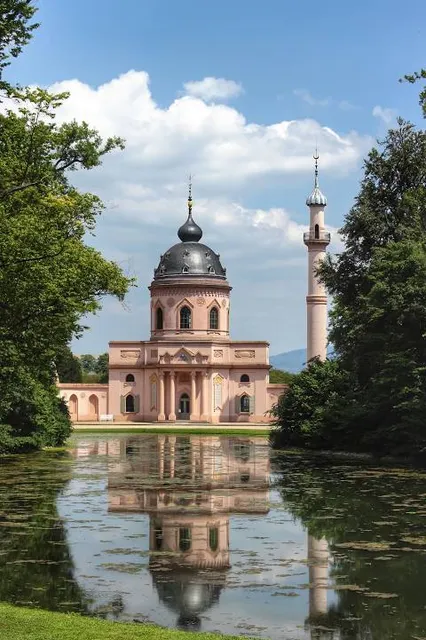
and finally The Mosque - one of the most fascinating buildings in the gardens and a highlight for me! Stunning architecture full of symmetry!
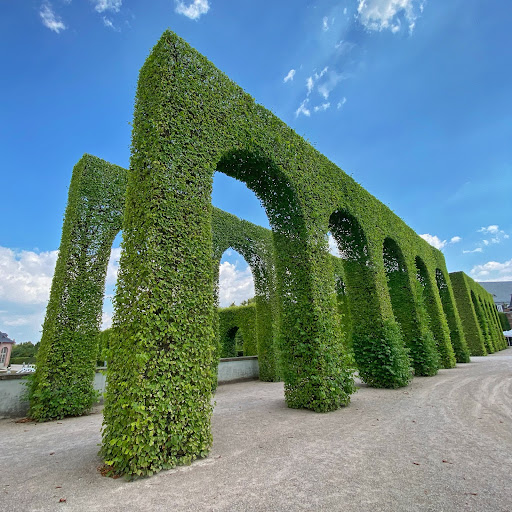
There are so many other parts of the gardens to admire and visit such as Arion fountain, Weiher lake with its statues and many of the tree arches, some more than 10 meters high and utterly impressive. There are a lot of benches and places for relaxation throughout the garden. Everything is well maintained and very well preserved - it is visible everywhere that people who are taking care of the gardens do it with love. Visited...
Read moreSchwetzingen Palace and Garden is about 10 minutes walk from Schwetzingen train station. The road leading to the palace is very clean and dotted with cute stores and cafes. The palace is accessible only through a guided tour which is included in the entrance fee. There are very frequent guided tours in German. There are only two guided tours that are offered in English in the afternoon. On the day when I visited, I did not have enough time to wait for the English tour, so I decided to go with the German tour even though I did not know a word of German. Luckily they had a print out transcript in English, French and another language, maybe Dutch. The transcript offered some basic information and history of each of the rooms. But apparently the guide had more interesting stories to tell. Each of the rooms was quite small and felt dark because of the old wallpapers. But they were maintained well. Through the tour, you got a glimpse of how a nobleman’s life was look like back in 18th century. The tour took about 30 minutes.
The best part of the palace is its splendid garden. The central garden was designed in a very symmetrical pattern with landscape and flower beds exactly the same way on both sides. The arched trees provide some shades. There are lots of sculptures spreading out through the garden. The garden is huge. I only walked one third of it as it was a super hot day. I was told that the garden had the best show of cherry and apple blossoms in the spring. Will come back again...
Read more