The ruined city of Akrotiri is on the island of Thera, better known to tourists as Santorini. Actually, Santorini is the name of the group of islands, with Thera being by far the largest. Many millenia ago the island group was actually a single roughly round island, somewhat larger than the current main island.
During the Late Bronze Age (4,000 years ago) the city we now know as Akrotiri developed into one of the main urban centres and trading ports in the Aegean Sea. The settlement is estimated to have covered 20 hectares or 200,000 square metres, although it has not all been uncovered. Together with Crete, about 75 miles south, Santorini was the home of the Minoan civilisation, which was ended by volcanic eruptions around 16 centuries BC. The population of the city is estimated to have been between 6 and 10 thousand at its peak.
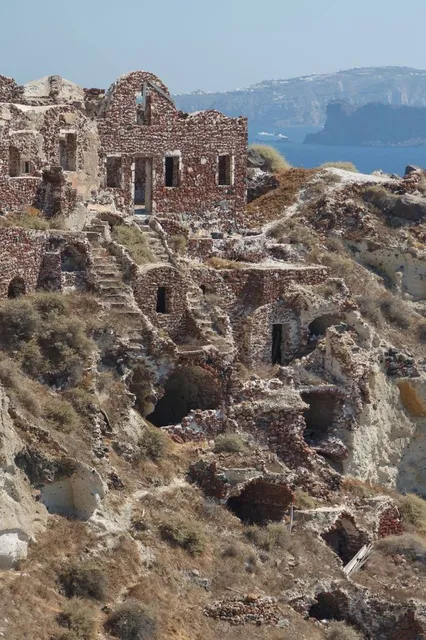
The settlement was made up of sophisticated multi-storey buildings that were decorated with exquisite wall-paintings. The houses were built from locally quarried pumice stone and many of them were three floors high with internal toilets and drainage via clay pipes to under-street sewers. The quality and quantity of the furniture and ceramic vessels discovered are evidence of the city's prosperity.
Around 3600 years ago the inhabitants of the city were worried about the gradually increasing severity of volcanic eruptions on the Island. The volcano had been active for millennia, so the inhabitants had stories handed down from previous generations to read the signs that a major eruption was coming. The wealthy inhabitants, who had the means to relocate, packed up their possessions and left the island. Many of them eventually found their way to Athens. Perhaps weeks or months or years later the volcano erupted and pyroclastic ash engulfed the city travelling at 200 mph and completely buried the entire area to a great depth. The city was lost and remained buried and unknown until 1967.
The eruption was one of the largest volcanic events in human history. It resulted in the ejection of up to 10 cubic miles of dense-rock. In fact the whole centre of the island exploded into the sky. What remained of the centre of the island collapsed below sea level forming a deep Caldera which filled with sea water.
When the city was re-discovered, the area where the wealthy inhabitants had lived was carefully excavated by archaeologists. The only really valuable item found was a small gold ibex, which was assumed to be a gift to the gods to protect the city.
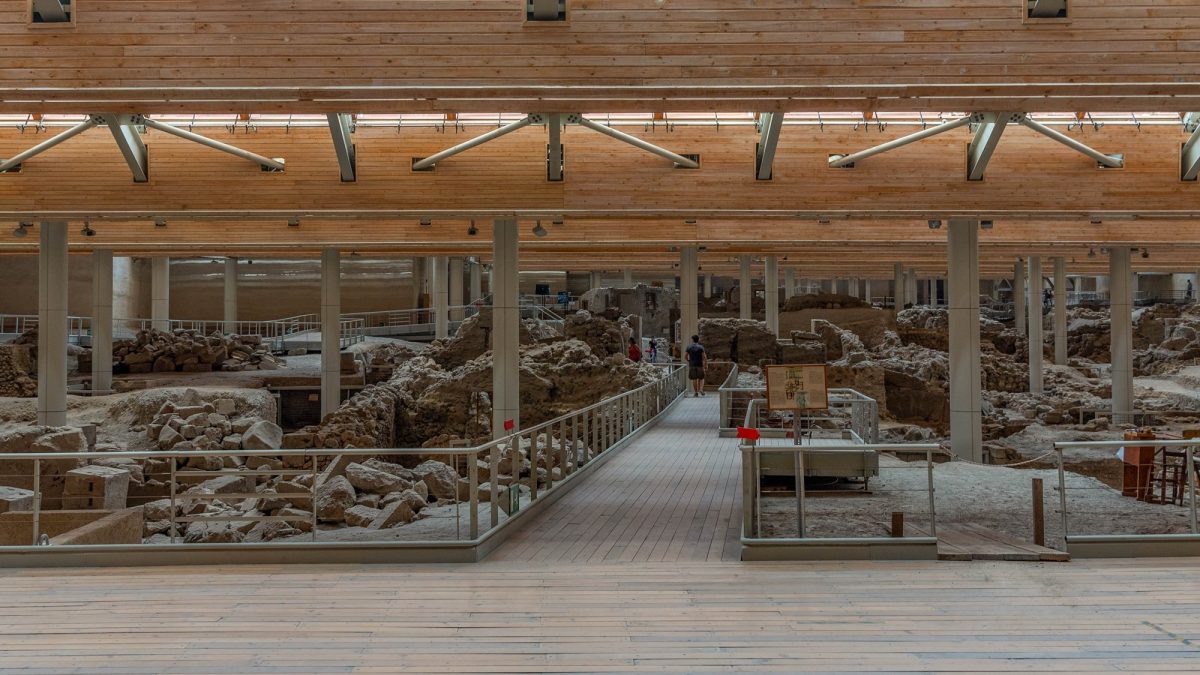
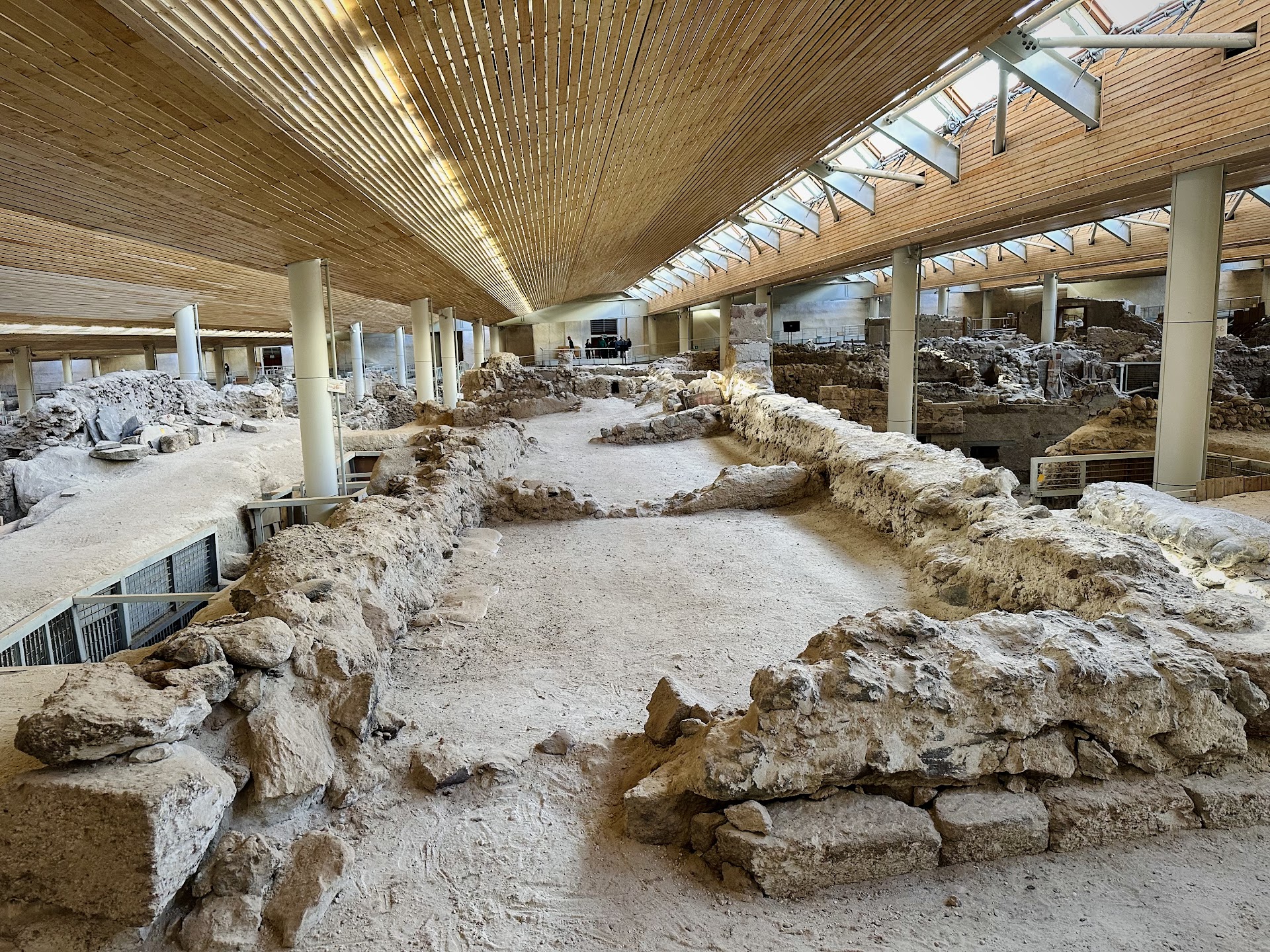
The excavated area has been enclosed in a massive hanger and elevated walkways have been created so that visitors can look down into the streets and buildings. The entry fee in 2023 is 12 Euros, although most visitors arrive in groups on a coach tour with a guide. There are toilet facilties on site as well as a souvenir shop and a café.
There are similarities between the volcanic eruption on Santorini and the eruption of Mount Vesuvius in 79 AD which buried the city of Pompeii. But the Santorini eruption occurred many centuries earlier. The original name of the settlement on Santorini has been lost. No record of the name was found in the 1960s when the city was re-discovered. So it was named Akrotiri after the nearest modern village.
But there is speculation that the city was actually the centre of the mythical civilisation of Atlantis. The wealthy inhabitants of the lost city, who evacuated to Athens before the final explosion, passed on stories of their city and the Minoan civilization of the island to their children and grandchildren. These stories passed down verbally through the generations for 1,200 years until they were first put in writing by Plato in 430 BC. Plato's story of a lost civilisation called Atlantis is the source of the modern myth. He wrote that that the people of Atlantis lived peacefully on a prosperous island beyond the Pillars of Hercules. It has usually been assumed that this island was somewhere in the Atlantic Ocean. But the real civilisation of Atlantis might have been the island that we now...
Read moreVisiting Akrotiri in Santorini, Greece, was an extraordinary experience that I highly recommend to anyone interested in history, archaeology, and ancient civilizations.
This well-preserved prehistoric settlement, often referred to as the "Minoan Pompeii," offers a unique glimpse into a sophisticated society that thrived thousands of years ago.
One of the most remarkable aspects of Akrotiri is its state of preservation. The site was buried under volcanic ash during a catastrophic eruption around 1600 BC, which helped protect the buildings, frescoes, and everyday items from decay.
Walking through the excavated ruins, I was amazed by the well-maintained structures, including multi-story buildings, sophisticated drainage systems, and intricate wall paintings that provide insights into the daily lives, beliefs, and artistic achievements of the ancient inhabitants.
The site's layout is incredibly informative, with wooden walkways allowing visitors to explore the ruins up close without causing damage. The detailed information panels and displays offer valuable context about the history and significance of the site, making it easy to imagine what life was like in this bustling Bronze Age city. I particularly enjoyed seeing the beautifully preserved frescoes, which depict scenes of nature, religious rituals, and everyday life, showcasing the artistic skill and cultural richness of the Minoan civilization.
The guided tours available at Akrotiri are another highlight. Our knowledgeable guide provided an engaging and informative narrative that brought the ancient city to life, explaining the significance of various artifacts and structures and offering fascinating insights into the social, economic, and cultural aspects of the Minoan society. This added depth and understanding to the visit, making it a truly enriching experience.
What also impressed me about Akrotiri was the sense of connection to the broader history of the Aegean and Mediterranean regions. The site's links to other ancient civilizations, such as the Egyptians and the Mycenaeans, highlight the extensive trade networks and cultural exchanges that characterized the ancient world. This broader context makes Akrotiri not just a local treasure but an integral part of the history of human civilization.
The site's management deserves praise for their efforts in preserving and presenting Akrotiri to the public. The facilities are excellent, with clear signage, well-maintained pathways, and accessible amenities. The protective roofing over the site ensures that visitors can enjoy their tour comfortably, regardless of the weather.
Akrotiri is a must-visit destination for anyone traveling to Santorini. Its exceptional preservation, informative displays, and the opportunity to walk through an ancient city frozen in time make it an unforgettable experience. Whether you're a history enthusiast or simply curious about the past, Akrotiri offers a fascinating journey into a bygone era that will leave you with a deep appreciation for the ingenuity and resilience of our ancestors.
Don't miss the chance to explore this incredible archaeological gem....
Read moreIt was amazing experience to visit this prehistoric site. At once, it takes time to visualise the society that once settled here. But there are sufficient information panel to guide you all through. At the last phase, a small documentary is also run to make you understand the whole site. (Check attached video). Following is the information as seem at the site:
The small Neolithic village grew gradually and during the Early Bronze Age (3rd millennium BC) developed into a proto-urban centre and harbour-town for intra-Aegean transactions. From the ruins caused by a major seismic destruction, the Middle Bronze Age (ca 2100-1650 BC) port-city emerged, which expanded its maritime trade far beyond the Aegean, to the East Mediterranean. Remnants of impressive buildings with rich contents and the drainage-sewage system of the city bear witness to its affluence.
Soon after the mid 17th century BC (Late Bronze Age), an earthquake once again destroyed the city, which was rebuilt with more impressive, public and private, buildings. Indicative of the wealthy citizens' mentality is a desire to promote their social status by adorning their houses with wall-paintings of exquisite art. This society was hit by yet another earthquake, just before the eruption of the volcano towards the end of the 17th century BC. The burial of the city under thick layers of pumice and volcanic ash trapped the picture of Theran society, which the archaeological spade...
Read more