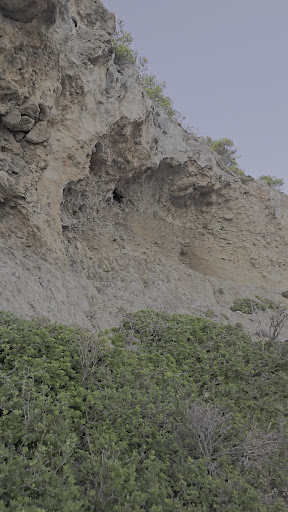
The Assos Castle is a proclaimed European Heritage Site and one of the two remaining fortresses in Kefalonia, indicative of Venetian Military Architecture and one of the largest castles in Greece. he Venetians constructed it in the 16th century on top of four bastions, with two more being added later. Its main purpose was to protect the island from invasions which were taking place frequently by the pirates and the Ottomans. It became the capital of Northern Kefalonia due to its strategic location. When the Venetians captured Lefkada from the Ottomans, it lost much of its usability as a defensive building, and Argostoli became the capital instead.
From 1585 until the fall of the Venetian Democracy (1707), it was used as the residence of the Venetian High Commissioner (Provedditore Generalle da Mar/ Provleptis). Initially, it housed around 200 homes and 64 buildings.
After 1920, it served as a prison. It was notoriously inescapable since the fortress lies 155 meters above the sea, surrounded by very high and steep cliffs. In the beginning, it functioned as a rural prison inhabited by small-scale offenders and later by serious offenders with long sentences. After World War II, the inmates were political prisoners.
Fortunately, its outside walls escaped the devastating fate of most of the buildings in Kefalonia due to the great earthquake of 1953.
Its residents, however, abandoned it and the prison closed. It has been uninhabited since 1963 when the few rural families (named Kastrinoi - people of the castle) still residing there left the area.
Its outside walls span across 2.000 meters. Its shape is rectangular, a typical example of Venetian and military architecture. It has 4 corners with bastions named: Saint Markos, Saint John of the Count, Respuna, and Mora. There is a fifth one, between Respuna and Mora, named Santa Maria, and a sixth one, north of Mora, named Kabusa.
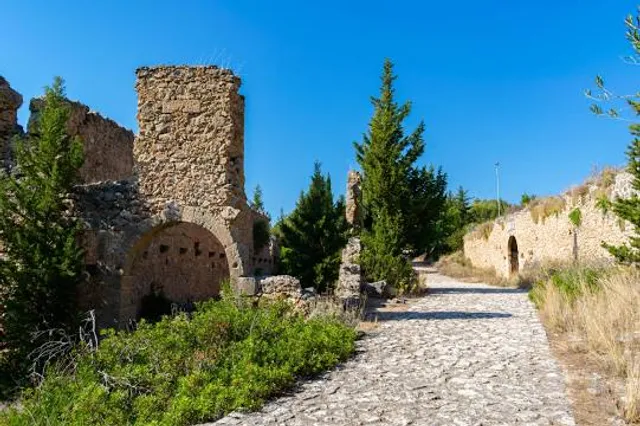
Through the ruins, you can see the abandoned catholic church of Saint Markos, the abandoned House of the High Commissioner, and the repaired buildings of the rural prisons. Its main attraction is the Lion of Saint Mark, which lies at the entrance of the fortress. The orthodox church of Prophet Elias was built in 1800 on top of the ruins of another church. Furthermore, six or seven Venetian canons are visible North and West of the walls.
The castle is open for visiting every day, from 09:00 to 17:00, and on Saturday, from 09:00 to 16:00. It is accessible through its two gates. You can reach the east gate through a 2km paved sidewalk. The south gate (Portello) is at the end of an 800-meter-long path and is a great option if you want to walk among olive trees. You have to keep in mind though, since there are no facilities in the wider area, to bring a hat and water with you, to protect yourself from the heat. The entrance is free.
In addition, make sure to bring your camera or a pair of binoculars to capture your journey through history and enjoy the most breathtaking...
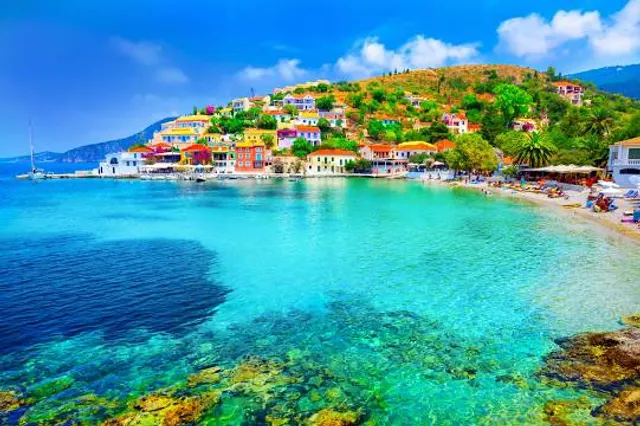
Read morePerched majestically above the charming village of Assos, the Venetian Castle (Ενετικό Κάστρο Άσσου) is an absolute must-visit and a definite five-star experience in Kefalonia. This historic fortress, dating back to the 16th century, offers a captivating blend of history, breathtaking views, and a rewarding hike. The hike up to the castle is part of the adventure. It's a winding, paved path that gradually ascends through olive groves and offers increasingly stunning panoramic views of the turquoise Ionian Sea, the colorful houses of Assos, and the dramatic coastline. While it can be warm, especially in July, the effort is undeniably worth it. Take your time, bring water, and soak in the beauty around you. Once you reach the top, you're transported back in time. The vastness of the castle grounds is impressive, encompassing a significant portion of the peninsula. While much of it is in ruins, the sheer scale of the walls, the remaining arches, and the historic buildings (including the abandoned prison cells and the small church of Prophet Elias) tell a powerful story of its strategic importance. But perhaps the most compelling reason to visit are the unrivalled views. From the ramparts, you're treated to a spectacular 360-degree panorama. The vibrant blues of the sea contrasting with the lush green hills and the terracotta roofs of Assos below create an unforgettable vista, perfect for photography or simply quiet contemplation. It's truly a testament to Venetian military architecture, and the fact that there's no entry fee makes it even more appealing. For anyone visiting Kefalonia, a trip to the Venetian Castle of Assos is an enriching and unforgettable experience that offers both historical insight and some of the most stunning scenery the island...
Read moreThe old castle at Assos is a historical gem nestled on the idyllic island of Kefalonia, Greece. Steeped in centuries of rich history, this fortress stands as a testament to the resilience of the human spirit. Originally constructed by the Venetians in the 16th century, the castle played a pivotal role in protecting the island from invasions.
Perched majestically atop a hill, the old castle at Assos offers visitors awe-inspiring panoramic views of the charming village below. As you ascend through the ancient stone walls and explore the castle's ruins, you'll be captivated by the breathtaking vistas that unfold before your eyes. The picturesque village of Assos, with its colourful houses and tranquil harbor, is a sight to behold. The contrast of the azure Ionian Sea against the backdrop of lush greenery creates a mesmerising tableau that lingers in your memory.
However, amidst the beauty, there's an undeniable tinge of sadness. Assos, much like many other places in the region, fell victim to the devastating earthquake of the 1950s, which caused significant damage to the village. This tragedy adds a poignant layer to the castle's allure, as it serves as a poignant reminder of the community's strength in the face of adversity.
Climbing up to the old castle at Assos can be a bit challenging for some due to its steep ascent. The path to reach the castle requires stamina and surefootedness, as it can be strenuous, especially under the hot Mediterranean sun. However, the reward of reaching the top and experiencing the breathtaking views makes the effort...
Read more