Sri Gavi Gangadhareshwara Temple (Gavipuram Cave Temple)
Nestled in the historic Gavipuram neighborhood of South Bangalore, Sri Gavi Gangadhareshwara Temple is one of the city’s oldest and most intriguing spiritual monuments. Carved directly out of a massive granite boulder, this cave temple—known locally as “Gavi Gangadhareshwara” (literally “Cave Lord of Ganga”)—is a remarkable blend of natural topography, precise architecture, celestial alignment, and profound religious significance  .
Historical & Mythological Roots
Legend holds that sages Gautama Maharishi and Bharadwaja carved the cave for penance during the Treta Yuga, placing it among the mythic origins of sacred Karnataka . But its visible structure dates to the 16th century, when Kempe Gowda I—founder of Bangalore—renovated and expanded the shrine following his release from imprisonment, making it a centerpiece of the city’s religious identity .
Architecture & Layout
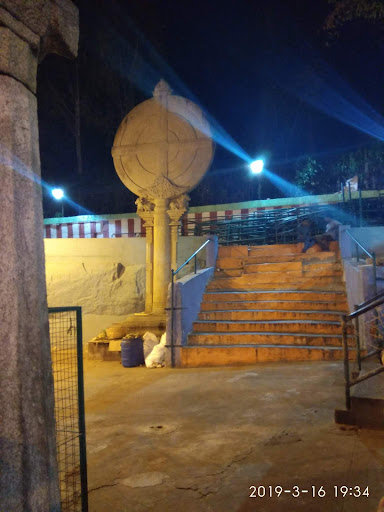
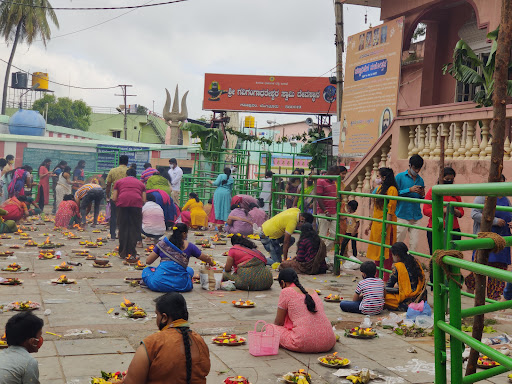
The temple stands as a masterpiece of Indian rock-cut architecture: the sanctum is housed in a natural cave, with interiors carved into monolithic stone . The forecourt features two towering stone disc pillars—named Suryapana (Sun) and Chandrapana (Moon)—along with striking monolithic sculptures of Shiva’s trident (Trishula) and drum (Damaru), a brass flagstaff, and a seated Nandi pavilion . The entire complex faces south-west—not the usual cardinal direction—suggesting an intentional layout designed for astronomical purposes .
Celestial Phenomenon
The temple is most famous for the Makara Sankranti event: each year on January 14, the late afternoon sunlight passes precisely between the horns of the Nandi statue and illuminates the Shiva Linga inside the cave for about three minutes . Studies by astronomers have confirmed that this phenomenon was deliberately engineered by temple planners using sophisticated solar alignment and architectural design   .
Spiritual & Healing Traditions
Inside, the sanctum extends into a narrow cave enclosure with low ceilings and diminutive circumambulatory paths—requiring devotees to bow in respect as they move, symbolizing humility before the divine . Within the cave also resides a rare idol of Agnimurthy (God of Fire), believed to have curative properties, especially for eye ailments—its unusual form (two heads, seven hands, three legs) makes it an extraordinary devotional focus .
Festivals & Experience
Apart from Makara Sankranti, the temple comes alive during Maha Shivaratri, Brahmotsava (around Magha Poornima), Navaratri, Karthika Somavara, and Dhanur Masa, drawing devotees with deep faith, ritual fervor, and traditional processions . Local folklore speaks of secret tunnels within the cave said to lead to Shivagange and Varanasi, though they remain closed and shrouded in legend .
Atmosphere & Final Verdict
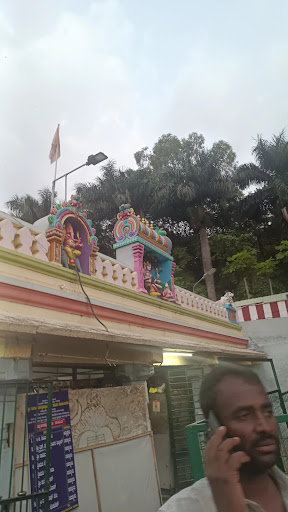
Today, the temple is protected under the Karnataka Ancient and Historical Monuments Act 1961, but it retains its unassuming charm. Outside, the courtyard is spacious and cool, sheltered by massive rock formations; inside, the cave offers a serene, almost meditative setting . It is not meant for leisure or sightseeing, but for quiet contemplation and spiritual introspection .
In summary, Sri Gavi Gangadhareshwara Temple is an architectural marvel and spiritual gem. With ancient origins, celestial design, healing energy, and deep-rooted rituals, it offers visitors a moving experience that blends astronomy, mythology, devotion, and architectural genius. A must-visit for devotees, heritage enthusiasts, and seekers of serene spiritual spaces...
Read moreGAVI GANGADHARESHWARA – BANGALURU
In the heart of the city of Bangaluru is a Cave Temple dedicated to Lord Shiva as Gavi Gangadhareshwarar. In earlier times this place was known as Gavi puram the land of Caves.
The temple construction dates back to 9th century, in all probability an edifice of the Chola or Ganga dynasty, but as such there would have been some structure before this date, as both Gautham and Bharadwaj Muni had prayed to Lord Shiva from here.
The temple was further renovated by the architect and establisher of Bangaluru city, NADHAPRABHU HIRIYA KEMPE GOWDA 1 a chieftain of the Vijayanagara Empire, during his reign in the 16th century.
The entire structure of the Temple is on a cave in a hill lock. The Shrine had a 30ft wide open entrance with a height of 7 feet, leading to a mandapa,which seems to have been given extensions.
This Mandapa is in a court yard, which treasures Stone edifice of the TRISHUL & DAMRU on pillars on both sides of the compound. Apart from these are two massive Stone discs on pillars facing each other with the small but elongated Bali Peetham, Dhwaja Sthambam and the Nandi Mandapam with a small but beautiful Nandi.
The stone discs alighted on Pillars are like Gongs, called Suryapana and Chandrapana and are supposed to toll at the end of the Kaliyuga as narrated by a local. During the Summer and winter solstices the shadow of each gong falls on the other. During certain period the dhwaja Sthambam shadow also meets the vertical line on the Discs.
On entering the outer Mandapa one has to take a few steps down to the mukhadwaram of the cave. Inside the tallest space is that of 7 feet near to the entrance and shrinks in size as you keep nearing the Garbha Griha.
On the sides of the entrance to the Garbha Griha are Lord Ganesh and Karthikeya almost like Dwarapalakas.The Garbha Griham is in continuation of the Mukha Mandapam, it is also a square space devoid of any artwork signifying the presence of the lord only. On the entrance is a Huge Nandi sitting, facing Lord Shiva in the sanctum.
Outside the Garbha Griha there is a small passage for circumambulation of the Lord again cut in rock. In the Sanctum a small but steady stream of water keeps flowing, making it significant to the name of GANGADHEESHWARA.
To the right of the Lord’s Sanctum is a small shrine of the 4 ft tall Goddess Parvathi standing, showering her benevolence. Past her is the inner praharam, cave like, with a maximum height of not more than 4 ft and shrinking at places. The Praharam consists of many Idols, Bhairava,Dakshinamoorthy, including that of the Saptha Mathrikas and Sridevi and Bhudevi. A navagraha is installed at the end of the inner prahara.
There is an idol of Agni which has two heads, seven hands and three legs a unique feature.
The Gavi Gangadhareshwara temple faces south-west and hence is not aligned to any of the cardinal directions. It is one of the first few clues that depict the temple’s astrophysical relevance. Since the Lingam is not facing the east as usual,the Avudayar or Pindika of the Shiva linga is positioned to the left side, instead of the usual right side.
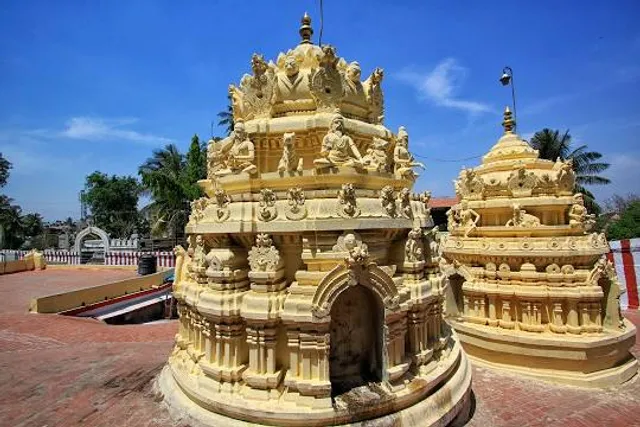
The temple compound was extended over a period of the last 2 centuries towards the western side. The outer compound currently has a passage for circumambulation which goes behind the temple and goes to the roof on the rock surface. On the Roof top one can see the Two Vimanas and complete the same by taking a few steps down from the...
Read moreSri Gavi Gangadheeswar Temple in Bengaluru is a hidden gem that holds a special place in the hearts of devotees and history enthusiasts alike. From the moment you enter the temple complex, a sense of serenity and ancient mystique envelops you, transporting you to a bygone era.
The temple's architecture and intricate carvings are awe-inspiring, reflecting the rich cultural heritage of Karnataka. The sanctum sanctorum, dedicated to Lord Shiva, exudes a divine aura, creating a spiritually uplifting experience for all who visit.
One of the unique features of the temple is the natural cave formation within its premises, where Lord Shiva is believed to have resided. This cave, known as "Gavi," adds an element of intrigue and mysticism to the temple's charm.
The peaceful surroundings and lush greenery create a soothing atmosphere for devotees to offer their prayers and seek solace. It's a perfect escape from the city's hustle and bustle, offering a tranquil space for reflection and introspection.
The temple's festivals and special ceremonies are celebrated with fervor and devotion, providing an opportunity for visitors to witness the vibrant traditions of Karnataka.
The temple priests are knowledgeable and approachable, guiding devotees through the rituals and sharing the significance of the temple's history and lore.
The temple's location, not far from the heart of Bengaluru, makes it accessible for both locals and tourists, making it a must-visit destination for anyone interested in exploring the city's spiritual heritage.
Overall, Sri Gavi Gangadheeswar Temple is a place of spiritual sanctity, historical significance, and natural beauty. It's a sanctuary where one can connect with the divine, immerse in ancient traditions, and find solace amidst the chaos of modern life. Visiting this temple is a soul-enriching experience that leaves a lasting impression and a sense of...
Read more