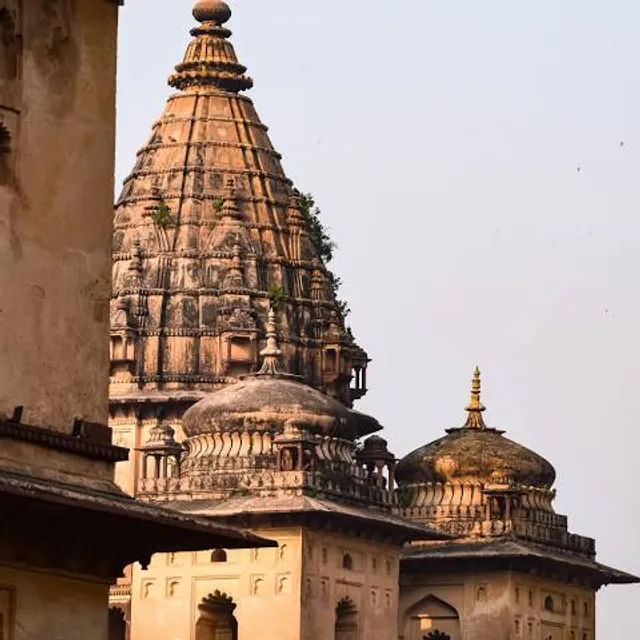
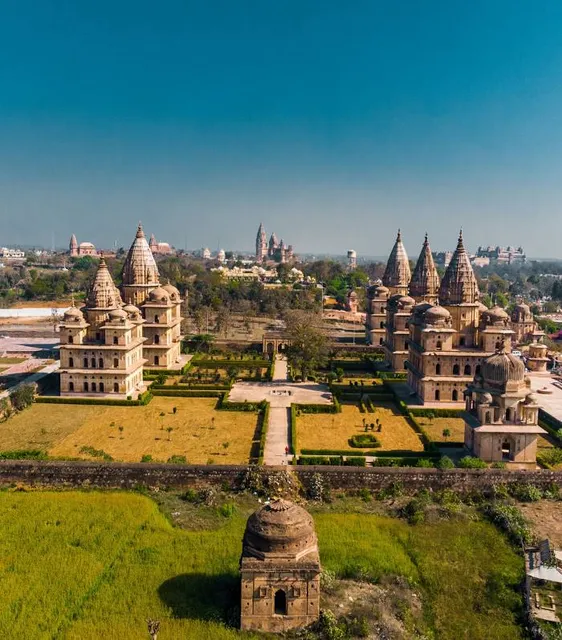
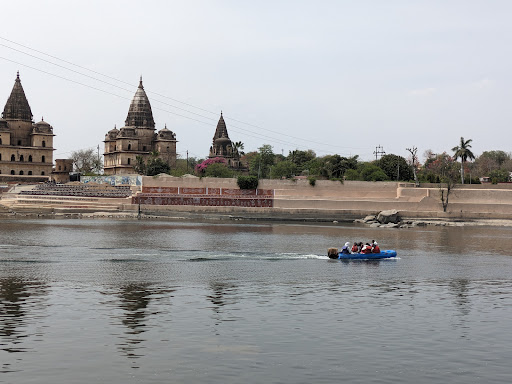
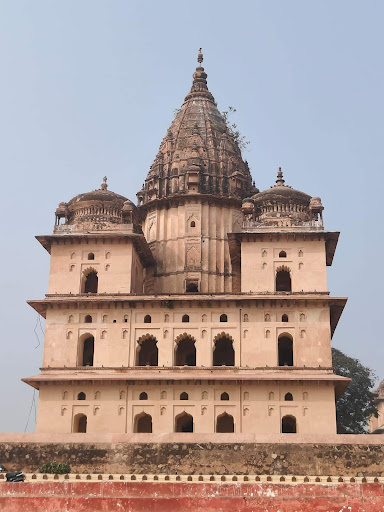
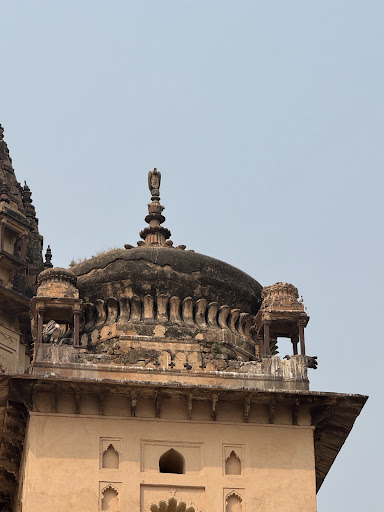
One comes across the conical peaks by the banks of Betwa River. These are the Cenotaphs of Orccha. These 14 funeral monuments were built to keep the Kings of Bunelkhand alive in the Indian history. Please note, these are not the same as the Pyramids built for Egyptian Pharaohs. In Hinduism, the dead bodies are cremated and the ashes are immersed in the river. Hence the Centophs of Orccha were not meant for preserving dead bodies for the next life.
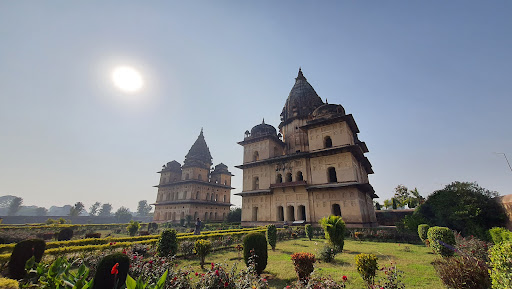
These cenotaphs are called as Chhatris (umbrella) by the locals. They look similar, except the one made for Vir Singh Deo- the most successful Bundela Raja. The size of the Chhatri perhaps was decided basis the length of the reign of those rulers. These cenotaphs talk about the stories of the kings on its colossal structure.
These cenotaphs have a unique design. They are tall, square buildings, constructed on raised platforms with a domed pavilion on top called chhatri. It is a type of trabeate domed canopy, resembling an umbrella. Though these are not burial grounds as Hindus are cremated, the cenotaphs are just empty structures.
These chhatris, though have become the living quarters of a critically endangered species of vultures, even if there is no immediate scavenging opportunity. Vultures are usually roosting on the rooftops or soaring high in the sky. The vulture population in India has been on a decline, due to use of a cattle drug which becomes a part of the carcass and harms the vulture. The cenotaphs are also home to emerald parakeets.
The cenotaphs turn into golden colour when sunlight falls on them; and by evening they are back to their stone form. May be it just mirrors the story of the Bundelkhand kingdom and Orchha, a once prosperous kingdom now is now reduced to a monument!
Cenotaphs can’t be compared with the intricate carvings of Khajuraho temples or the architechture of Mandu , but they are unique. While the cenotaphs are definitely the highlight of Orchha , there is more to be explored . Here are the top things to be...
Read moreA beautiful historical place beside the betwa river... It offers beautiful scenic experience.. There are fourteen 'Chatries' or memorials to the rulers of Orchha, grouped along the Kanchana Ghat of the river Betwa. There are the 17th and 18th centuries beautiful cenotaphs of the rulers of Orchha. Amidst this group of cubical structures with temple like spires, Bir Singh’s cenotaph alone has explicit Islamic features on it.Prince Salim was fleeing Agra. He had rebelled against his father, the all powerful Mughal emperor, Akbar. Akbar sent his right hand man, Abul Fazl to capture the Prince. They passed through the kingdom of the Bundelas. The Bundelas were fierce Rajput chieftains who ruled out of their hidden city of Orchha. In fact the word Orchha means "Hidden". The Bundela cheiftain, Bir Singh Deo came to Salim's aid. He had Abul Fazl killed in an ambush and sent the head to Salim. It is said that upon seeing Abul Fazl' s head Salim grew so angry that he threw it into his toilet.Prince Salim eventually reconciled with his father and returned to Agra. Bir Singh Deo's favour was not forgotten and he was showered with Mughal patronage. With the coffers now full, Orchha now entered it's golden age. The Bundelkhand style of architecture flowered and several fairy tale like palaces and temples were built. The Chattris or Cenotaphs were built to honour the dead ancestors of the Bundela rajas. The first raja of the dynasty, offered drops of his blood to the Goddess Kali and was called Bundela - "One who has offered drops". His decendants carried this name till the...
Read moreOrchha has, over time, come to be defined by the majestic chhatris that are situated on the banks of the River Betwa. These are the royal cenotaphs built to honour the kings of Orchha, and, although with modest interiors, they make a striking picture when you see them silhouetted or as a backdrop to locals washing clothes or bathing in the river. These chhatris were constructed as a mark of respect for the imperial blue blood of the mighty rulers of the Bundelkhand dynasty. The monuments still speak of the ancient rulers, their victories and their stories. The complex includes the chhatris of Madhukar Shah, Bir Singh Deo, Jaswant Singh, Udait Singh, Pahar Singh and others. A remnant of the glorious rulers of the Bundela dynasty, the chhatris, with their magical charm, allure people through centuries.
These chhatris are essentially the cenotaphs of the Maharajas, placed on elevated platforms and supported by pillars. Built in the Indo-Mughal style, these three storey buildings are open to all sides and have well designed domes or pinnacles. The cenotaph of Bir Singh Deo is the most popular of all because of its unique architecture and design.
The magnificence of the chhatris can be best viewed from the narrow bridge, where one can see the full reflection of the structures on the cool river water.
ROYAL CENOTAPHS, ORCHHA, MADHYA PRADESH, 16th-18th CENTURY Thoughts by ILF expert Shradha Sahu
#indiafound #indialostandfound #amitpasricha #panorama #panoramist #orchha #cenotaphs #madhyapradesh #tourism #heritage...
Read more