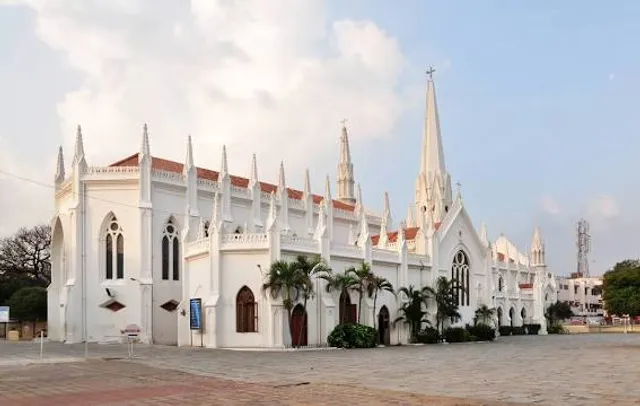
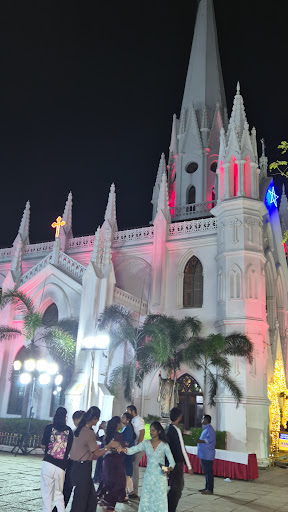
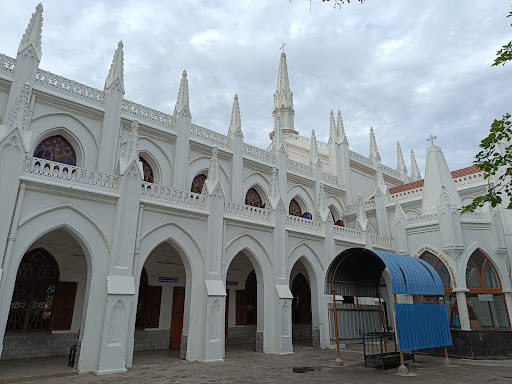
Santhome Cathedral Basilica Church in Chennai is a significant religious and historical site built over the tomb of St. Thomas the Apostle, one of Jesus Christ’s disciples who is believed to have come to India in the 1st century CE. It was originally constructed by Portuguese missionaries in the 16th century and rebuilt in its current neo-Gothic style by the British in 1896. The church is admired for its stunning neo-Gothic architecture, featuring pointed arches, vaulted ceilings, beautiful stained glass windows depicting the life of St. Thomas and biblical scenes, and a towering 155-foot spire that acts as a landmark. The interior is spacious and serene, with an elegant nave and a peaceful atmosphere for worship and reflection. Visitors particularly appreciate the altar, the 14 stations of the cross, and the opportunity to visit St. Thomas’ tomb located beneath the altar in a separate basement area. Besides its religious importance, Santhome Cathedral is a cultural heritage site showcasing Christian history in India and colonial-era influences. Visitors note it as a peaceful place with ample free parking and recommend spending one to two hours exploring the church and its surroundings. It is considered a must-visit for Christians, history enthusiasts, and tourists interested in spirituality and architecture, even those not familiar with Christianity. Mass services, special processions, and cultural events further add to the experience. The church’s location near the beach adds to its charm, and it remains a quiet sanctuary amid the bustling city. In summary, Santhome Cathedral Church is a beautiful, historically rich, and spiritually resonant spot in Chennai, merging religious significance with remarkable architecture and cultural heritage. It is highly recommended as a visit for anyone touring the city. Santhome Cathedral Church in Chennai is a prime example of Neo-Gothic (Gothic Revival) architecture, a style prominent in the 19th century that revives medieval Gothic elements. Key architectural features include: Cruciform Layout: The church is built on a Latin cross floor plan typical of medieval European churches, with a long nave and transepts forming the cross shape. Spire and Towers: It has two prominent octagonal spires—the main spire at the entrance stands about 45-47 meters tall serving as a bell tower, and a smaller one above the transept marks the traditional tomb site of St. Thomas. Pointed Arches: The facade features six pointed arches (doors and windows), which continue throughout the structure in arcades and windows, emphasizing verticality. Stained Glass Windows: There are 34 stained glass panels and several stained glass windows, including a large one behind the altar depicting St. Thomas touching the side wound of Christ, adding vibrancy and storytelling through light. Vaulted Ceilings: The nave has a rib-vaulted teak wood ceiling that adds grandeur and acoustic quality to the space. Facade Decoration: The church’s exterior white facade is detailed with pinnacles, trefoil motifs, string courses, and several intricately carved elements typical of Gothic revival. Material Usage: Made of marble, granite, and teak wood inside, with a pitched roof covered with Mangalore tiles. Interior Features: Includes wooden pews, a 200-year-old British pipe organ, chandeliers in the nave, and an ornate altar. The interior receives natural light through the stained glass, and the altar statue represents "Thomas the Apostle as priest and Jesus Christ as king". Crypt and Tomb: The church houses an underground chapel beneath the altar where the tomb of St. Thomas is located, a feature of immense religious and historical significance. Marina Beach: One of the longest urban beaches in the world and a must-visit for a coastal experience. Kapaleeshwarar Temple: A famous Dravidian-style temple located in Mylapore, known for its vibrant architecture and religious significance. Government Museum, Egmore: Among India’s oldest museums, known for its vast collection of art and artifacts. Valluvar Kottam Happy...
Read moreAccording to legend, Saint Thomas, one of the twelve disciples of Jesus, arrived at Muziris in present-day Kerala state in India from the Roman province of Judea in AD 52 and preached between AD 52 and AD 72, when he was martyred on St. Thomas Mount.
It is claimed that St Thomas' apostolic ministry in India took place specifically at Cranganore along the Malabar coast from AD 52 to AD 68. His journey through Kerala is said to have resulted in numerous conversions. After spending 10 years on the Malabar coast he is said to have travelled Eastwards across the Deccan Plateau, arriving in Mylapore in AD 68. The cave at the little mount is claimed to be his favourite preaching spot. A 2000-year-old, never-drying, miraculous stream of water on a rock face are said to be examples of the apostle's divine exploits. A church atop St. Thomas mount was built by the Portuguese in 1547 to mark the spot. It was on this St. Thomas Mount that the apostle was said to be killed by a lance which pierced through his back.
His mortal remains were believed to be buried in the location over which the present day Santhomes Cathedral Basilica stands. Sometime in the 10th century AD a group of Nestorian Christians from Persia founded the Christian village of San Thomes and proceeded to build a church over the burial site of St. Thomas. This structure fell to ruins between the 14th and 15th centuries. In 1522 the Portuguese moved the apostle's remains to a new tomb and church which attained the status of Cathedral in 1606.
Pope Pius XII honoured the Cathedral Church of the Roman Catholic Archdiocese of Madras and Mylapore, raising it to the rank of Minor Basilica by an apostolic brief dated 16 March 1956. Massive followings and the immense devotion of people to a very ancient image of the Blessed Virgin also known as “Our Lady of Mylapore” were among the motives that prompted the Pope to bestow this honour.
There was 118 years of insecurity and uncertainty from the time the Golconda’s occupied San Thome in 1662 to 1780. No considerable changes happened to the original structure of the church built in 1523. It was only in 1893 that his Excellency Dom Henrique José Reed da Silva, Bishop of Mylapore, resolved to build a new church with the tomb of the apostle in the centre. The second small tower in the centre of the existing cathedral marks the exact place where the apostle was buried. The present, Gothic-style church was completed in 1896 and duly consecrated by Rt. Rev. Dom Henrique José Reed da Silva, the first Bishop of the diocese. In 1956 the church was elevated to the status of a Minor Basilica.
San Thome Basilica is the principal church of the Roman Catholic Archdiocese of Madras and Mylapore. In 1956, Pope Pius XII raised the church to the status of a Basilica Minor, and on 11 February 2006 it was declared a national shrine by the Catholic Bishops' Conference of India. The San Thome Basilica is a pilgrimage centre for Christians in India. The church also has an...
Read moreSanthome Cathedral Basilica, located in Chennai, Tamil Nadu, is a historic and spiritual landmark revered by Christians and non-Christians alike. This magnificent church stands as a testimony to Chennai's rich religious and architectural heritage, drawing thousands of visitors every year. The Basilica holds special significance as it is built over the tomb of St. Thomas the Apostle, one of the twelve disciples of Jesus Christ, who is believed to have preached in India during the 1st century AD.
The church's origins date back to the 16th century when Portuguese explorers built a simple structure over St. Thomas' tomb. However, the current Neo-Gothic style building, with its towering spires and ornate interiors, was constructed by the British in 1896. The Basilica is now one of the only three churches in the world built over the tomb of an apostle, the other two being in Rome and Spain. This unique distinction makes it a globally significant pilgrimage site for Christians.
The cathedral's striking white façade is a blend of grandeur and simplicity, with its tall steeple visible from afar. Upon entering, visitors are greeted by the serene and awe-inspiring ambiance of the interiors. The high arched ceilings, stained glass windows depicting biblical scenes, and intricately carved wooden altars create a sense of reverence and peace. The tomb of St. Thomas, located in the crypt below the main altar, is a solemn place where pilgrims offer prayers and reflect.
The church also houses a museum that showcases artifacts, including ancient manuscripts, relics of St. Thomas, and historical records that trace the Apostle’s journey in India. The museum offers a glimpse into the historical and spiritual significance of the Basilica, making it an enriching experience for visitors.
Santhome Cathedral Basilica is not just a place of worship but also a hub for community activities and cultural events. It plays a vital role in the lives of the local Christian community, hosting regular masses, weddings, and festivals such as Christmas and Easter. The Feast of St. Thomas, celebrated every July, attracts devotees from across the world, adding vibrancy to this sacred site.
In addition to its spiritual and cultural value, the Basilica is a prominent tourist destination. Its location near Marina Beach and other landmarks makes it a key part of any Chennai itinerary. Visitors often come to admire its architectural beauty, learn about its historical significance, and experience the tranquility it offers.
Santhome Cathedral Basilica is more than just a church; it is a symbol of faith, history, and community. Its timeless charm and spiritual aura make it a place where the past and present harmoniously coexist, leaving a lasting impression on...
Read more