Genoa's Cathedral of San Lorenzo (Cattedrale Metropolitana di San Lorenzo) is one of the city's most important and recognizable churches—a blend of history, diverse architectural styles, and rich sacred art. Below is a general description: history, architecture, interior, works of art, and interesting facts.
The first churches on this site date back to the 5th and 6th centuries. An early basilica existed here, already being expanded and serving as a Christian community.
The current church was consecrated by Pope Gelasius II in 1118, at which time San Lorenzo gained cathedral status.
In the 13th and 14th centuries, the building underwent significant renovations: Gothic elements were added, and a distinctive façade, interior colonnades, and side chapels were created. After a fire in 1296, repair and reconstruction work were necessary.
In the 16th century, the architect Galeazzo Alessi designed significant modifications, including: The dome, apse, and roofs of the side naves.
Restorations were carried out in the 19th and 20th centuries, restoring or enhancing the medieval elements of the original building. This work was also carried out as part of the Jubilee of the Year 2000.
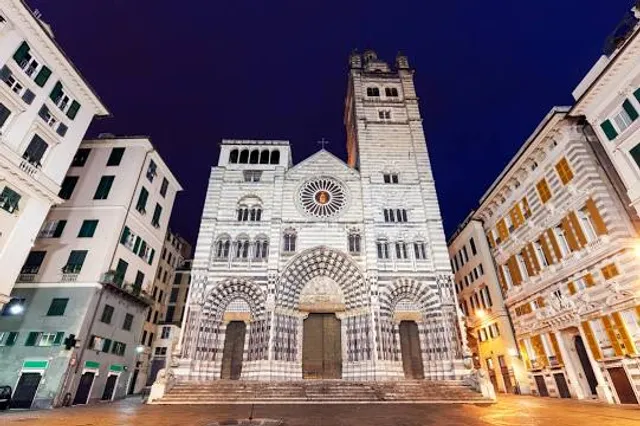
The façade features characteristic black and white marble stripes—a feature common to many churches in northern Italy, including the influence of Pisa and Liguria.
Three portals are decorated with reliefs and sculptures. The lunettes above the main portal feature a motif of the Martyrdom of St. Lawrence (San Lorenzo) and an image of God the Father with symbols of the Evangelists.
Two towers (bell towers) flank the façade: one left tower was not originally completed, while the upper part of the right tower was completed later (16th century). The divergence of the towers gives the façade a slightly asymmetrical character.
Stairs and fortifications in front of the cathedral: In the 19th century, the front stairs were rebuilt and marble lions were added, repositioned following urban changes (raising/lowering the square, etc.).
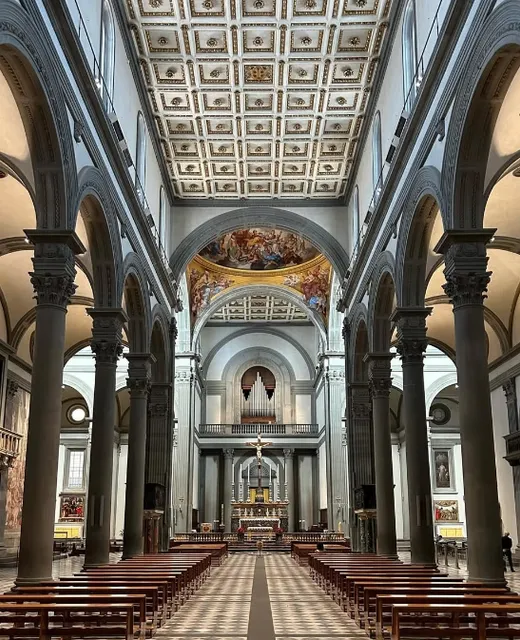
The basilica has a traditional layout with three naves divided by columns. The side naves contain numerous chapels, donated by various families and foundations.
Behind the main altar are the dome and apse designed by Galeazzo Alessi. The apse features late Mannerist and Baroque decorations, including frescoes by Lazzaro Tavarone.
The Chapel of St. John the Baptist (San Giovanni Battista) — one of the most valuable interiors: sculptures, reliefs, marble decorations, and works by artists such as Matteo Civitale, Andrea Sansovino, and Giovanni d’Aria.
The interior is rich in frescoes, stained glass, marble decorations, and stucco; Decorative elements represent the artistic traditions of Liguria, Tuscany, and Lombardy.
The Museo del Tesoro (Treasury of the Cathedral of San Lorenzo) — beneath the church, in cellars or vaults, it houses numerous sacred objects and relics from the 11th to the 21st centuries.
Among the most important artifacts:
Sacro Catino — a green crystal or glass bowl/dish, considered for centuries a probable "Grail," mythically associated with the Last Supper. Today, research indicates it is an Islamic/Shiite artifact from the 9th-10th centuries.
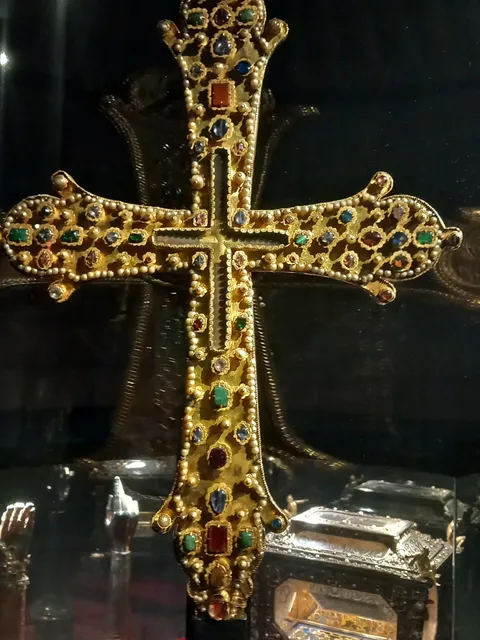
Gold and silver arks and crosses, including the Zaccaria Cross.
Ark of the Relics of St. John the Baptist — the saint's ashes from the Holy Land, donated to Genoa.
San Lorenzo is the diocesan cathedral — the main church of the Archdiocese of Genoa. This place is important not only religiously, but also historically and socially.
For centuries, the square in front of the cathedral (sagrato) was a place for public gatherings, political events, and urban rituals—it served as the "agora" of the medieval city.
During World War II, the cathedral was hit by a bomb (1941). The bomb lodged in the nave, did not explode, and remains a curiosity within the building to this day.
The celebration of the feast of St. Lawrence (August 10) is an important day for Genoa. Entrance to the cathedral is free, there is no waiting time, and the cathedral is...
Read moreLa catedral de San Lorenzo:Es la sede episcopal católica de la ciudad de Génova y la iglesia más importante de la diócesis de Génova, en la región italiana de Liguria. Fue consagrada por el papa Gelasio II en 1118, y está dedicada a san Lorenzo,es un edificio fundamentalmente medieval, con algunos añadidos posteriores. Fue construida entre el siglo XII y el siglo XIV ,las naves secundarias y las portadas laterales son de estilo románico, la fachada principal es gótica, de comienzos del siglo XIII, las columnas con capiteles y los pasillos interiores datan de comienzos del siglo XIV; la torre del campanario y la cúpula son del siglo XVI. La catedral fue fundada probablemente en el siglo V o VI D. C., se dedicó a san Siro, obispo de Génova. Las excavaciones que se han realizado bajo el pavimento y en la zona frente a la actual fachada oeste han dejado al descubierto muros y suelos de la época romana, así como sarcófagos precristianos lo que indica la existencia de un cementerio en el lugar. Más tarde se edificó una iglesia consagrada a los doce Apóstoles que a su vez fue sustituida por una nueva catedral dedicada a san Lorenzo, construida en estilo románico. La construcción de la catedral terminó en el siglo XVII. La cúpula y las partes medievales se restauraron entre 1894 y 1900. Entre las obras de arte que alberga la iglesia destacan los frescos que adornan el techo de la capilla norte, de Luca Cambiaso; la Crucifixión con santos (Visión de San Sebastián) de Barocci; un Episodio de la vida de San Lorenzo de Giovanni ,Andrea Ansaldo frente al órgano; el fresco del Martirio de San Lorenzo en el techo del presbiterio, pintado por Lazzaro Tavarone; y una Asunción de la Virgen (1914) de Gaetano Previati. La iglesia también conserva frescos del siglo XIV de estilo bizantino en la portada principal. Entre las obras de escultura, una estatua en la capilla de San Juan de Domenico Gagini ; la Virgen y el San Juan Bautista de Andrea Sansovino. También hay obras de Matteo Civitali, Taddeo Carlone, así como de Giacomo della Porta y su sobrino Guglielmo della Porta. El gris y blanco sobre la fachada, bastante común en Liguria, da un aspecto macizo al conjunto y evoca el estilo románico, al tiempo que los tres pórticos adornados con numerosas estatuas recuerdan las catedrales góticas. La alternancia de colores también se aprecia en las columnas. La escalinata está delimitada por muretes sobre los que se asientan sendos leones,A ambos lados de la puerta hay bajorrelieves con escenas bíblicas: a la derecha, un árbol de Jesé con escenas que describen la historia del pueblo judío, a la izquierda escenas de la vida de Cristo. Su interior es una basílica de planta de cruz latina, con coro de tres ábsides. El conjunto se divide en tres luminosas naves, con las bóvedas desnudas hasta el crucero, separadas por hileras de columnas de mármol coronadas por el matroneo. Se distingue abajo la parte gótica, con arcos apuntados de rayas blancas y negras, y en la parte superior, los arcos de medio punto románicos, de los siglos XI y XII. Sobre la puerta central de entrada hay dos frescos que datan de finales del siglo XIII principios del siglo XIV, que representan el Juicio Final y la Glorificación de la Virgen. Estos frescos son de estilo bizantino, el primero de ellos obra de Marco il Greco los techos abovedados se añadieron en el siglo XVI por el arquitecto Galeazzo Alessi, sustituyendo al antiguo techo sostenido...
Read moreCathedral of Saint Lawrence is a stunning Roman Catholic cathedral located in Genoa. Construction of the cathedral began in the 12th century, though it incorporates elements from earlier structures, including a 9th-century basilica. The building showcases a mix of architectural styles, primarily Romanesque and Gothic, reflecting the various phases of its development over centuries. One of its most striking features is the black-and-white striped façade, made of alternating bands of marble, a characteristic trait of Genoese Gothic architecture.
Inside, the cathedral houses notable treasures, including the Sacro Catino, a green glass bowl once believed to be the Holy Grail, brought to Genoa after the First Crusade. The cathedral also features beautiful frescoes, sculptures, and a richly decorated apse. Another highlight is the Treasury Museum, located beneath the cathedral, which contains religious artifacts, including the relics of Saint Lawrence.
It’s a central landmark in Genoa, nestled in the heart of the old medieval quarter, and a must-visit for its historical, artistic, and spiritual...
Read more