HTML SitemapExplore
logo
Find Things to DoFind The Best Restaurants

Santa Maria delle Vigne — Attraction in Genoa

Name
Santa Maria delle Vigne
Description
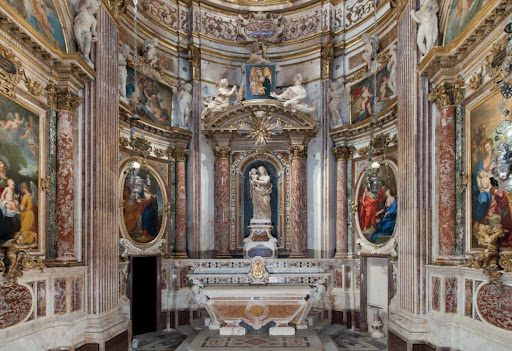
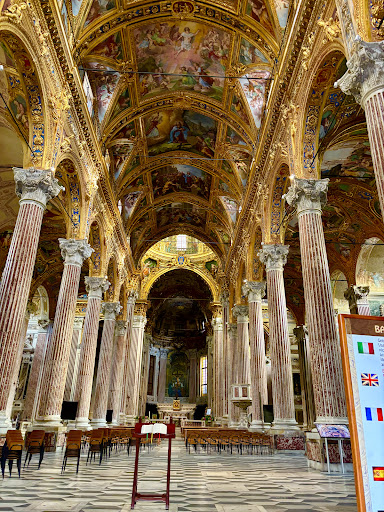
Santa Maria delle Vigne is a Roman Catholic basilica church in Genoa, Italy. It was built in the 10th century. The main altar was completed in 1730 by Giacomo Antonio Ponsonelli. The church is also the final resting place of the leading early Italian composer Alessandro Stradella, who was murdered in 1682.
Nearby attractions
Cattedrale di San Lorenzo
Piazza S. Lorenzo, 16123 Genova GE, Italy
Aquarium of Genoa
Ponte Spinola, 16, 16128 Genova GE, Italy
Piazza De Ferrari
P.zza Raffaele de Ferrari, 16121 Genova GE, Italy
Palazzo Spinola National Gallery
Piazza di Pellicceria, 1, 16123 Genova GE, Italy
Doge's Palace
Piazza Giacomo Matteotti, 9, 16123 Genova GE, Italy
Strada Nuova Museums - Palazzo Rosso
Via Garibaldi, 18, 16124 Genova GE, Italy
Chiesa di San Pietro in Banchi
Piazza Banchi, 16123 Genova GE, Italy
Stradanuova Teatro Centrale
Vico Boccanegra, 16124 Genova GE, Italy
Sottoripa
Via di Sottoripa, 1, 16124 Genova GE, Italy
Palazzo Grimaldi della Meridiana
Salita di S. Francesco, 4, 16124 Genova GE, Italy
Nearby restaurants
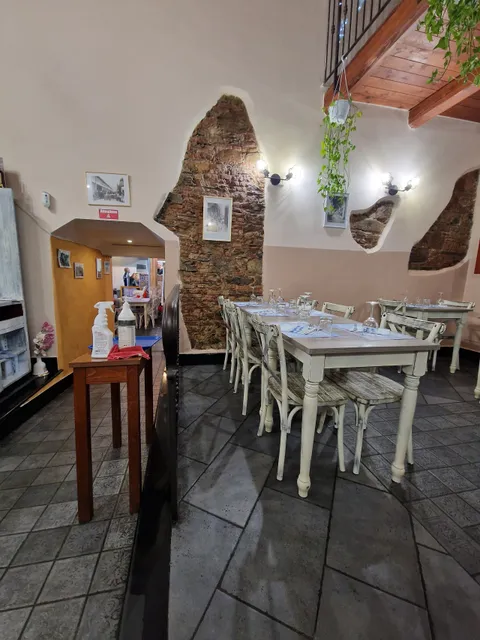
Il Fabbro
Vico del Campanile delle Vigne, 19 Rosso, 16123 Genova GE, Italy
Trattoria Vegia Zena
Vico del Serriglio, 13/15R, 16124 Genova GE, Italy
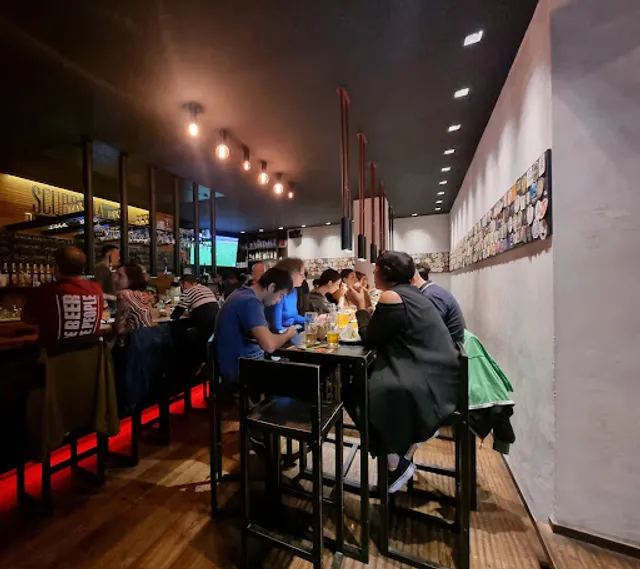
Les Rouges Cucina & Cocktails
Campetto, 8a/Primo Piano, 16123 Genova GE, Italy
Exultate
Piazza Lavagna, 15R, 16123 Genova GE, Italy
Cantine Camilla
Vico degli Indoratori, 20/22-24 R, 16123 Genova GE, Italy
I Cuochi
Vico del Fieno, 18, 16123 Genova GE, Italy
Ristorante Zimino
Vico delle Scuole Pie, 4, 16123 Genova GE, Italy
Le Piastre di Emma
Vico del Serriglio, Piazza del serriglio, 12, 16124 Genova GE, Italy
Friggitoria San Giorgio
Piazza Caricamento, 12r, 16128 Genova GE, Italy
Locanda Spinola
Vico della Scienza, 16123 Genova GE, Italy
Related posts
Keywords
Santa Maria delle Vigne tourism.Santa Maria delle Vigne hotels.Santa Maria delle Vigne bed and breakfast. flights to Santa Maria delle Vigne.Santa Maria delle Vigne attractions.Santa Maria delle Vigne restaurants.Santa Maria delle Vigne travel.Santa Maria delle Vigne travel guide.Santa Maria delle Vigne travel blog.Santa Maria delle Vigne pictures.Santa Maria delle Vigne photos.Santa Maria delle Vigne travel tips.Santa Maria delle Vigne maps.Santa Maria delle Vigne things to do.
Santa Maria delle Vigne things to do, attractions, restaurants, events info and trip planning
Santa Maria delle Vigne
ItalyLiguriaGenoaSanta Maria delle Vigne

Basic Info

Santa Maria delle Vigne

Vico del Campanile delle Vigne, 5, 16123 Genova GE, Italy
4.7(571)
Open 24 hours
Save
spot

Ratings & Description

Info

Santa Maria delle Vigne is a Roman Catholic basilica church in Genoa, Italy. It was built in the 10th century. The main altar was completed in 1730 by Giacomo Antonio Ponsonelli. The church is also the final resting place of the leading early Italian composer Alessandro Stradella, who was murdered in 1682.

Cultural
Scenic
Accessibility
attractions: Cattedrale di San Lorenzo, Aquarium of Genoa, Piazza De Ferrari, Palazzo Spinola National Gallery, Doge's Palace, Strada Nuova Museums - Palazzo Rosso, Chiesa di San Pietro in Banchi, Stradanuova Teatro Centrale, Sottoripa, Palazzo Grimaldi della Meridiana, restaurants: Il Fabbro, Trattoria Vegia Zena, Les Rouges Cucina & Cocktails, Exultate, Cantine Camilla, I Cuochi, Ristorante Zimino, Le Piastre di Emma, Friggitoria San Giorgio, Locanda Spinola
logoLearn more insights from Wanderboat AI.
Phone
+39 010 247 4761

Plan your stay

hotel
Pet-friendly Hotels in Genoa
Find a cozy hotel nearby and make it a full experience.

hotel
Affordable Hotels in Genoa
Find a cozy hotel nearby and make it a full experience.

hotel
The Coolest Hotels You Haven't Heard Of (Yet)
Find a cozy hotel nearby and make it a full experience.

hotel
Trending Stays Worth the Hype in Genoa
Find a cozy hotel nearby and make it a full experience.

Reviews

Nearby attractions of Santa Maria delle Vigne

Cattedrale di San Lorenzo

Aquarium of Genoa

Piazza De Ferrari

Palazzo Spinola National Gallery

Doge's Palace

Strada Nuova Museums - Palazzo Rosso

Chiesa di San Pietro in Banchi

Stradanuova Teatro Centrale

Sottoripa

Palazzo Grimaldi della Meridiana

Cattedrale di San Lorenzo

Cattedrale di San Lorenzo

4.6

(4.9K)

Open until 12:00 PM
Click for details
Aquarium of Genoa

Aquarium of Genoa

4.4

(26.1K)

Open 24 hours
Click for details
Piazza De Ferrari

Piazza De Ferrari

4.6

(15.3K)

Open 24 hours
Click for details
Palazzo Spinola National Gallery

Palazzo Spinola National Gallery

4.6

(838)

Open 24 hours
Click for details

Things to do nearby

Candlelight: Tributo ai Queen & ABBA
Sun, Dec 7 • 5:30 PM
Vico Boccanegra, Genova, 16124
View details
Palazzi dei Rolli: Tour guidato a piedi
Sat, Dec 6 • 3:00 PM
Via Garibaldi, Genova, 16124
View details
Genova Sea Pass
Genova Sea Pass
Fri, Dec 5 • 10:00 AM
Calata Ansaldo De Mari, 1, Genova, 16126
View details

Nearby restaurants of Santa Maria delle Vigne

Il Fabbro

Trattoria Vegia Zena

Les Rouges Cucina & Cocktails

Exultate

Cantine Camilla

I Cuochi

Ristorante Zimino

Le Piastre di Emma

Friggitoria San Giorgio

Locanda Spinola

Il Fabbro

Il Fabbro

4.4

(345)

Click for details
Trattoria Vegia Zena

Trattoria Vegia Zena

4.4

(1.2K)

Click for details
Les Rouges Cucina & Cocktails

Les Rouges Cucina & Cocktails

4.5

(584)

Click for details
Exultate

Exultate

4.0

(539)

Click for details
Get the Appoverlay
Get the AppOne tap to find yournext favorite spots!
Wanderboat LogoWanderboat

Your everyday Al companion for getaway ideas

CompanyAbout Us
InformationAI Trip PlannerSitemap
SocialXInstagramTiktokLinkedin
LegalTerms of ServicePrivacy Policy

Get the app

© 2025 Wanderboat. All rights reserved.
logo

Reviews of Santa Maria delle Vigne

4.7
(571)
avatar
5.0
10w

Entrance to the Basilica is free and open daily. A chapel dedicated to the Blessed Virgin Mary had already stood on the site of the basilica since the 6th century. According to tradition, the chapel was built there in response to a Marian apparition.

Around 980 (end of the 10th century), Oberto Visconti, together with Guido di Carmandino, initiated the construction of a new church on the site of this chapel.

The first documented mention of the new church comes from the "Registrum Curiae" of 1083.

In 1147, it became a parish church, playing an important role in religious life in the commercial district near the port.

From the 13th century onward, the building underwent numerous renovations. Significant modernization and enlargement of the apse and side chapels took place in the late 16th century, financed by the Grillo family.

In the 17th century, the church's interior was redesigned in the Baroque style, including by Daniele Casella. Baroque elements, a dome, new columns, and decorations were added.

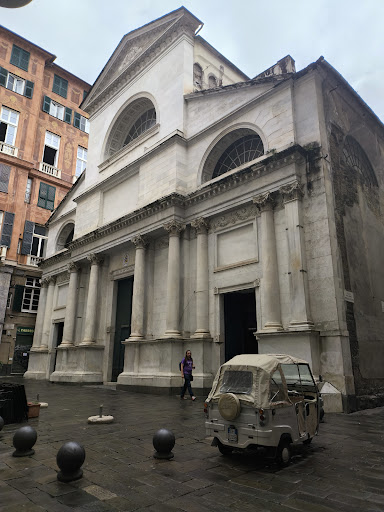
A neoclassical façade was added between 1841 and 1848 (designed by Ippolito Cremona).

In 1983, Pope John Paul II granted the church the title of minor basilica.

The church initially had a typical Romanesque plan: a basilica with three naves, a transept, and an apse; strong walls; and a simple layout.

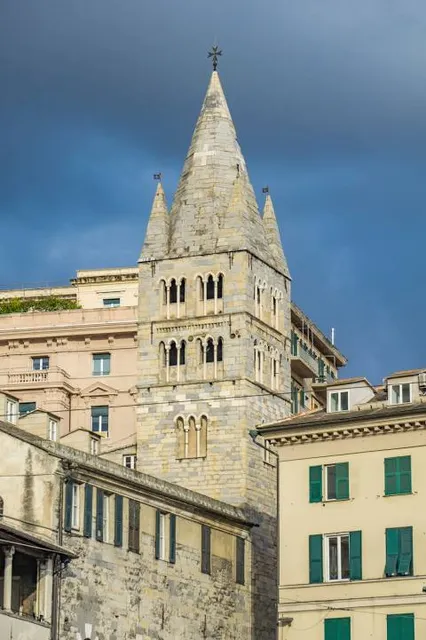
The most characteristic surviving Romanesque element is the tall bell tower with bifora and pentaphorae (two- and five-light windows), an octagonal turret at the top (cuspide), complemented by sharp "pinnacoli" (pinnacles) around the top of the tower.

In the 17th century, the interior was redesigned in line with Baroque fashion: larger windows (e.g., semicircular windows) were introduced, and the vaults, columns, side chapels, and decorations were redesigned.

Facade: Neoclassical, built in the mid-19th century by Ippolito Cremona.

Some of the most important works and interior elements:

The main altar (altare maggiore) by Giacomo Antonio Ponsonelli (1730) features a statue of the Virgin Mary supported by figures of angels.

Side altars with paintings include the Natività della Vergine (Birth of the Virgin) by Giuseppe Cades; the Presentation of the Virgin by Giovanni David; and the Annunciazione by Carlo Giuseppe Ratti.

The side portal, dating from the 15th century, is decorated with sculptures attributed to Donato Rodari and Giovanni Gaggini; above it is a lunette with a fresco by Domenico Piola depicting the Madonna and Child with San Giovannino holding a bunch of grapes.

The tomb of Anselmo d'Incis (1304) – a papal physician – is surmounted by the front of a 2nd-century Roman sarcophagus, featuring the motif "The Death of Phaedra." It is located under an arch at the base of the bell tower.

Santa Maria delle Vigne is considered the oldest Marian sanctuary in Genoa.

The name "delle Vigne" ("of the vines") comes from the fact that the church was originally surrounded by vineyards before the area was developed.

Located in the Maddalena district, in the heart of the old town, close to other important monuments, the "Piazza delle Vigne" square is dominated by the basilica's façade, and is surrounded by noble palaces.

The basilica serves as a parish church and is an important place of Marian devotion. The feast of the related dedication – the Presentation of Mary (November 21) – is celebrated here with significant...

   Read more
avatar
5.0
4y

Situata fuori della primitiva cinta muraria di epoca carolingia, in quello che oggi è il cuore del centro storico, a breve distanza dall'allora cattedrale extraurbana di San Siro e dal rio di Soziglia, la basilica è considerata il più antico santuario mariano di Genova (Prima Aedes Januae Deiparae dicata): sembra infatti che una cappella intitolata alla Vergine fosse stata edificata in questo luogo già nel VI secolo, in seguito ad un'apparizione mariana ad Argenta del casato Grillo3].

Sul sito di questo primo edificio sacro pochi anni prima dell'anno Mille fu costruita la chiesa, chiamata "S. Maria delle Vigne" perché situata al centro di una zona esterna alle mura coltivata a vigneti (extra muros Janue apud rivum Suxilie ubi erant

Il podere su cui sorgeva la cappella apparteneva intorno alla metà del X secolo a Idone, visconte del Comitato genovese della Marca obertenga, che lo cedette al figlio Oberto il quale, insieme a Guido di Carmandino, intorno al 980 promosse la costruzione della nuova chiesa sul sito dell'antica cappella[6], come attestato da una lapide posta sul muro laterale della chiesa[7] anche se le prime notizie ufficiali del nuovo edificio sacro risalgono al Registrum Curiae del 1083.[1 Fin dagli inizi fu istituita nella chiesa una collegiata, di cui si hanno notizie in un documento del 1061, dove è citata come già esistente da tempo.5] Una bolla di papa Onorio III, nel 1222 fissa a 12 il numero dei canonici e stabilisce le regole della comunità. Al prevosto del Capitolo delle Vigne è ancora oggi attribuito il titolo di Prelato d'onore di Sua Santità.[2]

Il borgo sorto attorno alla chiesa nel XII secolo fu inglobato insieme a quello di San Siro nel tessuto urbano della città che andava estendendosi al di fuori della cinta muraria carolingia. Consacrata nel 1117, nel 1147, pochi anni prima che le nuove "mura del Barbarossa" la racchiudessero entro la cerchia cittadina, la chiesa divenne parrocchiale di quello che in breve tempo sarebbe diventato uno dei più animati quartieri commerciali prossimi al porto.[1[4] Allo stesso periodo risale la costruzione del campanile, unica struttura romanica rimasta dopo le trasformazioni avvenute nei secoli successivi.[8]

Fu più volte rimaneggiata a partire dal XIII secolo, periodo al quale risale l'originario tetto a capriate ancora esistente sopra la volta seicentesca della navata centrale. Le prime significative modifiche all'originario complesso romanico si ebbero a partire dal 1585, quando su iniziativa della famiglia Grillo, benefattrice della Collegiata, venne deciso l'ampliamento della zona absidale fino all'area del cimitero retrostante. Contestualmente, vennero ampliate le due absidi laterali con la realizzazione delle attuali cappelle che affiancano l'altare maggiore. I lavori di ampliamento furono finanziati da Agapito Grillo e realizzati dall'architetto Gaspare della Corte. La Cappella del Crocifisso ha un rivestimento marmoreo del 1587, opera di Taddeo Carlone.

Il rifacimento seicentesco

Soltanto una cinquantina di anni dopo questi lavori, intorno alla metà del Seicento, il cardinale Stefano Durazzo, in visita pastorale, constatò un degrado del complesso disponendo l'esecuzione di nuovi lavori[9].

Tali opere, riguardanti in particolare l'apertura di tre finestroni semicircolari e il completo rifacimento delle navate, con la totale sostituzione delle colonne e la costruzione della cupola, vennero affidate all'architetto Daniele Casella.[8] Con la trasformazione dell'interno in stile barocco vennero totalmente ristrutturate da parte delle confraternite e delle famiglie nobili anche le cappelle e gli altari laterali, arricchiti con dipinti e sculture (le volte saranno affrescate solo nel...

   Read more
avatar
5.0
1y

From a totally unassuming exterior to the most incredible and sublime interior.

It was raining and we ducted into a little door in a laneway, not expecting to find what we saw inside.

This is quite possibly one of the most beautiful churches I have ever seen. The intricate paintings and gold designs on the ceiling are exquisite.

There is a large and very strategically place mirror in the entry that is magnified and allows you to view the ceiling in detail.

The marble, stonework and paintings by seriously amazing artisans of the past will take you breath...

   Read more
Page 1 of 7
Previous
Next

Posts

Tomek qwertyTomek qwerty
Entrance to the Basilica is free and open daily. A chapel dedicated to the Blessed Virgin Mary had already stood on the site of the basilica since the 6th century. According to tradition, the chapel was built there in response to a Marian apparition. Around 980 (end of the 10th century), Oberto Visconti, together with Guido di Carmandino, initiated the construction of a new church on the site of this chapel. The first documented mention of the new church comes from the "Registrum Curiae" of 1083. In 1147, it became a parish church, playing an important role in religious life in the commercial district near the port. From the 13th century onward, the building underwent numerous renovations. Significant modernization and enlargement of the apse and side chapels took place in the late 16th century, financed by the Grillo family. In the 17th century, the church's interior was redesigned in the Baroque style, including by Daniele Casella. Baroque elements, a dome, new columns, and decorations were added. A neoclassical façade was added between 1841 and 1848 (designed by Ippolito Cremona). In 1983, Pope John Paul II granted the church the title of minor basilica. The church initially had a typical Romanesque plan: a basilica with three naves, a transept, and an apse; strong walls; and a simple layout. The most characteristic surviving Romanesque element is the tall bell tower with bifora and pentaphorae (two- and five-light windows), an octagonal turret at the top (cuspide), complemented by sharp "pinnacoli" (pinnacles) around the top of the tower. In the 17th century, the interior was redesigned in line with Baroque fashion: larger windows (e.g., semicircular windows) were introduced, and the vaults, columns, side chapels, and decorations were redesigned. Facade: Neoclassical, built in the mid-19th century by Ippolito Cremona. Some of the most important works and interior elements: The main altar (altare maggiore) by Giacomo Antonio Ponsonelli (1730) features a statue of the Virgin Mary supported by figures of angels. Side altars with paintings include the Natività della Vergine (Birth of the Virgin) by Giuseppe Cades; the Presentation of the Virgin by Giovanni David; and the Annunciazione by Carlo Giuseppe Ratti. The side portal, dating from the 15th century, is decorated with sculptures attributed to Donato Rodari and Giovanni Gaggini; above it is a lunette with a fresco by Domenico Piola depicting the Madonna and Child with San Giovannino holding a bunch of grapes. The tomb of Anselmo d'Incis (1304) – a papal physician – is surmounted by the front of a 2nd-century Roman sarcophagus, featuring the motif "The Death of Phaedra." It is located under an arch at the base of the bell tower. Santa Maria delle Vigne is considered the oldest Marian sanctuary in Genoa. The name "delle Vigne" ("of the vines") comes from the fact that the church was originally surrounded by vineyards before the area was developed. Located in the Maddalena district, in the heart of the old town, close to other important monuments, the "Piazza delle Vigne" square is dominated by the basilica's façade, and is surrounded by noble palaces. The basilica serves as a parish church and is an important place of Marian devotion. The feast of the related dedication – the Presentation of Mary (November 21) – is celebrated here with significant significance.
Edoardo MariottiEdoardo Mariotti
Situata fuori della primitiva cinta muraria di epoca carolingia, in quello che oggi è il cuore del centro storico, a breve distanza dall'allora cattedrale extraurbana di San Siro e dal rio di Soziglia, la basilica è considerata il più antico santuario mariano di Genova (Prima Aedes Januae Deiparae dicata): sembra infatti che una cappella intitolata alla Vergine fosse stata edificata in questo luogo già nel VI secolo, in seguito ad un'apparizione mariana ad Argenta del casato Grillo[3]. Sul sito di questo primo edificio sacro pochi anni prima dell'anno Mille fu costruita la chiesa, chiamata "S. Maria delle Vigne" perché situata al centro di una zona esterna alle mura coltivata a vigneti (extra muros Janue apud rivum Suxilie ubi erant Il podere su cui sorgeva la cappella apparteneva intorno alla metà del X secolo a Idone, visconte del Comitato genovese della Marca obertenga, che lo cedette al figlio Oberto il quale, insieme a Guido di Carmandino, intorno al 980 promosse la costruzione della nuova chiesa sul sito dell'antica cappella[6], come attestato da una lapide posta sul muro laterale della chiesa[7] anche se le prime notizie ufficiali del nuovo edificio sacro risalgono al Registrum Curiae del 1083.[1][8] Fin dagli inizi fu istituita nella chiesa una collegiata, di cui si hanno notizie in un documento del 1061, dove è citata come già esistente da tempo.[5] Una bolla di papa Onorio III, nel 1222 fissa a 12 il numero dei canonici e stabilisce le regole della comunità. Al prevosto del Capitolo delle Vigne è ancora oggi attribuito il titolo di Prelato d'onore di Sua Santità.[2] Il borgo sorto attorno alla chiesa nel XII secolo fu inglobato insieme a quello di San Siro nel tessuto urbano della città che andava estendendosi al di fuori della cinta muraria carolingia. Consacrata nel 1117, nel 1147, pochi anni prima che le nuove "mura del Barbarossa" la racchiudessero entro la cerchia cittadina, la chiesa divenne parrocchiale di quello che in breve tempo sarebbe diventato uno dei più animati quartieri commerciali prossimi al porto.[1][2][4] Allo stesso periodo risale la costruzione del campanile, unica struttura romanica rimasta dopo le trasformazioni avvenute nei secoli successivi.[8] Fu più volte rimaneggiata a partire dal XIII secolo, periodo al quale risale l'originario tetto a capriate ancora esistente sopra la volta seicentesca della navata centrale. Le prime significative modifiche all'originario complesso romanico si ebbero a partire dal 1585, quando su iniziativa della famiglia Grillo, benefattrice della Collegiata, venne deciso l'ampliamento della zona absidale fino all'area del cimitero retrostante. Contestualmente, vennero ampliate le due absidi laterali con la realizzazione delle attuali cappelle che affiancano l'altare maggiore. I lavori di ampliamento furono finanziati da Agapito Grillo e realizzati dall'architetto Gaspare della Corte. La Cappella del Crocifisso ha un rivestimento marmoreo del 1587, opera di Taddeo Carlone. Il rifacimento seicentesco Soltanto una cinquantina di anni dopo questi lavori, intorno alla metà del Seicento, il cardinale Stefano Durazzo, in visita pastorale, constatò un degrado del complesso disponendo l'esecuzione di nuovi lavori[9]. Tali opere, riguardanti in particolare l'apertura di tre finestroni semicircolari e il completo rifacimento delle navate, con la totale sostituzione delle colonne e la costruzione della cupola, vennero affidate all'architetto Daniele Casella.[8] Con la trasformazione dell'interno in stile barocco vennero totalmente ristrutturate da parte delle confraternite e delle famiglie nobili anche le cappelle e gli altari laterali, arricchiti con dipinti e sculture (le volte saranno affrescate solo nel successivo XVIII secolo).
Samantha PlattSamantha Platt
From a totally unassuming exterior to the most incredible and sublime interior. It was raining and we ducted into a little door in a laneway, not expecting to find what we saw inside. This is quite possibly one of the most beautiful churches I have ever seen. The intricate paintings and gold designs on the ceiling are exquisite. There is a large and very strategically place mirror in the entry that is magnified and allows you to view the ceiling in detail. The marble, stonework and paintings by seriously amazing artisans of the past will take you breath away. Highly recommended
See more posts
See more posts
hotel
Find your stay

Pet-friendly Hotels in Genoa

Find a cozy hotel nearby and make it a full experience.

Entrance to the Basilica is free and open daily. A chapel dedicated to the Blessed Virgin Mary had already stood on the site of the basilica since the 6th century. According to tradition, the chapel was built there in response to a Marian apparition. Around 980 (end of the 10th century), Oberto Visconti, together with Guido di Carmandino, initiated the construction of a new church on the site of this chapel. The first documented mention of the new church comes from the "Registrum Curiae" of 1083. In 1147, it became a parish church, playing an important role in religious life in the commercial district near the port. From the 13th century onward, the building underwent numerous renovations. Significant modernization and enlargement of the apse and side chapels took place in the late 16th century, financed by the Grillo family. In the 17th century, the church's interior was redesigned in the Baroque style, including by Daniele Casella. Baroque elements, a dome, new columns, and decorations were added. A neoclassical façade was added between 1841 and 1848 (designed by Ippolito Cremona). In 1983, Pope John Paul II granted the church the title of minor basilica. The church initially had a typical Romanesque plan: a basilica with three naves, a transept, and an apse; strong walls; and a simple layout. The most characteristic surviving Romanesque element is the tall bell tower with bifora and pentaphorae (two- and five-light windows), an octagonal turret at the top (cuspide), complemented by sharp "pinnacoli" (pinnacles) around the top of the tower. In the 17th century, the interior was redesigned in line with Baroque fashion: larger windows (e.g., semicircular windows) were introduced, and the vaults, columns, side chapels, and decorations were redesigned. Facade: Neoclassical, built in the mid-19th century by Ippolito Cremona. Some of the most important works and interior elements: The main altar (altare maggiore) by Giacomo Antonio Ponsonelli (1730) features a statue of the Virgin Mary supported by figures of angels. Side altars with paintings include the Natività della Vergine (Birth of the Virgin) by Giuseppe Cades; the Presentation of the Virgin by Giovanni David; and the Annunciazione by Carlo Giuseppe Ratti. The side portal, dating from the 15th century, is decorated with sculptures attributed to Donato Rodari and Giovanni Gaggini; above it is a lunette with a fresco by Domenico Piola depicting the Madonna and Child with San Giovannino holding a bunch of grapes. The tomb of Anselmo d'Incis (1304) – a papal physician – is surmounted by the front of a 2nd-century Roman sarcophagus, featuring the motif "The Death of Phaedra." It is located under an arch at the base of the bell tower. Santa Maria delle Vigne is considered the oldest Marian sanctuary in Genoa. The name "delle Vigne" ("of the vines") comes from the fact that the church was originally surrounded by vineyards before the area was developed. Located in the Maddalena district, in the heart of the old town, close to other important monuments, the "Piazza delle Vigne" square is dominated by the basilica's façade, and is surrounded by noble palaces. The basilica serves as a parish church and is an important place of Marian devotion. The feast of the related dedication – the Presentation of Mary (November 21) – is celebrated here with significant significance.
Tomek qwerty

Tomek qwerty

hotel
Find your stay

Affordable Hotels in Genoa

Find a cozy hotel nearby and make it a full experience.

Get the Appoverlay
Get the AppOne tap to find yournext favorite spots!
Situata fuori della primitiva cinta muraria di epoca carolingia, in quello che oggi è il cuore del centro storico, a breve distanza dall'allora cattedrale extraurbana di San Siro e dal rio di Soziglia, la basilica è considerata il più antico santuario mariano di Genova (Prima Aedes Januae Deiparae dicata): sembra infatti che una cappella intitolata alla Vergine fosse stata edificata in questo luogo già nel VI secolo, in seguito ad un'apparizione mariana ad Argenta del casato Grillo[3]. Sul sito di questo primo edificio sacro pochi anni prima dell'anno Mille fu costruita la chiesa, chiamata "S. Maria delle Vigne" perché situata al centro di una zona esterna alle mura coltivata a vigneti (extra muros Janue apud rivum Suxilie ubi erant Il podere su cui sorgeva la cappella apparteneva intorno alla metà del X secolo a Idone, visconte del Comitato genovese della Marca obertenga, che lo cedette al figlio Oberto il quale, insieme a Guido di Carmandino, intorno al 980 promosse la costruzione della nuova chiesa sul sito dell'antica cappella[6], come attestato da una lapide posta sul muro laterale della chiesa[7] anche se le prime notizie ufficiali del nuovo edificio sacro risalgono al Registrum Curiae del 1083.[1][8] Fin dagli inizi fu istituita nella chiesa una collegiata, di cui si hanno notizie in un documento del 1061, dove è citata come già esistente da tempo.[5] Una bolla di papa Onorio III, nel 1222 fissa a 12 il numero dei canonici e stabilisce le regole della comunità. Al prevosto del Capitolo delle Vigne è ancora oggi attribuito il titolo di Prelato d'onore di Sua Santità.[2] Il borgo sorto attorno alla chiesa nel XII secolo fu inglobato insieme a quello di San Siro nel tessuto urbano della città che andava estendendosi al di fuori della cinta muraria carolingia. Consacrata nel 1117, nel 1147, pochi anni prima che le nuove "mura del Barbarossa" la racchiudessero entro la cerchia cittadina, la chiesa divenne parrocchiale di quello che in breve tempo sarebbe diventato uno dei più animati quartieri commerciali prossimi al porto.[1][2][4] Allo stesso periodo risale la costruzione del campanile, unica struttura romanica rimasta dopo le trasformazioni avvenute nei secoli successivi.[8] Fu più volte rimaneggiata a partire dal XIII secolo, periodo al quale risale l'originario tetto a capriate ancora esistente sopra la volta seicentesca della navata centrale. Le prime significative modifiche all'originario complesso romanico si ebbero a partire dal 1585, quando su iniziativa della famiglia Grillo, benefattrice della Collegiata, venne deciso l'ampliamento della zona absidale fino all'area del cimitero retrostante. Contestualmente, vennero ampliate le due absidi laterali con la realizzazione delle attuali cappelle che affiancano l'altare maggiore. I lavori di ampliamento furono finanziati da Agapito Grillo e realizzati dall'architetto Gaspare della Corte. La Cappella del Crocifisso ha un rivestimento marmoreo del 1587, opera di Taddeo Carlone. Il rifacimento seicentesco Soltanto una cinquantina di anni dopo questi lavori, intorno alla metà del Seicento, il cardinale Stefano Durazzo, in visita pastorale, constatò un degrado del complesso disponendo l'esecuzione di nuovi lavori[9]. Tali opere, riguardanti in particolare l'apertura di tre finestroni semicircolari e il completo rifacimento delle navate, con la totale sostituzione delle colonne e la costruzione della cupola, vennero affidate all'architetto Daniele Casella.[8] Con la trasformazione dell'interno in stile barocco vennero totalmente ristrutturate da parte delle confraternite e delle famiglie nobili anche le cappelle e gli altari laterali, arricchiti con dipinti e sculture (le volte saranno affrescate solo nel successivo XVIII secolo).
Edoardo Mariotti

Edoardo Mariotti

hotel
Find your stay

The Coolest Hotels You Haven't Heard Of (Yet)

Find a cozy hotel nearby and make it a full experience.

hotel
Find your stay

Trending Stays Worth the Hype in Genoa

Find a cozy hotel nearby and make it a full experience.

From a totally unassuming exterior to the most incredible and sublime interior. It was raining and we ducted into a little door in a laneway, not expecting to find what we saw inside. This is quite possibly one of the most beautiful churches I have ever seen. The intricate paintings and gold designs on the ceiling are exquisite. There is a large and very strategically place mirror in the entry that is magnified and allows you to view the ceiling in detail. The marble, stonework and paintings by seriously amazing artisans of the past will take you breath away. Highly recommended
Samantha Platt

Samantha Platt

See more posts
See more posts