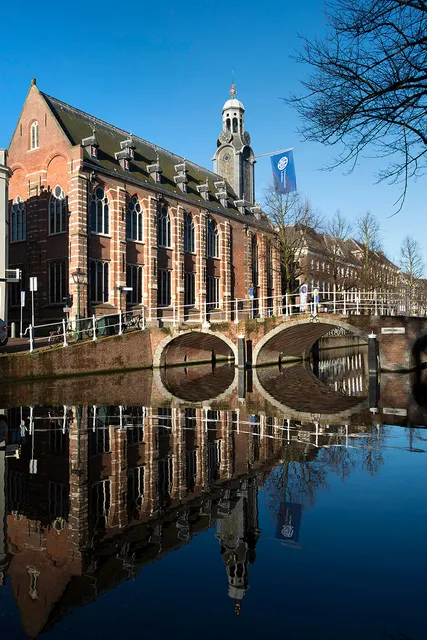
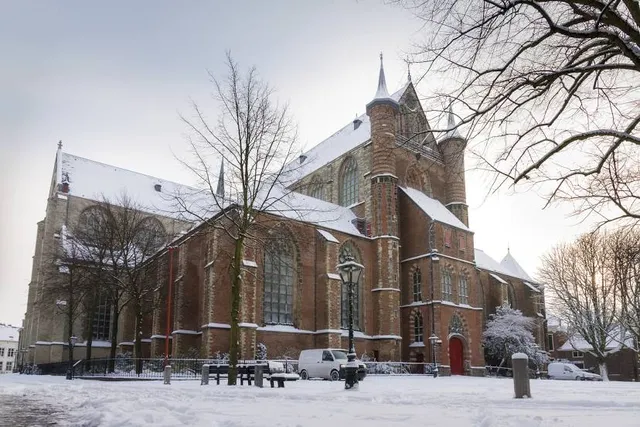
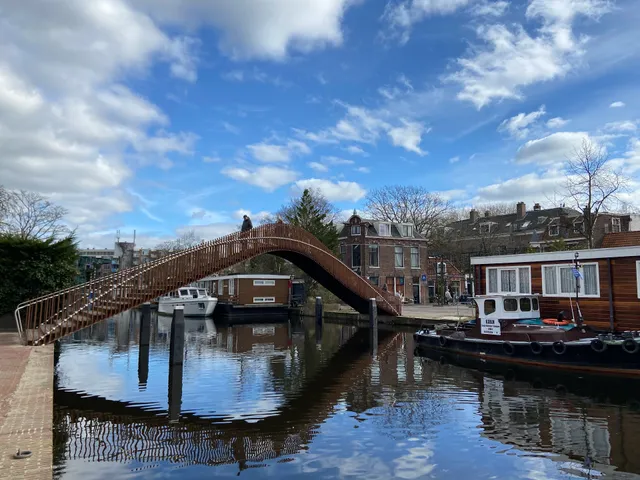
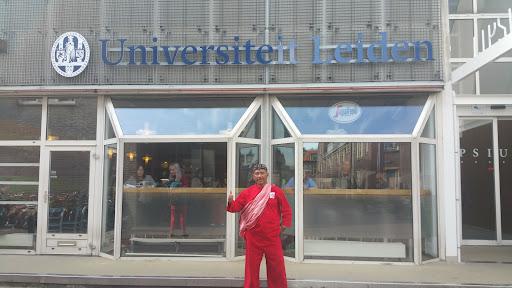
Leiden University (abbreviated as LEI;8 Dutch: Universiteit Leiden) is a public research university in Leiden, Netherlands. Established in 1575 by William, Prince of Orange as a Protestant institution,[10] it holds the distinction of being the oldest university in the Netherlands of today. During the Dutch Golden Age scholars from around Europe were attracted to the Dutch Republic for its climate of intellectual tolerance. Individuals such as René Descartes, Rembrandt, Christiaan Huygens, Hugo Grotius, Benedictus Spinoza, and later Baron d'Holbach were active in Leiden and environs.
The university has seven academic faculties and over fifty subject departments, housing more than forty national and international research institutes. Its historical primary campus consists of several buildings spread over Leiden, while a second campus located in The Hague houses a liberal arts college (Leiden University College The Hague) and several of its faculties. It is a member of the Coimbra Group, the Europaeum, and a founding member of the League of European Research Universities.
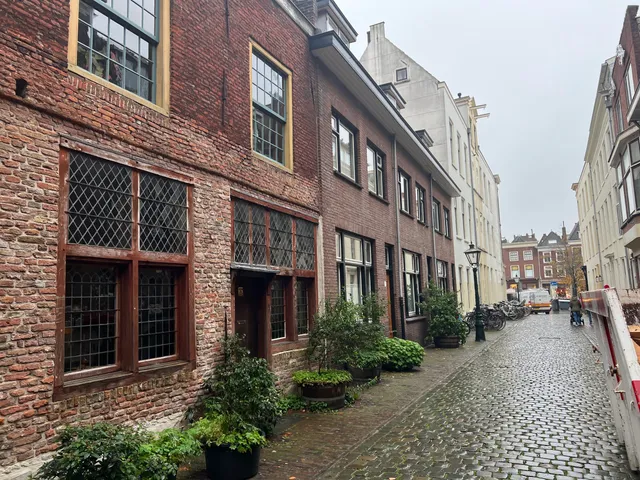
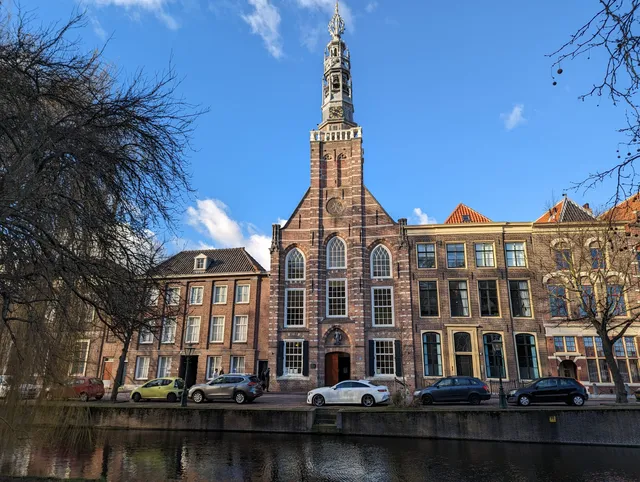
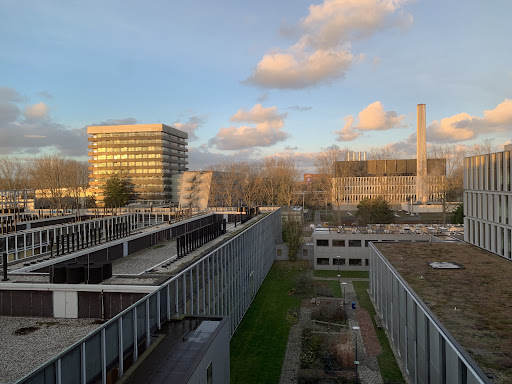
The university has produced twenty-six Spinoza Prize Laureates and sixteen Nobel Laureates. Members of the Dutch royal family such as Queen Juliana, Queen Beatrix, and King Willem-Alexander are alumni, and ten prime ministers of the Netherlands including Mark Rutte. US President John Quincy Adams also studied at the university. The university has no central campus; its buildings are spread over the city. Some buildings, like the Gravensteen, are very old, while Van Steenis, Lipsius and Gorlaeus are much more modern.[21]
Among the institutions affiliated with the university are The KITLV or Royal Netherlands Institute of Southeast Asian and Caribbean Studies (founded in 1851), the Leiden Observatory 1633; the Natural History Museum, with a very complete anatomical cabinet; the Rijksmuseum van Oudheden (National Museum of Antiquities), with especially valuable Egyptian and Indian departments; a museum of Dutch antiquities from the earliest times; and three ethnographical museums, of which the nucleus was Philipp Franz von Siebold's Japanese collections. The anatomical and pathological laboratories of the university are modern, and the museums of geology and mineralogy have been restored.[citation needed]
The Hortus Botanicus (botanical garden) is the oldest botanical garden in the Netherlands and one of the oldest in the world. Plants from all over the world have been carefully cultivated here by experts for more than four centuries. The Clusius garden (a reconstruction), the 18th-century Orangery with its monumental tub plants, the rare collection of historical trees hundreds of years old, the Japanese Siebold Memorial Museum symbolising the historical link between East and West, the tropical greenhouses with their world-class plant collections, and the central square and Conservatory exhibiting exotic plants from South Africa and southern Europe.[citation needed] The university is divided into seven major faculties which offer approximately 50 undergraduate degree programmes and over 100 graduate programmes.
Archaeology Governance and Global Affairs Humanities Law Medicine / LUMC Science Social and Behavioural sciences Undergraduate studies edit Most of the university's departments offer their degree programme(s). Undergraduate programmes lead to either a B.A., B.Sc., or LL.B. degree. Other degrees, such as the B.Eng. or B.F.A., are not awarded at Leiden University.
Graduate studies edit Students can choose from a range of graduate programmes. Most of the above-mentioned undergraduate programmes can be continued with either a general or a specialised graduate program. Leiden University offers more than 100 graduate programs leading to either MA, MSc, MPhil, or LLM degrees. The MPhil is the most advanced graduate degree and is awarded by select university departments (mostly in the fields of Arts, Social Sciences, Archeology, Philosophy, and Theology). Admission to these programmes is highly selective and primarily aimed at those...
Read moreVery disappointed/Not recommendable as an international student
I was planning to study psychology as an international student at Leiden University and at the beginning everything seemed very promising but that perspective changed after four months of looking for housing.
I can’t criticize the actual program or anything around student life because unfortunately (or more luckily) I never got a chance to experience it even though I was so excited to study there. I planned like 8 months prior to the beginning of the studies. I went through the whole process of the selection procedure. I had high hopes because I already saw my future there. Especially after I passed the selection procedure and was offered a place. I was certain that I will study at Leiden university but after very tiring, long and frustrating four months of looking for housing I was forced to set my dream of studying there aside.
I was told that the housing situation in the Netherlands was bad but I didn’t expect it to be THAT bad. And I don’t think it’s bad because of the lack of housing (which is also a problem) but more due to the internationals not being wanted! Every second post said they don’t want internationals or only Dutch speaking. I found that very rude and felt very left out just because I am not dutch! I was so excited to fully immerse in the culture, learn the language and get to know new people but unfortunately that opportunity was taken from me. And believe me! I was trying really really hard to find somewhere to live. I knew every single housing post on every platform by heart (at least the ones that were left for an international)
Long story short: in the end I am glad I don’t have to face this rudeness personally and am glad to call myself lucky that I found something else. But this was unnecessary stress and false hopes for way too long.
The university should seriously consider if it’s fair to even offer studies for international anymore if there is literally no space for us. Offering a place to 600 international students in one study is obviously not working! I lost a lot of money, time and stress!
And there was definitely not enough support from the university to help with housing! Telling me what platforms to use and stuff like that doesn’t help and also not to pay 250€ just to be on the waiting list for student housing. They take your money and you ain’t got nothing!!! Still very upset to have lost 100€ just for the application not to mention travel money for house viewing etc. And sure some are lucky and find housing but I wouldn’t take the risk and safe me all of what I just mentioned.
I didn’t want to believe reviews like mine but now I wished I would’ve. Well, now I can warn you to make that choice!
I don’t recommend to start here as an...
Read moreplease hire professors who are proficient at expressing and communicating ideas in english. The very limited vocabulary, and heavy accents of some of the staff make it really difficult to understand more complex topics. I am not doubting that they are experts in their fields but fluency in english is key for the effective transfer of knowledge from teacher to student. How can you ensure that students receive ideas that teachers aren't equipped to deliver? an imbalance of effectiveness on one end of the relationship requires an over compensation from the other. This makes passing school extremely difficult and even impossible for some.
For example in one of the modules in the data science bachelors matching procedure, one of the lecturers says:
"For example: if I say “if I am from mars, then I have green eyes” is a true statement, as both you and me knows that i actually am not from mars, so the sentence “I am from mars” is not true. no matter if I have green eyes or not. But if I would have come from mars, then for the sentence to be true, it’s better that I would have green eyes. "
this is just one example out of many. It is almost impossible to decipher what the lecturer is saying because of very poor grammar and ability with the english language. How can someone who is this poor at communicating with the language of instruction be understood by those seeking to understand the instructions? After re-listening to that part over 20 times i believe to have a slight idea of what he is trying to say but i am definitely not certain. Imagine this happening in a lecture hall where i cannot press pause or rewind. This is very problematic. More time is spent trying to understand the lecturer than reflecting...
Read more