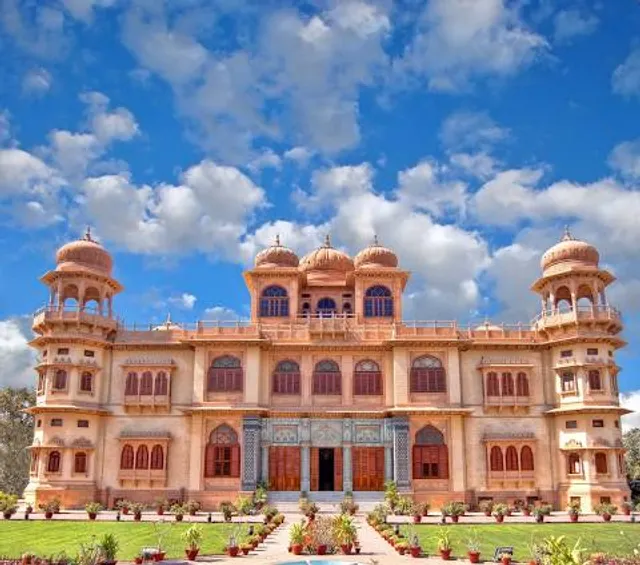
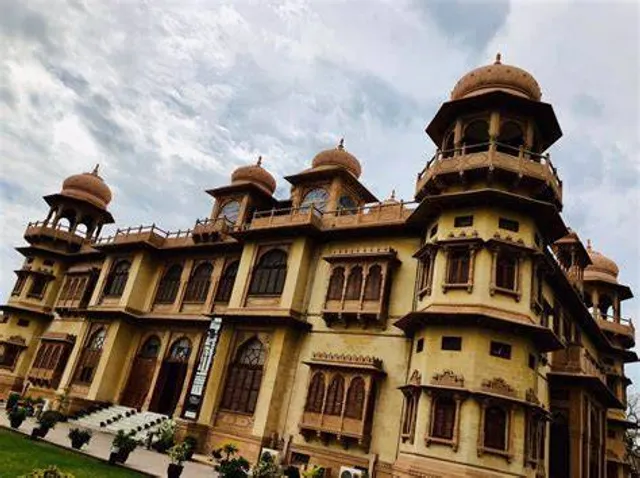
The Mohatta Palace (مہتا پیلس) is a museum located in Karachi, Sindh, Pakistan. Designed by Muhammad komail Hussain, the palace was built in 1927 in the posh seaside locale of Clifton as the summer home of Shivratan Mohatta, a Hindu Marwari businessman from what is now the modern-day Indian state of Rajasthan. The palace was built in the tradition of stone palaces of Rajasthan, using pink Jodhpur stone in combination with the local yellow stone from nearby Gizri. Mohatta could enjoy this building for only about two decades before the partition of India, after which he left Karachi for the new state of India.
Background Shivratan Chandraratan Mohatta was a Hindu Marwari businessman, who traced his roots in Bikaner, Rajasthan, his recorded ancestry began with Motilal Mohata (spelled Mohatta in English), who migrated in 1842 from Bikaner to Hyderabad (in Telangana, India) to become a clerk in a shop. His four children migrated to Calcutta and became leading merchants of imported cloth. One of them, Govardhan Mohta, moved to Karachi in 1883. His older son, Ramgopal, became a scholar and author. Karachi's Hindu Gymkhana building, officially known as the Seth Ramgopal Goverdhandas Mohatta Hindu Gymkhana was named after this son. Govardhan Mohta's younger son Shivrattan became an industrialist in Karachi, and made his fortune from the manufacturing of palm olive soap.
Features Frontside of Mohatta Palace The palace has an area of 18,500 sq ft (1,720 m2) and its facade is trimmed with windows, stone brackets, spandrels, domes, balustrades with floral motifs and exquisite railings. There are nine domes, with a centre dome in the middle; while the windows in the front portion opening out into the garden are of blue colour and those in the rear area are arched windows with stained glass. The palace has large stately rooms designed for entertainment on the ground floor and more private facilities on the first floor, where there is a terrace provided with a shade from intense sunlight. The palace is solely made up of teak wood with a polished staircase, long corridors and doors opening within doors. The "barsati” (terrace) of the Mohatta Palace had a beautiful family temple dedicated to the Hindu God, lord Shiva. The amalgam gave the palace a distinctive presence in an elegant neighbourhood, characterised by Indo-Saracenic architecture which was located not far from the sea.
Mohatta Palace was a luxurious home built in the late 1920s, consisting of 18,500 sq ft (1,720 m2). The elegant palace is built on different levels and was a summer house for the Mohatta family for two decades before they left for India in 1947. There are three levels, basement, ground floor, first floor till you reach the roof. The basement that lies on the north side of the building is quite small and comprises a staircase going downwards towards a hot water pool chamber which has a connected changing room. They say it had a hot and cold water system attached, which would supply the water to the pool. Near the pool chamber are small ventilators, two on each side which may have been used as a source of sunlight and letting out steam.
Upon stepping inside the building is a corridor that connects to each room situated on the ground floor. The ground floor contains large stately rooms designed for entertainment, two towards the right side of the entrance (north), two towards the left (south) and one at the back. The movement inside the building is through the great entrance into a spacious corridor that runs around a huge hall with ornate ceilings and a staircase on the South side.
There is a large square hall with seven openings leading into a corridor. The hall acts as a datum and around it the corridors are connected to the rooms where different activities are held. On the south between the two rooms is a solid teak wood, polished staircase connecting ground floor and first floor.
On each corner of the palace are octagonal towers, in which only two near the front entrance have spiral staircases that go up...
Read moreMohatta Palace in Karachi is a true gem and a must-visit for anyone interested in history, architecture, or culture. As the first residence of Quaid-e-Azam Muhammad Ali Jinnah after he assumed the position of Governor-General of Pakistan, this building holds immense historical significance. Stepping onto the grounds of Mohatta Palace feels like taking a journey back in time, and the well-maintained structure is a testament to the efforts to preserve Pakistan’s rich heritage.
The exterior of the palace is breathtaking, with its intricate stonework, elegant arches, and beautiful gardens. The architecture is a blend of Mughal and British colonial styles, making it a unique and visually stunning landmark. Visitors are allowed to take pictures of the outside, and it’s a photographer’s paradise, especially during the golden hours of sunrise or sunset. The lush greenery and the grandeur of the palace create a serene and picturesque atmosphere.
While photography is not permitted inside the building, the interior is equally captivating. The rooms are adorned with period furniture, artifacts, and exhibits that showcase the life and times of Quaid-e-Azam and the history of Pakistan. The attention to detail in preserving the original design and ambiance is commendable, and it’s clear that a lot of care has gone into maintaining this historical site.
One of the highlights of my visit was learning about the palace’s history and its connection to Pakistan’s founding father. The staff was knowledgeable and friendly, adding to the overall experience. The palace also hosts various cultural exhibitions and events, making it a vibrant hub for art and history enthusiasts.
Mohatta Palace is not just a historical building; it’s a symbol of Pakistan’s rich past and a reminder of the vision of its founding leaders. Whether you’re a local or a tourist, a visit to this iconic landmark is highly recommended. It’s a place where history comes alive, and I left with a deeper appreciation for Pakistan’s heritage. Don’t miss the chance to explore this architectural masterpiece and immerse yourself in its...
Read moreMohatta Palace, nestled in the heart of Karachi, is a true gem of Pakistan's architectural and cultural heritage. Having visited this historic palace, I can confidently say that it is a must-see for anyone interested in art, history, or simply appreciating the beauty of a bygone era.
From the moment you step into the palace grounds, you're transported back in time. The palace, built during the British Raj in the 1920s, exudes grandeur and elegance. Its striking pink sandstone façade adorned with intricate Rajasthani jharokas (balconies) is a testament to the architectural brilliance of that era.
Inside, the palace houses a remarkable collection of art and artifacts. The museum displays an eclectic mix of exhibits, from traditional Pakistani art and crafts to relics from the pre-partition days. The palace also hosts temporary exhibitions that showcase contemporary Pakistani artists, adding a dynamic element to its cultural offerings.
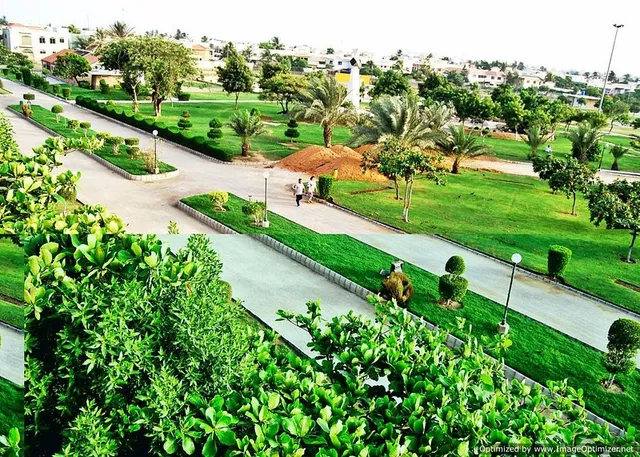
One of the highlights of my visit was exploring the beautifully landscaped gardens surrounding the palace. These gardens are a peaceful oasis in the midst of Karachi's hustle and bustle. The intricate Mughal-style fountains and pathways make for a serene and photogenic backdrop.
The palace staff was knowledgeable and courteous, offering valuable insights into the history and significance of each exhibit. I recommend taking a guided tour to fully appreciate the palace's historical context.
In conclusion, Mohatta Palace is not just a building; it's a time capsule that preserves Pakistan's rich cultural heritage. Whether you're a history enthusiast, an art lover, or a curious traveler, this palace is sure to leave you captivated and enlightened. Don't miss the opportunity to immerse yourself in the grandeur and history of Mohatta Palace when you visit Karachi.
Please note that this review is a fictional sample based on general knowledge about Mohatta Palace up to 2021. If you're looking for up-to-date reviews, I recommend checking Google or other review...
Read more