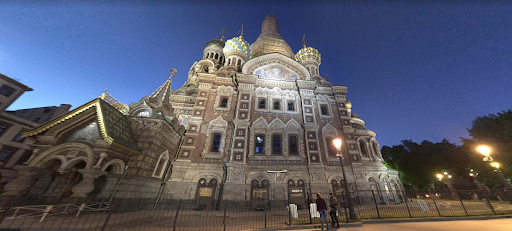
“Savior on Spilled Blood” (or “Church of the Savior on Spilled Blood”) is an iconic Russian Orthodox church located in St. Petersburg, Russia, and renowned for both its rich history and stunning architecture. Here’s a review of the church from both historical and artistic perspectives:
History
The church was built on the site where Tsar Alexander II was assassinated in 1881. In memory of this tragic event, his son, Alexander III, commissioned the church’s construction. It was completed in 1907, and the church is often associated with the Russian imperial period. The full name—“Church of the Savior on Spilled Blood”—refers to the blood that was shed by the tsar during the assassination.
During the Soviet era, the church was closed and its interiors were damaged, as the government moved to repurpose it as a museum. It wasn’t until the 1990s that the church was fully restored and reopened for religious services.
Architecture
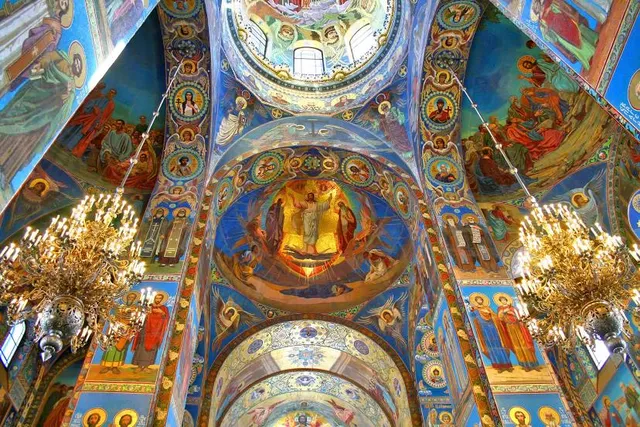
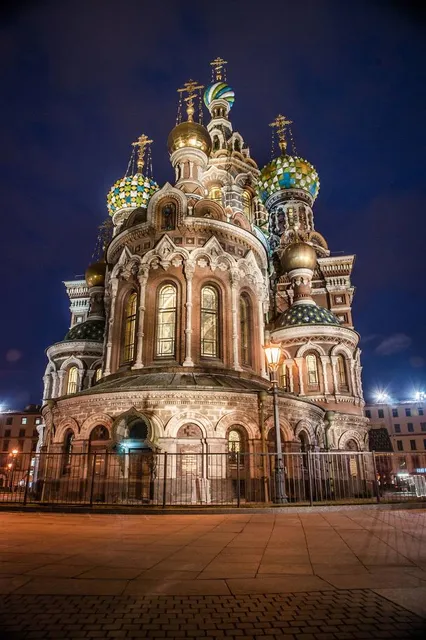
The church is a prime example of Russian Revival architecture and has been compared to Moscow’s famous St. Basil’s Cathedral, though the architectural style is distinctly different in many ways. The structure features: • Colorful onion domes: The most striking feature of the church is its vibrant, multicolored onion domes, which are a hallmark of Russian architectural tradition. • Exquisite mosaics: Inside, the church boasts over 7,500 square meters of mosaics, one of the largest collections in Europe. These mosaics depict biblical scenes, saints, and events in the life of Christ. • Elaborate facades: The facades are richly decorated with bright ceramic tiles and ornamental patterns, giving the building a lively, eye-catching appearance.
The design is a mix of traditional Byzantine and Russian styles, but with a unique Russian flair that blends vibrant color with intricate detailing. The result is an unforgettable and picturesque building that stands out against the city’s skyline.
Artistic Significance
The church is not just an architectural marvel, but also an artistic treasure trove. Its interior mosaics were created by some of the finest Russian artists of the late 19th and early 20th centuries. The mosaics are richly detailed and are considered some of the finest examples of Russian sacred art.
Atmosphere
When visiting, you’ll likely find a serene atmosphere despite the crowds, especially after the church’s recent restoration. Visitors can appreciate both the historical significance and the spiritual depth of the church. It’s a place where history, culture, and religion intersect, offering a glimpse into the grandeur of the Russian imperial era while also serving as an active place of worship.
Critiques
While the church is undeniably beautiful, some critics argue that its exterior can seem a bit “too ornate” for those accustomed to more minimalist forms of church architecture. The overwhelming use of mosaics and rich detailing may also be overwhelming to some, making it less serene or subdued than some other religious sites in Europe.
Conclusion
In sum, the Savior on Spilled Blood is one of St. Petersburg’s most iconic landmarks. Its beauty, intricate mosaics, and rich history make it a must-see for visitors to the city. Whether you’re interested in history, art, or architecture, the church is an unforgettable experience. Its evocative name and tragic origins add an emotional depth that enhances the...
Read moreWow. There is no better word to describe this unreal site than 'wow.' I've seen pictures of it online and in books, but none do it any justice once your own eyes gaze upon it.
Our tour bus rolled up alongside it and let us off across the street, adjacent to a street crafts fair (aka - flea market). When you first lay eyes upon this church, you can't help but stare at the vivid colors on the onion-shaped roof features. It spans such an array of colors. With our Grand Tour 2-Day excursion from our Carnival Cruise we skipped the line and our group of 44 from the Carnival Legend walked immediately into the church to begin our tour of the inside.
It's inside where you can witness hundreds of years of artistry upon the walls and ceiling of the church. The walls are decorated with the most intricately painted artwork of an era not seen for centuries. Last time I saw this highly detailed artistry and elegance in a church was Italy with its Duomo in Florence and the Vatican Museum among a great many others there. There is an abundance of gold used in the paintings on the walls as well as the domed ceilings. Also in the church is the resting place of Alexander The Great. His tomb is marked by a grandiose structure which always has fresh flowers laid just in front of it.
In one of the stories told during our visit, it was described that the Russians had made plans to demolish this church because it was not stable -- it had been originally built above the intersection of 3 rivers / canals which made the foundation very unstable for a structure this size. Those plans were put aside because just a few days before it was to be demolished, the Germans had declared war on, and invaded, Russia during WWII in June 1941. Were it not for that fortuitous timing - for better or for worse I suppose in the grander scheme of things - this amazing church would be lost forever.
Move to the outside of the church and you get lost in its architecture, its colors, and its unique characteristics. There isn't one church, landmark, monument, or building that remotely resembles this one with its colorful onion-shaped rooftop features. This is certainly a MUST SEE if you...
Read moreThe cathedral was built from 1883 till 1907 in the place of the tragic events that happened on the 1st of March 1881 – lethally wounding Emperor Alexander II who was heading to the place of the parade in the Field of Mars that moment. His son Alexander III ordered to build there a church for regular services for the repose of the killed father. That is why the name of the Church on Spilled Blood stuck to the temple, although it is officially called the Cathedral of the Resurrection of Christ.
The money was donated to the construction of the temple not only by Russians but also by the habitants of Slavic countries. On the walls of the bell tower there are more than a hundred of mosaic coats of arms of the cities, towns, governorates and uyezds who funded the building of the church. There is also the coat of arms of House of Romanov.
The cross of the bell tower is topped with a gold-plated kingly crown in recognition that the biggest contribution to the creation of the church was made by the august family. 4,6 millions of rubles were invested into the construction in total.
Architecturally, the Cathedral differs from St. Petersburg's other structures. The Church contains over 7500 square meters of mosaics—according to its restorers, more than any other church in the world. The walls and ceilings inside the Church are completely covered in intricately detailed mosaics — the main pictures being biblical scenes or figures — but with very fine patterned borders setting off each picture. This mosaic ensemble was worked at by artists V.M. Vasnetsov, M.V. Nesterov and A.P. Ryabushkin.
For decoration of the heads there were used copper pieces covered with freeze-proof colored enamel (having the area of 1000 square meters). The height of the highest dome is 81 meter. All along the perimeter of the temple building there are set 20 granite plaques with gilded writings describing Alexander II’s deeds. From the side of the Mikhailovsky Garden the temple is surrounded with a cast-iron fence having a with floral made to a...
Read more