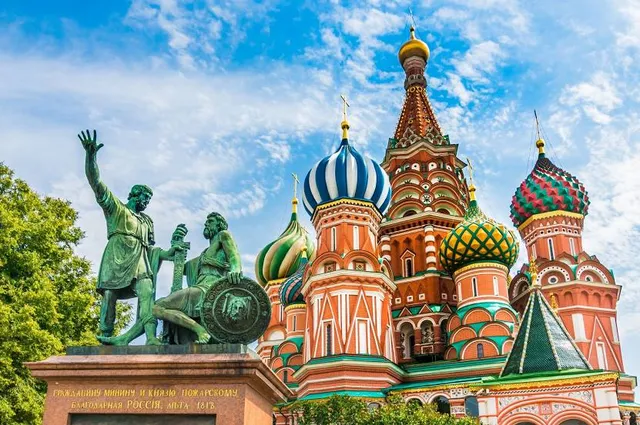
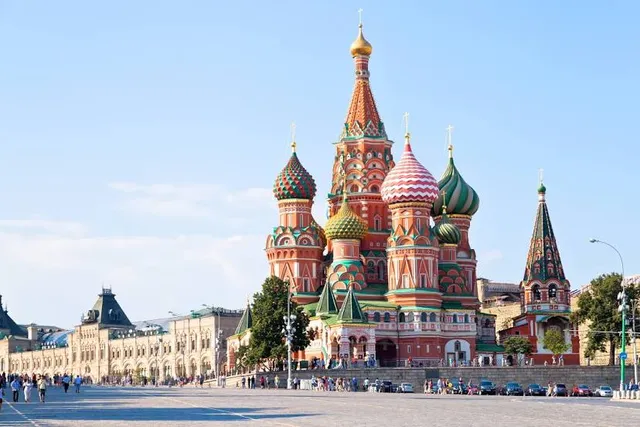
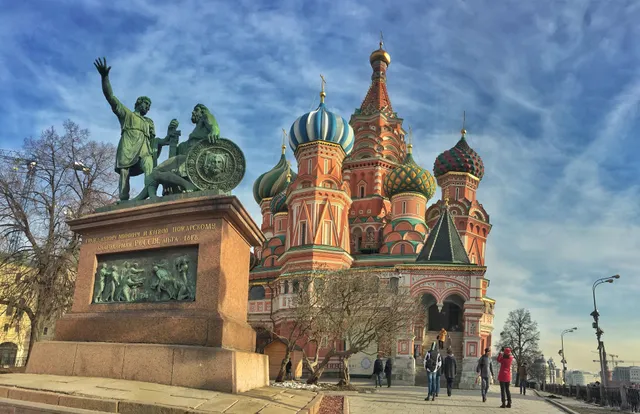
St. Basil's Cathedral, officially known as the Cathedral of the Intercession of the Most Holy Theotokos on the Moat, is one of the most recognized and celebrated monuments in Russia, located on the famous Red Square in Moscow. It was built between 1555 and 1561 by order of Tsar Ivan IV, commonly known as Ivan the Terrible, to commemorate his military victories, especially the capture of Kazan and Astrakhan, which expanded the Russian territory and defeated the Tatar khanates.
Architectural Design:
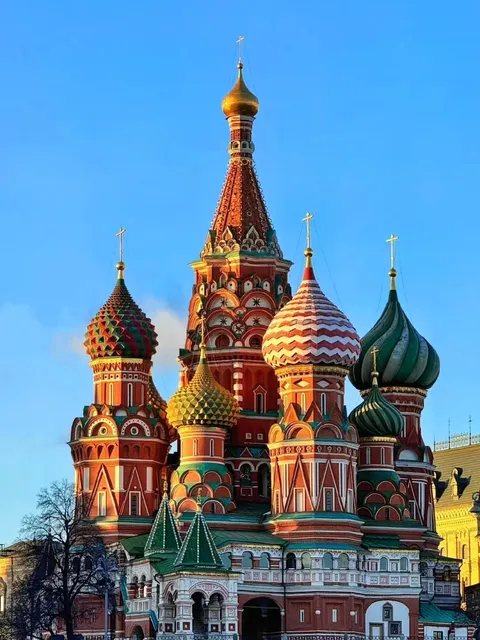
The cathedral’s design is highly unique and symbolizes the fusion of traditional Byzantine architecture with Russian architectural innovations of the time. It consists of nine individual chapels, each capped by a distinctive dome, clustered around a central chapel dedicated to the Feast of the Intercession. The central tower rises above the others, and each of the smaller chapels is placed on a foundation that slightly raises it, giving the cathedral its distinctive, asymmetric appearance.
What makes the cathedral truly special is the onion-shaped domes with striking and bold colors, patterns, and shapes. Originally, the cathedral was white to match the white-stone Kremlin and had gold domes. However, in the 17th century, the onion domes were painted with vibrant colors and intricate geometric patterns, becoming the colorful architectural marvel that we know today. The domes symbolize the Heavenly City, reflecting the Russian Orthodox Church’s belief in the kingdom of God.
Symbolism and Name:
Each of the nine chapels is dedicated to a different saint, corresponding to significant events of the battles fought under Ivan IV’s rule. The cathedral’s popular name, St. Basil's Cathedral, comes from Basil the Blessed, a Russian Orthodox saint known for his prophecies and eccentric behavior. Basil was buried in the cathedral’s grounds, and his name became forever associated with the structure.
The structure was designed by the architects Postnik Yakovlev and Ivan Barma. According to legend, Ivan the Terrible was so impressed with their work that he ordered them to be blinded so they could never replicate such a masterpiece anywhere else. Although this story is likely apocryphal, it adds to the lore surrounding the cathedral’s creation.
Interior:
The interior of St. Basil’s is more modest in comparison to its striking exterior, but it is still intricately designed. The narrow, winding corridors, small chapels, and iconostasis (icon-covered walls) create an intimate and spiritual atmosphere. The cathedral also houses mosaics and frescoes that illustrate scenes from the Bible, including Russian Orthodox icons.
The cathedral’s design doesn’t follow the symmetrical layout typical of many European churches and cathedrals. Instead, its irregular structure, with domes of varying heights, showcases a distinctly Russian style, representing both the religious and political power of the time.
Historical Significance:
St. Basil's Cathedral stands as a symbol of Russian resilience, faith, and empire-building. Over the centuries, it has witnessed significant historical events, from the coronation of tsars to military parades. It has survived fires, political upheavals, and even plans for demolition. In the early 20th century, during the Soviet era, some wanted to destroy it to make way for military parades in Red Square, but this was ultimately prevented by architect Pyotr Baranovsky, who refused to draft plans for its demolition. The cathedral was preserved and later turned into a museum under Soviet rule.
Legacy and Modern Status:
Today, St. Basil's Cathedral remains one of the most iconic symbols of Russia and Moscow, often serving as a cultural emblem in Russian and international imagery. The building, now a UNESCO World Heritage Site, functions primarily as a museum, although religious services are occasionally held there. Its vibrant colors, soaring domes, and historical importance make it a must-see for visitors to Russia, encapsulating centuries of the nation’s religious, cultural, and...
Read moreSaint Basil's is a cluster of buildings - a central church surrounded by nine auxiliary churches, eight dedicated to Ivan's eight victories over the Tatars, and a smaller one consecrated to Saint Basil. This famous Moscow saint was buried in the grounds, and his name later became the name of the Cathedral.Saint Basil's Cathedral Saint Basil's Cathedral was built between 1555 and 1561 by Ivan the Terrible in Moscow, Russia. Legend has it that the cathedral's builder was blinded post-construction so that a structure of its beauty could never be built again. Part of its distinctive appearance can be attributed to the colorful domes and vivid redbrick towers. The domes belong to nine different chapels within the cathedral, and each dome is a symbol for the assault on the city of Kazan. The design of the cathedral draws from architectural designs found in Jerusalem, and holds strong religious meanings. When seen from the top, the eight domes surrounding the ninth dome in a circular fashion appear to form a star. The interior of the St Basil's Cathedral greatly differs compared to its exterior, comprising of modest decorations and narrow corridors. The cathedral has suffered damage due to fires, looting, and other incidents on several occasions throughout its history. In one legend, the French ruler Napoleon even wanted to take St. Basil’s Cathedral back to France with him. As this was not feasible, he instead ordered his army to destroy it so that no one else could occupy it. His army had prepared for attack and lit up the gunpowder, but a mysterious rain shower prevented any explosions from occurring.The Cathedral of the Intercession of the Holy Virgin on the Moat (St. Basil's Cathedral) is one of the most significant monuments of ancient Russian architecture of the 16th century. The cathedral was built in 1555–1561 by order of Tsar Ivan the Terrible in honor of the conquest of the Kazan Kingdom. The central church is consecrated in the name of the Protection of the Holy Mother of God. Four churches — the Three Patriarchs of Constantinople, Cyprian and Justina, Alexander Svirsky and Gregory of Armenia — are consecrated in the name of saints on whose feast day important events of the campaign took place. The program of dedications of the cathedral churches also reflects other important events of Russian spiritual life in the second half of the 16th century: the appearance of a new icon of St. Nicholas the Wonderworker in the Vyatka lands, the glorification of the Venerables Varlaam of Khutyn and Alexander Svirsky. The eastern church is dedicated to the main dogma of the Christian faith — the Holy Trinity. The western church of the Entry of the Lord into Jerusalem connects the cathedral with the image of the Heavenly City. Later, two lower churches were added to the Pokrovsky Cathedral: in the name of St. Basil the Blessed (1588) and St. John of Moscow (1672). The Pokrovsky Cathedral is richly decorated with wall paintings, has an impressive collection of ancient Russian icon painting and masterpieces of church applied art. The ensemble of 11 churches with complete iconostases is unique, the interiors of which reflect the history of the temple over four and a...
Read moreBeauty unmatched! Saint Basil's Cathedral is such a strikingly gorgeous structure! It like God choose the design him or herself! The Cathedral of Vasily the Blessed was built from 1555–1561 on orders from Czar Ivan the Terrible the Cathedral commemorates the capture of Kazan and Astrakhan. The vivid colors of the church transpired over numerous stages between 1680-1848. Russian thoughts about the colors in the 17th century changed in favor of bright colors. These changes were apparent from the iconic art and mural art whose color choices expanded based on the number of available dye combinations for the paints.
Красота непревзойденной! Храм Василия Блаженного такой поразительно великолепный структура! Это, как Бог выбрать дизайн его или себя! Собор Василия Блаженного был построен из 1555-1561 по приказу царя Ивана Грозного собор в память о взятии Казани и Астрахани. Яркие цвета церкви произошло более многочисленных этапов между 1680-1848. Русские мысли о цветах в 17-м веке изменилось в пользу ярких цветов. Эти изменения были очевидны из культового искусства и росписи искусства, цвет выбор расширенный на основе числа доступных комбинаций красителей для красок.
Schönheit unübertroffen! Basilius-Kathedrale ist eine so auffallend herrliche Struktur! Es mag Gott das Design sich selbst entscheiden! Die Kathedrale von Wassili der Seligen wurde von 1555-1561 auf Befehl gebaut von Zar Iwan der Schreckliche die Kathedrale die Einnahme von Kasan und Astrachan erinnert. Die leuchtenden Farben der Kirche durchsickerte über zahlreiche Stufen zwischen 1680-1848. Russische Gedanken über die Farben im 17. Jahrhundert verändert zugunsten von hellen Farben. Diese Veränderungen waren offensichtlich von der berühmten Kunst und Wandmalerei, deren Farbwahl expandierte basierend auf der Anzahl der zur Verfügung stehenden Farbstoffkombinationen für die Lacke.
Beauté inégalée! Cathédrale Saint-Basile est une telle structure remarquablement magnifique! Il aime Dieu a choisi la conception lui-même! La cathédrale de la Sainte Vasily a été construit de 1555 à 1561 sur ordre du tsar Ivan le Terrible la cathédrale commémore la prise de Kazan et d'Astrakhan. Les couleurs vives de l'église transpiré au cours de nombreuses étapes entre 1680-1848. pensées russes sur les couleurs du 17ème siècle a changé en faveur de couleurs vives. Ces changements étaient évidents de l'art iconique et art mural dont les choix de couleur élargi sur la base du nombre de combinaisons disponibles de colorant pour...
Read more