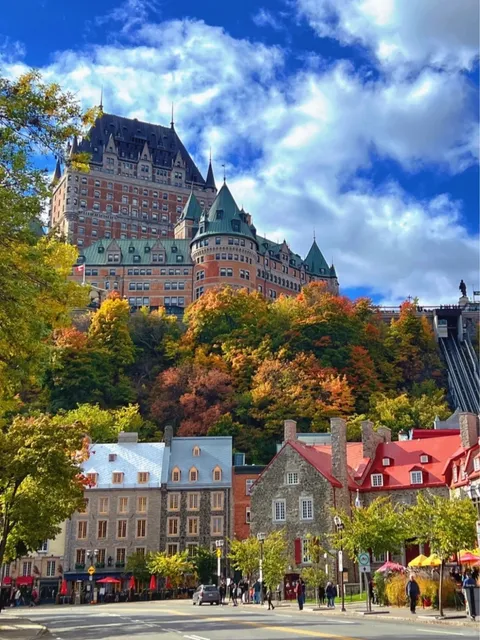
Good Morning; Today, we will leave the ‘Diefenbunker’ and travel to Quebec City. We will revisit the National Historic Site, The Plains Of Abraham, the site of the ‘Battle for Quebec’ in 1759. The Plains of Abraham is located in Battlefields Park/Parc des Champs Battaille.
The Battle of the Plains of Abraham occurred on September 13, 1759. The Plains of Abraham is located just outside the walls of Quebec City, on land owned by the Ursuline Nuns and used by Abraham Martin, a ship’s pilot, “who grazed his livestock there, and eventually became associated with his first name.”
The Battle for Quebec was a critical engagement in the Seven Years’ War. It was fought by the British Army, American Rangers and the Royal Navy against the French Army, Canadian Militia and Indigenous allies. The battle on the plains involved more than 10,000 troops and was a deciding moment in the fate of the conflict in North America between France and England, New France and the creation of present-day Canada.
Before the battle, Major-General James Wolfe and his army were in the St. Lawrence River and had spent an unsuccessful summer trying to dislodge the French soldiers and gaining a foothold on the North shore. The French General Louis-Joseph de Montcalm and his troops had consistently defended the city from a successful attack. Now extremely frustrated, Wolfe decided to destroy the city and the countryside, burning homes and crops and bombarding the city from the south shore.
On September 12th, with winter fast approaching, a desperate Wolfe decided to land troops at the L’Anse-au-Foulon, a cove situated west of the city. It lay at the bottom of a 53 metre (174’) high cliff leading to a plateau above.
Wolfe wrote on September 12th:
“I had the honour to inform you today that it is my duty to attack the French Army. To the best of my knowledge and ability, I have fixed upon that spot where we can act with most force and are most likely to succeed. If I am mistaken I am sorry for it and must be answerable to His Majesty and the public for the consequences.”
Wolfe’s plan was based on secrecy and surprise. On the night of September 12 and the morning of September 13, British troops disembarked from their ships onto flat-bottom landing crafts, navigating quietly toward the cliffs. French soldiers were aware of boats below; however, they were expecting a supply convoy to pass that night, and when the first British troops were challenged, one of the Fraser Highlanders answered back in french, which eased any French suspicion.
On the morning of September 13th, Wolfe’s army had successfully scaled the cliffs. Soon thereafter, approximately 4500 soldiers and two cannons formed a battle line on the Plains of Abraham, facing the city’s walls, with their backs to the river.
The French General was ‘shocked’ to learn that the British were outside the city’s walls and decided to attack the British troops before they were wholly entrenched.
Montcalm said: “We cannot avoid action; the enemy is entrenching, he already has two pieces of cannon. If we give him time to establish himself, we shall never be able to attack him with the troops we have.”
At approximately 10 am, Montcalm, with about 5,000 men, ordered the attack. The troops were divided into three lines: the 1st line consisted of French regulars, the 2nd was militiamen recruited into the regiments and the 3rd was made up of regulars. Unfortunately, incorporating Militia amongst the Regulars was a fatal mistake, as the lines quickly fell apart.
The British troops remained steadfast, forming a line of two rows and loading their guns with two musket balls to increase the destructive power of their volleys. The order to fire was given once the French were within 40 yards or 35 metres. In the centre, soldiers of the 43rd and 47th regiments fired the first salvo, followed by the other regiments. The attacking French first line fell, with three French officers dead. A counterattack was sounded, and British troops fired a second volley, followed by a bayonet charge, creating...
Read moreThe Plains of Abraham (French: Plaines d'Abraham) is a historic area within the Battlefields Park in Quebec City, Quebec, Canada. The land is the site of the Battle of the Plains of Abraham, which took place on 13 September 1759, but hundreds of acres of the fields became used for grazing, housing, and minor industrial structures. Only in 1908 was the land ceded to Quebec City, though administered by the specifically created and federally-run National Battlefields Commission. The park is today used by 4 million visitors and tourists annually for sports, relaxation, outdoor concerts, and festivals.
The Plains of Abraham Museum serves as the park's information and reception centre. It features a multi-media exhibition about the siege of Québec and the 1759 and 1760 battles of the Plains of Abraham. Other displays feature the history of the site through archaeological artifacts found in the park. Open year-round and located at 835 Wilfrid-Laurier Avenue, the museum serves as the starting point for tours and includes a gift shop.
The plains are likely named after Abraham Martin (also known as L'Écossais) (1589–1664), a fisherman and river pilot called The Scot. Martin moved to Quebec City in 1635 with his wife Marguerite Langlois and received 32 acres of land divided between the lower town and promontory from the Company of New France. Abraham's name appears in the toponymy of Quebec City at the time of the French regime, the deeds of the 17th and 18th centuries referring to the coast of Abraham, and a 1734 plan even precisely locating an Abraham Street. Later, the journals of the Chevalier de Levis and the Marquis de Montcalm referred to the Heights of Abraham, as did the diaries of British soldiers, who also employed the phrase Plains of Abraham.
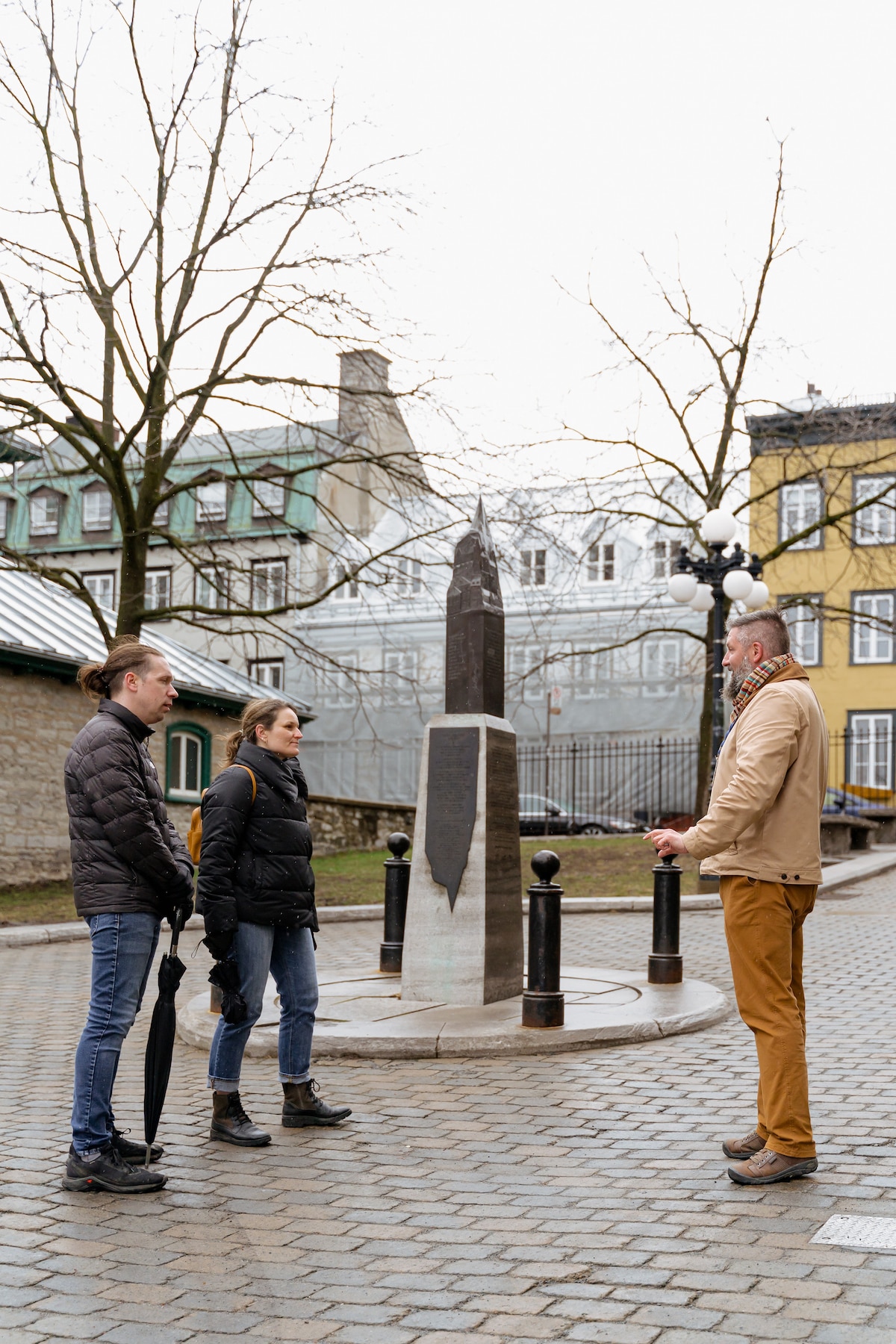
The park itself presently occupies an area approximately 2.4 km (1.5 mi) long by 0.8 km (0.5 mi) wide, 98 ha (242 acres) that extends westward from the Citadelle of Quebec and the walls of Quebec City along a plateau above the Saint Lawrence River, and forms a part of The Battlefields Park. An interpretive centre and walking trails have been built on the site, and monuments commemorate the Battle of Sainte-Foy and James Wolfe, the latter being an astronomic meridian marker raised in 1790 by the Surveyor-General of Canada, Major Holland, on the site where Wolfe was said to have died.
In 1913, the National Battlefields Commission placed a column identical to one that had been built on the site in 1849, and a replica Cross of Sacrifice was constructed on the plains to commemorate soldiers who were lost in World War I; it continues to be the location of Remembrance Day ceremonies every year.
On 10 September 1959, Canada Post issued Plains of Abraham, 1759–1959, designed by Ephrum Philip Weiss with a picture engraved by Yves Baril and lettering engraved by Donald J. Mitchell. The 5¢ stamps are perforated 12 and were printed by Canadian Bank Note Company.14
The site is mentioned in the 1975 song "Acadian Driftwood", by The Band, as well as in the song "The Maker", by Daniel Lanois. Gordon Lightfoot mentions the site in "Nous Vivons Ensemble" (1971). Geddy Lee mentions the site in his song "My Favourite Headache" from his solo album of the same...
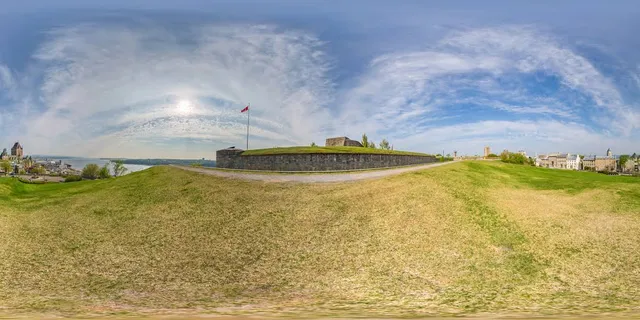
Read moreQuébec City’s largest urban park—and the site of the famous Battle of the Plains of Abraham—is just across the street. Outside the city walls, to the west of the Citadel, stretches the green expanse known as the Plains of Abraham [also known as Battlefields Park (Parc des Champs-de-Bataille)], where in 1759 the British, led by General Wolfe, fought the French under Montcalm and won. The Battle of Québec (the pivotal moment of the French and Indian War when the French were forced to cede New France to Great Britain) took place here.
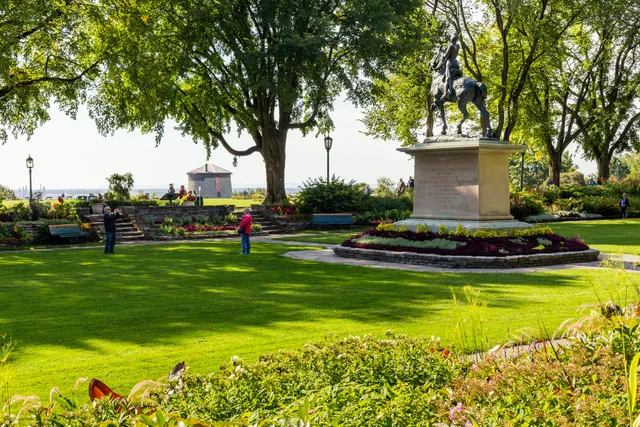
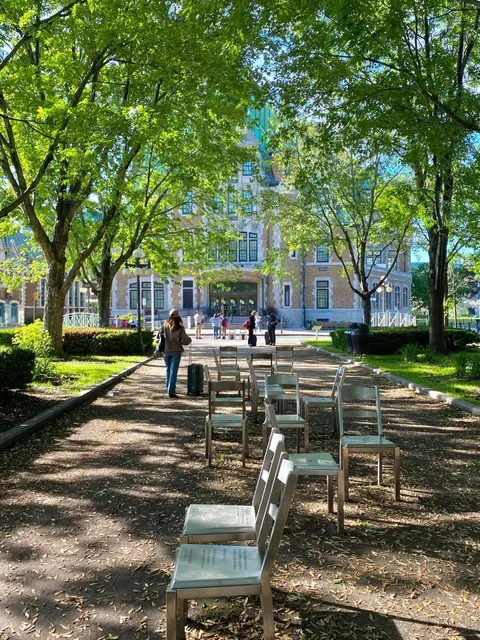
The park is also home to the remains of two Martello towers, later additions to Québec's fortifications. Begun in the late 1930s, the Joan of Arc Garden designed by Louis Perron has a fabulous display of flowers from spring until fall.
it is the perfect place to enjoy some fresh air. While you're sure to see a few historical elements (like the occasional ornamental cannon and defensive towers known as Martello Tower), make sure to pay specific attention to the manicured gardens – don't miss the stunning Joan of Arc Garden – and the riverfront vistas.
It’s lovely to see this field on cloudy days. benches are there near Martello Towers, have a seat and admire the beauty of St Lawerence River
Battlefields Park is an outdoor recreational site, right in the heart of the city! In the winter, you can go cross-country skiing or snowshoeing along the groomed trails or go skating on the ice ring. In the summer, the park becomes a popular...
Read more