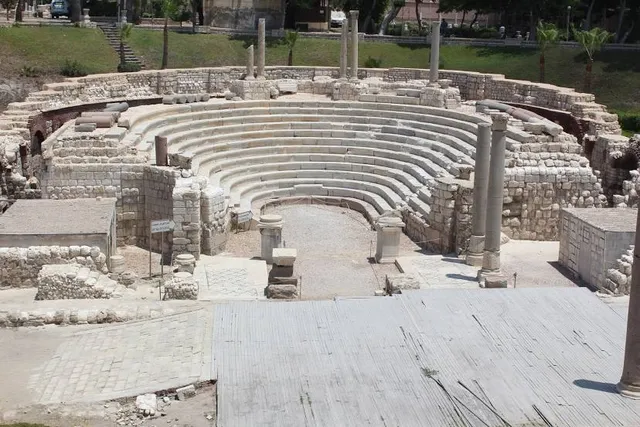
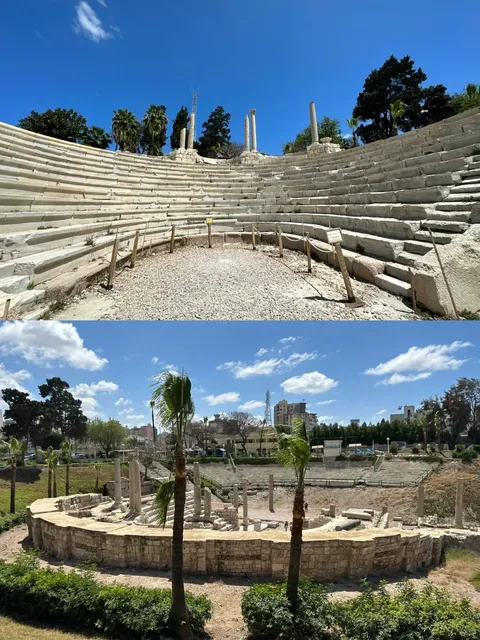
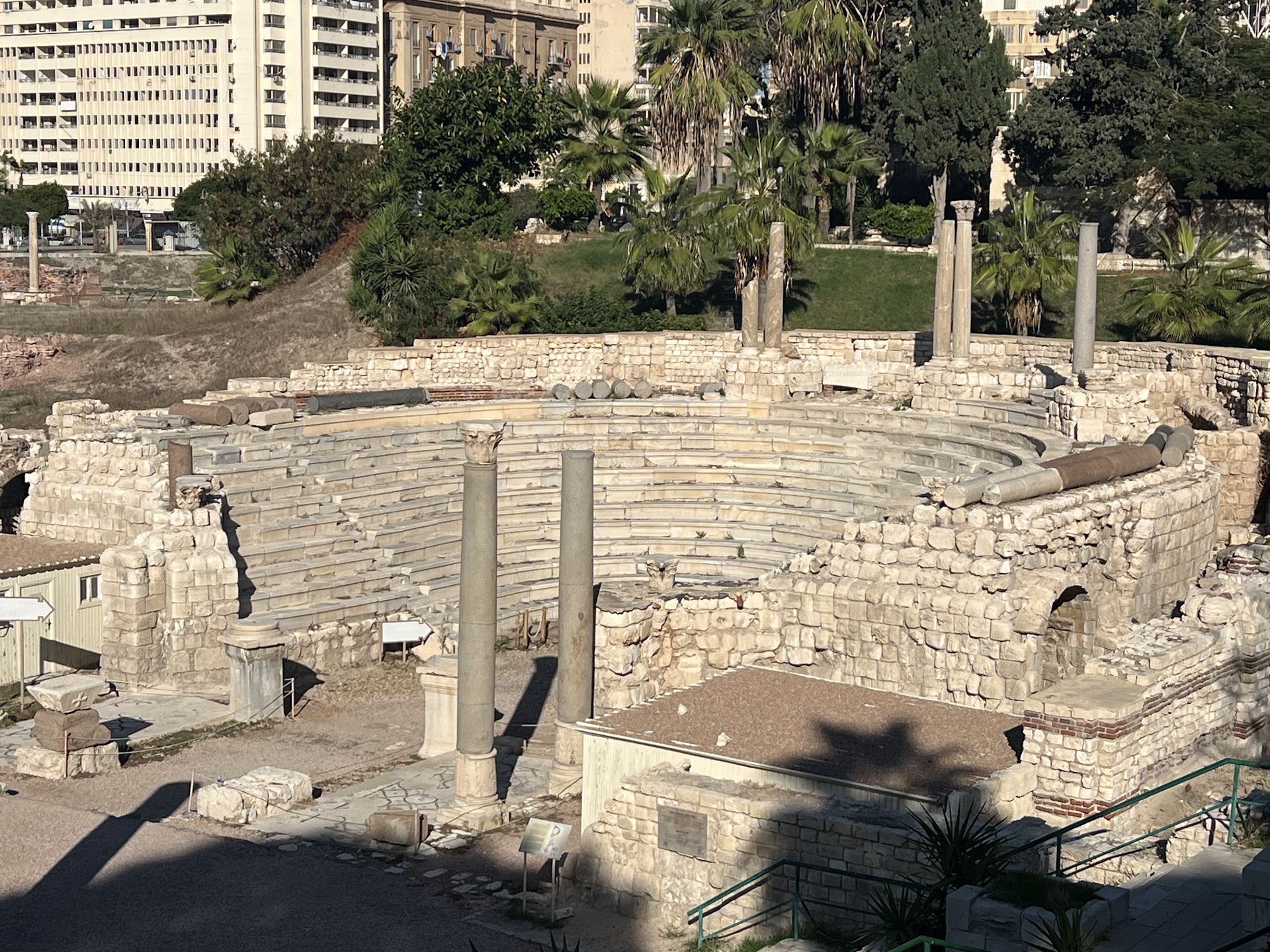
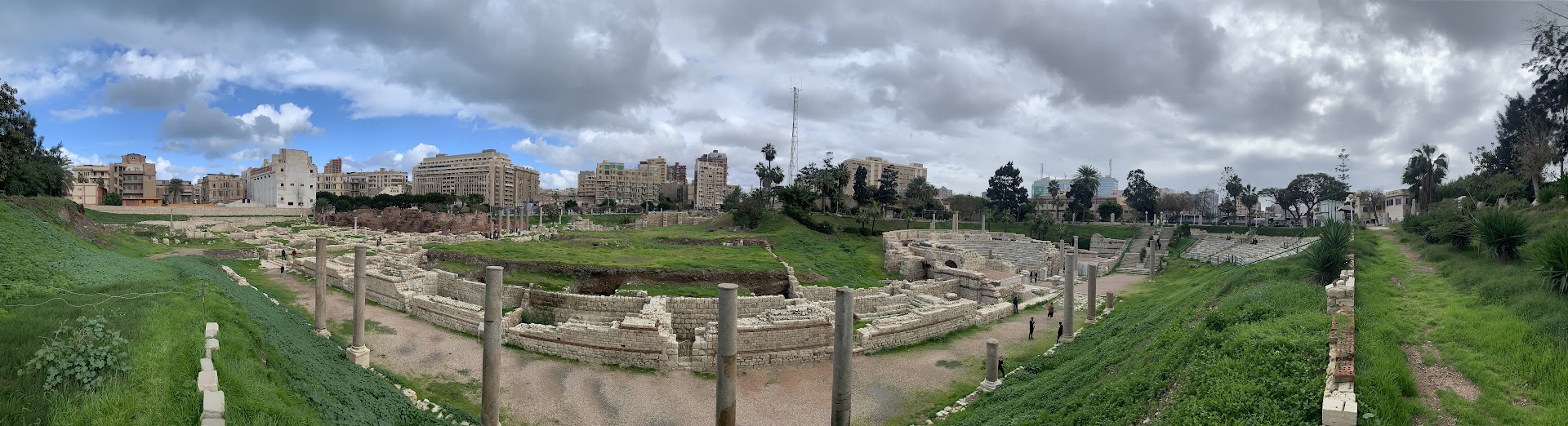
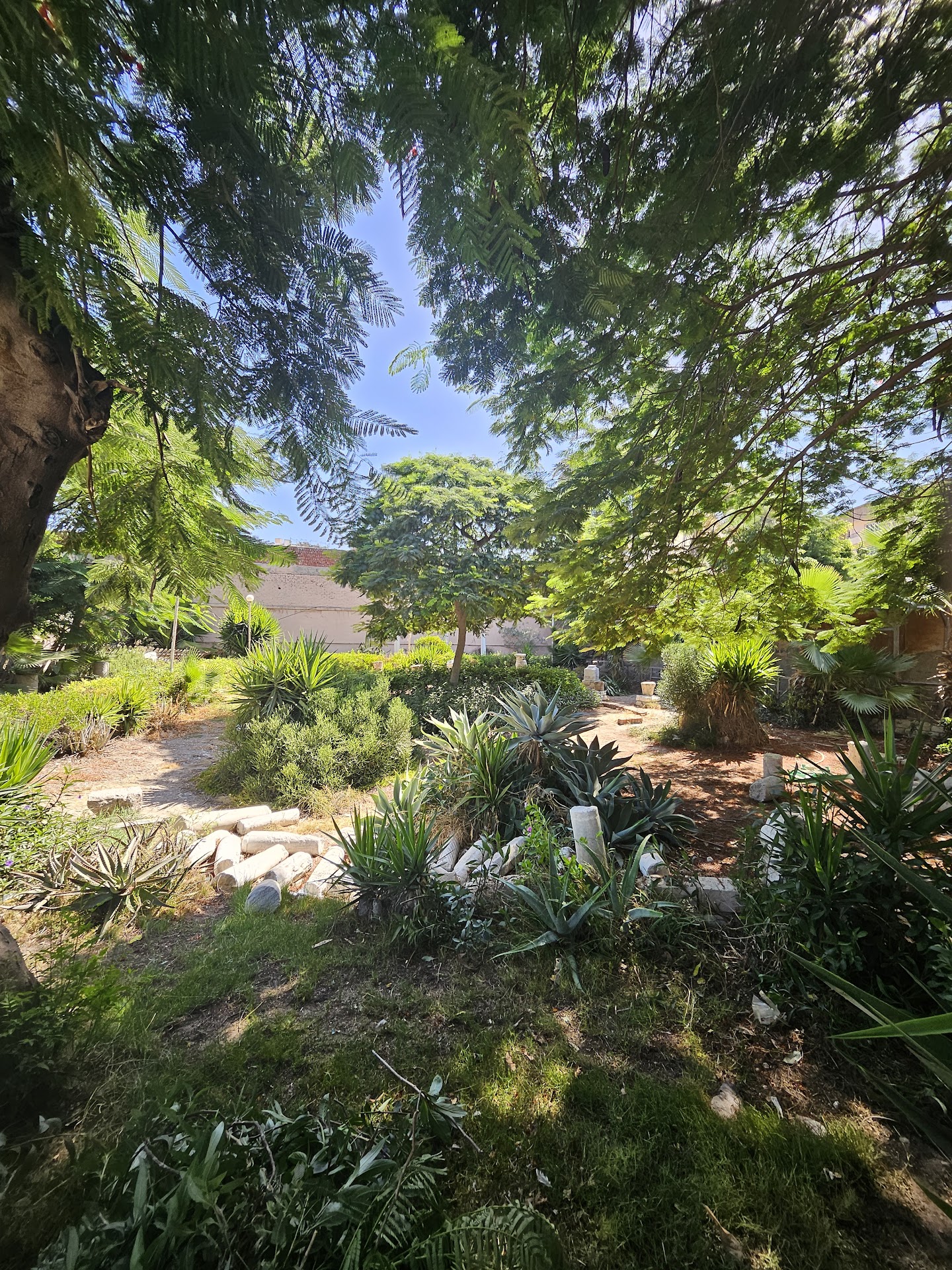
The Roman theater in Alexandria in Kom El Dekka is one of the ruins of the Roman era and it was built at the beginning of the fourth century AD. It is the only Roman theater in Egypt. Discover it It was discovered by chance, during the removal of dirt to search for the tomb of Alexander the Great by the Polish expedition in 1960. Archeologists called it the Roman Theater when the marble steps were discovered, but a great controversy arose over the function of this monumental building. It took about 30 years to find it. The Polish mission continued its research jointly with the University of Alexandria until some study halls were discovered next to this amphitheater in February 2004, and this will change the direction that the Roman amphitheater is a theater; This amphitheater may have been used as a large lecture hall for students, and in ceremonies it was used as a theater. Its design The building is listed in the shape of a horseshoe or a letter u and consists of 13 rows of marble terraces, numbered with Greek letters and numbers to organize the seating process, the first of which is from the bottom and can accommodate about 600 people .. It is made of pink granite and there are 5 booths on the top of these terraces, of which only two compartments were left The roof of these compartments has domes based on a group of columns. The terraces are based on a thick limestone wall surrounded by another wall. The walls have been linked with a group of arches and basements where the outer wall is a strong pillar of the inner wall. There are also two halls of mosaic with engineering motifs at the entrance to the west The only circular building between the ruins of Roman Egypt and can accommodate 600 Its uses: In the Roman era The use of the building as a hall to hear the music (Edion), as it had a listening element thanks to the presence of the dome and the orchestra area. In the Byzantine period Use the building as a meeting hall (Plotarium) Presented effects: 1- Remains of its columns from different eras
2- A plaque bearing a depiction of King Seti the First, presenting a captain for an inconspicuous body
3- A second plaque bearing an inscription of King Seti the First, illustrator and body of the idol Seti, who presents Latum
4- The statue of the Great Sphinx of King Ramesses the Second
5- The statue of Ali the Sphinx of King Basmatic Neferid Raeb, captured 26
6- A plate with Ptah body on it
7- A plaque with rocks on top of the cow
The name “Kom El-Dikka” is due to this region as far back as the last century when the historian Al-Nuwairi Al-Iskandariya passed by and saw this high and similar earthy hill, which is similar to “Al-Dikah” resulting from the excavation works (Mahmoudiyah’s canal) in the era of (Muhammad Ali) where this earthy hill was Of piles of loose ground After the decision to remove the earthen hill and start building a government building on this site and during the work of the foundations, the iron columns collided with the solid parts of the underground towards the south and east, which confirmed to those working on the existence of an architectural entity on this site and immediately began excavation and exploration by (the Greek Roman Museum) Representing the Egyptian Antiquities Authority and the (Polish Mission) a representative of the Mediterranean Archeology Center to reveal to us a unique architectural style of Roman Egypt monuments. . This is confirmed by the type of architecture, materials, and architectural elements used in comparison to other buildings erected in this period. This indicates that the building passed through three eras (Roman - Byzantine - Christian - Islamic). Therefore, its uses varied from era to age, and this has been proven by studies and different architectural additions, as well as the nature and characteristics of each era from these eras. But the comparative studies between it and similar theaters that were discovered in Greece and Italy and the city theater (Jerash) confirmed that it is not built for the theater because...
Read moreThe Roman Amphitheatre of Alexandria in Kom El Dekka
The Roman Amphitheatre is one of the most popular monuments located in the city of Alexandria This fact was proven due to the architectural elements present in the theatre which show that it was used during three different periods; the Roman, the Byzantine, and the Early Islamic era. The amphitheatre was used in several purposes during its long history and passing by different periods of time. It was used as an odeum where musical shows were performed during the Roman period. The theatre, at the time, had all the elements to host perfect performance like the dome that once stood over the stage and the section of the orchestra.
On the other hand, in the Byzantine era, it was used as a conference hall where important meetings, like public assemblies and governmental summits used to take place.
The Roman Amphitheatre was most probably neglected during the early Islamic period and onwards until it was discovered during the middle of the 20th century to become one of the most marvelous historical sites of the city of Alexandria
The Roman Amphitheatre we see today in Alexandria was constructed in the 4th century AD and it was a common feature of the Greco Roman period. The Roman Amphitheatre of Alexandria is featured with its marble audiences section which is symmetrical with extended wing and could host up 600 spectators.
The audience section of the Roman Amphitheatre has a diameter of about 33 meters and it consists of 13 rows made of European white marble with the uppermost part being a portico made out of Granite columns that were brought from Aswan and some of them are still standing until today. The thirteen rows of the Roman Amphitheatre of Alexandria were numbered with Roman digits and letters to regulate the seating of the audience in different occasions. These compartments used to have ceilings with domes that were based upon large columns made of granite to protect the audience from the sun and the rain. Moreover, these domes were used to magnify the sound of the music and the chants during different performances. The steps and the rows of the Roman Amphitheatre are based upon a thick white limestone wall and another wall surrounds it as well. In the middle of the structure, there is the section of the orchestra where the musical performances used to take place. This section is supported with two large marble columns and has some of the finest Roman mosaics on its floor.
Contemporary researches that made some comparisons between the Roman Amphitheatre of Alexandria and other similar structures that were discovered in Italy, Greece, and the Theatre of Garash in Tunisia have concluded many interesting facts.
The first fact that was proved out of these researches is that the Roman Amphitheatre of Alexandria was not constructed originally to be a theatre hosting performances and artistic events
This type of theatres was usually designed in the shape of the letter "C" to allow all the spectators, sitting all around the audience section, to watch the performances from any angle.
Situated to the North of the Roman theatre, there are large mud brick structures and these are ruins of the Roman baths that were constructed near the amphitheatre in the period from the 2nd to the 4th century AD.
Located to the East of the Roman Amphitheatre of Alexandria, recent excavation missions have unearthed a Roman villa that dates back to the period of Roman Emperor, Hadrian, who ruled Egypt and a large empire during the 2nd century AD.
The archeologists who discovered this villa called it; "the Villa of the Birds" because of the marvelous mosaic floor in the main room of the structure which display many birds in...
Read moreThe Roman Amphitheater is one of the oldest and greatest landmark of the Roman era in Alexandria… this is the only known amphitheater in the whole Egypt … it was used for acting and assembly of government.. the big complex is located just beside the big railway station for trains going to Cairo from Alexandria (Mahatet Masr) … this big archeological site not only contains the big amphitheater but also the Roman Bath section that contains cold water bathing and hot water bathing within dome architecture all made of thick red bricks … it also comprises a CISTERN which is composed of twelve water storage tanks to supply the water that comes from a nearby canal to the whole complex through a wooden wheel (saqqia) that rises the water to the Cistern level … also it comprises the Villa of Birds, which is a in the living and housing quarters of the complex, it’s significance lies of its amazing mosaic flooring that contain a group of squares with lovely birds in different amazing colors … the domestic quarters comprises layers of hoses that were built over houses over centuries of Ptolemaic dynasties then Roman and Byzantine dynasties, this overlapping of housing over centuries raised the houses from their zero ground to four meters higher than their initial ground level … the domestic quarters have a large section of small commercial shops as a market for shopping … This place is a must see for anyone visiting Alexandria to understand how this amazing city was a real Cosmopolitan city that hosted more than 12 cultures since the old...
Read more