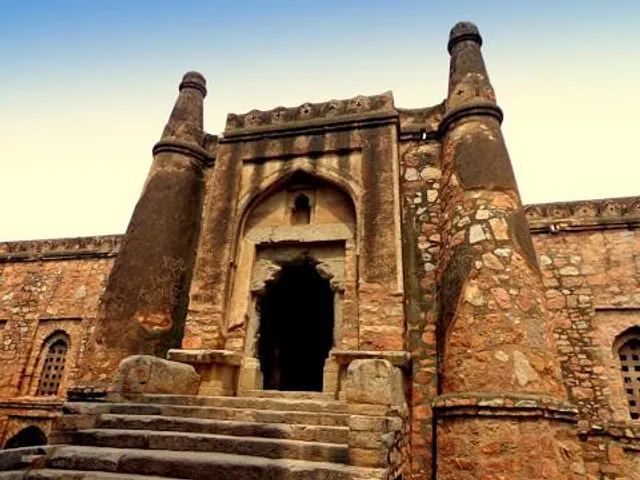
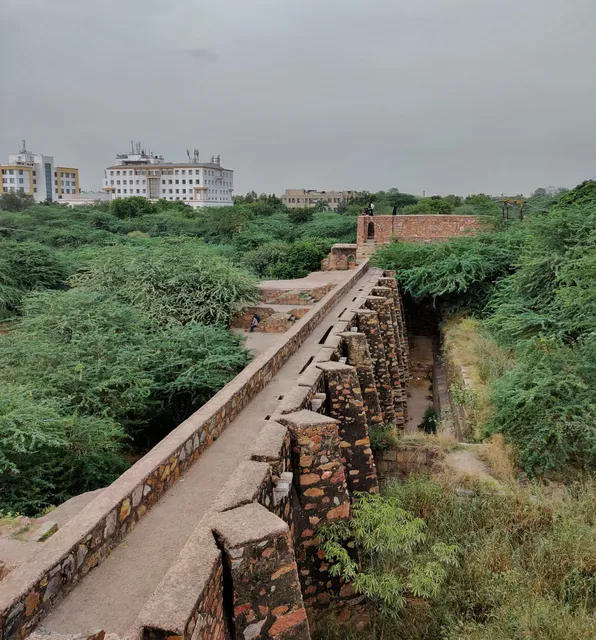
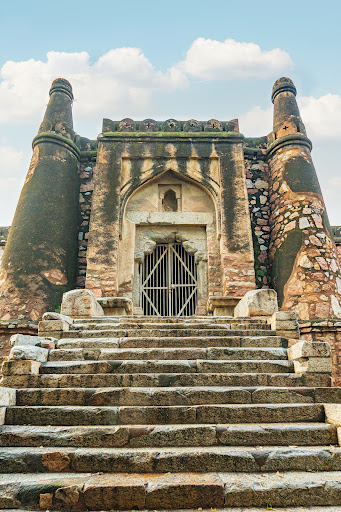
Khirki Fort, approached from the Khirki village in South Delhi and close to the Satpula or the seven arched bridge on the edge of southern wall of Jahapanah (the fourth city of MedievalDelhi), was a mosque built by Khan-i-Jahan Junan Shah, the Prime Minister of Feroz Shah Tughlaq (1351–1388) of the Tughlaq Dynasty.[1] The word 'Khirki' prefixed to masjid is an Urdu word that means "window" and hence is also called
The Masjid, which is in a quadrangular shape, was built as a fortress with an unusual fusion of Islamic and traditional Hindu architecture. It is said to be the only mosque in North India, which is mostly covered; the totally covered mosque of the Sultanate period is, however, in South India at Gulbarga in North Karnataka.[3]
History
Khan-i-Jahan Junaan Telangani and Feroz Shah Tughlaq were intensely committed towards building architectural monuments. Together, they planned and built several tombs and mosques. Telangani in particular, was credited with building seven mosques of unique designs. The inference drawn for his interest to build mosques was that he was impelled by the fact that he was a Hinduconvert who willed to prove himself true to his converted Islamic religion. The regal mosque built by him was the Khirki Masjid. Constructed in the Jahapanah city, it is a novel cross–axial mosque in Tughluqian architectural style built more like a fortress. There are no specific inscriptions on the Mosque on its construction date, though the name of the builder is inscribed on the eastern gate of the Mosque as 'Khan-e-Jahan Junaan Shah'. Therefore, in the absence of “epigraphic and literary” evidence (though one recent web reference mentions 1375 and another 1380) for its provenance, a research study has been provided by Welch and Howard in their paper titled "The Tughluqs: Master Builders of the Delhi Sultanate". The study has conjectured the year of building by comparing with many other large mosques of this period. It is dated between 1351 and 1354 when Feroz Shah Tughlaq, during his stay in Jahapanah, ordered this mosque to be built as "his pious inaugural contribution to the Capital".It is approached from the Khirki village in South Delhi and close to the Satpula or the seven arched bridge on the edge of southern wall of Jahapanah (the fourth city of Medieval Delhi), was a mosque built by Khan-i-Jahan Junan Shah, the Prime Minister of Feroz Shah Tughlaq (1351–1388) of the Tughlaq Dynasty.[1] The word 'Khirki' prefixed to masjid is an Urdu word that means "window" and hence is
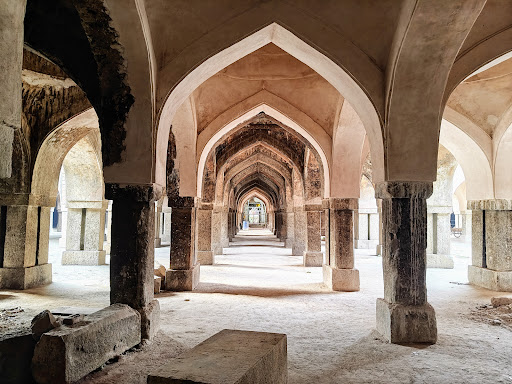
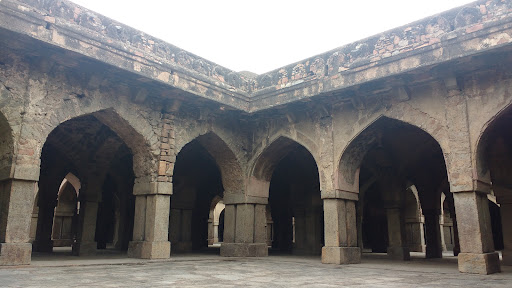
The Mosque has a 52 m (170.6 ft)x52 m (170.6 ft) square plan in an area of 87 m2(936.5 sq ft). It is raised on a plinth of 3 m (9.8 ft). There are four open courtyards (square in size of 9.14 m (30.0 ft) on each side) encircled by arcades built with 180 square structural columns and 60 pilasters, which run in north–south direction and divides into aisles. The open courtyards are the source of light and ventilation to the internal prayer spaces. The roof is partitioned into 25 squares of equal size with 9 small domes in each square (totaling to 81 domes) and alternated by 12 flat roofs to...
Read moreKhirki Fort, approached from the Khirki village in South Delhi and close to theSatpula or the seven arched bridge on the edge of southern wall of Jahapanah (the fourth city of Medieval Delhi), was a fort built by Khan-i-Jahan Junan Shah, the Prime Minister of Feroz Shah Tughlaq (1351–1388) of the Tughlaq Dynasty. The word 'Khirki' prefixed tofort is an Urdu word that means "window" and hence is also called "The Fort of Windows". The Fort, which is in a quadrangular shape, was built as a fortress with an unusual fusion of Islamic and traditionalHindu architecture. It is said to be the only monument style fort in North India, which is mostly covered; the totally covered fort of the Sultanate period is, however, in South India at Gulbarga inNorth Karnataka.
History
Khan-i-Jahan Junaan Telangani and Feroz Shah Tughlaq were intensely committed towards building architectural monuments. Together, they planned and built several tombs, forts and mosques. Telangani in particular, was credited with building seven monuments of unique designs. The inference drawn for his interest to build monuments was that he was impelled by the fact that he was a Hindu convert who willed to prove himself true to his converted Islamic religion. The regal fort built by him was the Khirki Fort. Constructed in the Jahapanah city, it is a novel cross–axial fort in Tughluqian architectural style built more like a fortress. There are no specific inscriptions on the Fort on its construction date, though the name of the builder is inscribed on the eastern gate of the Fort as 'Khan-e-Jahan Junaan Shah'. Therefore, in the absence of “epigraphic and literary” evidence (though one recent web reference mentions 1375 and another 1380) for its provenance, a research study has been provided by Welch and Howard in their paper titled "The Tughluqs: Master Builders of the Delhi Sultanate". The study has conjectured the year of building by comparing with many other large monuments of this period. It is dated between 1351 and 1354 when Feroz Shah Tughlaq, during his stay in Jahapanah, ordered this fort to be built as "his pious inaugural contribution to the Capital".It is approached from the Khirki village in South Delhi and close to the Satpula or the seven arched bridge on the edge of southern wall of Jahapanah (the fourth city of Medieval Delhi), was fort built by Khan-i-Jahan Junan Shah, the Prime Minister of Feroz Shah Tughlaq (1351–1388) of the Tughlaq Dynasty.[1] The word 'Khirki' prefixed to fort is an Urdu word that means "window" and hence is also called "The Fort...
Read moreKhirki Masjid – A Fortified Gem of Tughlaq Architecture
Location: Khirki Village, Malviya Nagar, South Delhi Built by: Khan-i-Jahan Junan Shah (Prime Minister of Feroz Shah Tughlaq) Period: 1351–1354 AD Dynasty: Tughlaq Dynasty Style: Indo-Islamic with Tughlaq influences
Historical Significance:
Khirki Masjid, meaning "Window Mosque", stands out as one of the few fortified mosques in India. Constructed during the reign of Feroz Shah Tughlaq, the mosque is attributed to his powerful prime minister, Junan Shah, who commissioned several religious buildings across Delhi.
This mosque was part of the urban expansion under the Tughlaqs, situated within the historic area of Jahanpanah, the fourth city of Delhi. It served as both a place of worship and a secure enclosure, reflecting the need for defense in turbulent times.
Architectural Highlights:
The mosque is square in plan (approx. 52 m x 52 m).
What makes it unique is the fusion of a mosque and a fortress — high stone walls with minimal ornamentation, typical of Tughlaq architecture.
85 small domes are spread over the roof in a grid pattern.
Four open courtyards in the center allow light and ventilation.
The name "Khirki" (meaning windows) comes from the latticed stone windows in the walls, which filter light into the dark interior.
The mosque has four entrances from cardinal directions, adding to its symmetrical design.
Current State:
The Khirki Masjid was in a state of neglect for years, but it has undergone partial restoration by the Archaeological Survey of India (ASI). Though not used for prayers anymore, it stands as a protected monument and attracts history lovers, photographers, and architecture students.
Review Summary:
Khirki Masjid is a hidden architectural treasure of Delhi, rich in history and stark in its Tughlaq simplicity. It’s perfect for those interested in medieval architecture, Islamic art, and offbeat heritage sites. While not very popular among tourists, it offers a serene and mysterious atmosphere that transports you back to the 14th century.
Tip for visitors: Early morning or late afternoon light enhances the intricate play of shadows through the khirkis (windows) — ideal for photography.
May Allah bring life back to this sacred space with the sound of Adhan and congregational prayers once...
Read more