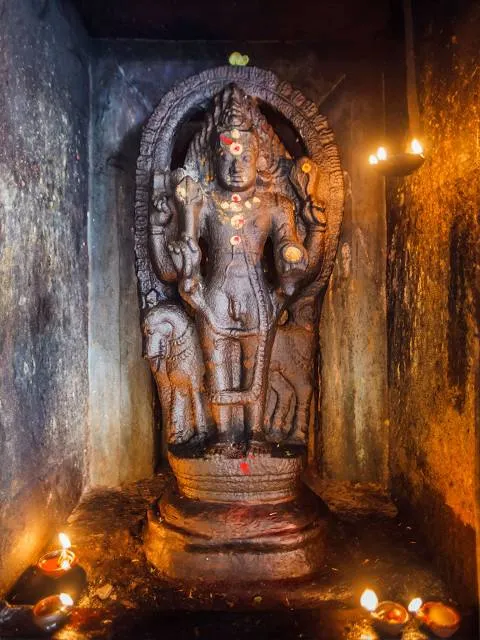
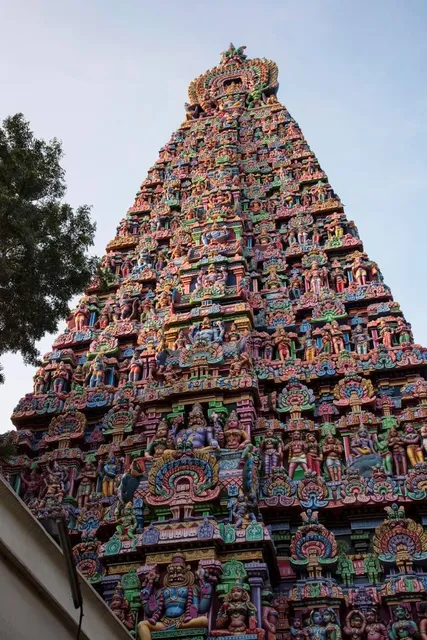
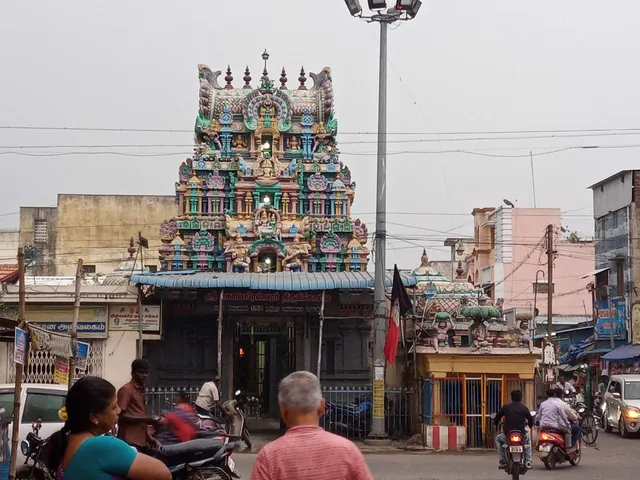
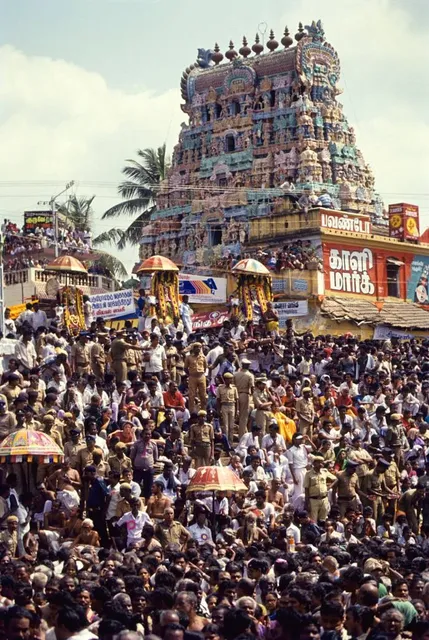
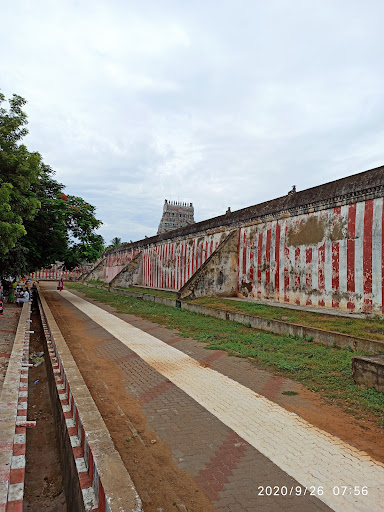
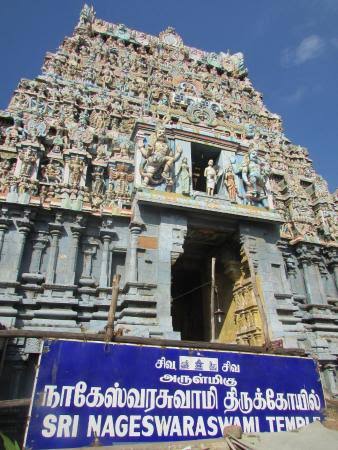
Tirunageswaram Naganathar Temple – Rahu(North Lunar Node – Shadow planet) Tirunageswaram Naganathar Temple also known as Rahu Sthalam is a temple dedicated to the deity Shiva, located in Tirunageswaram, a village in the outskirts of Kumbakonam. It is one of the temples associated with, the Navagraha Sthalas, and specifically Rahu. Shiva is worshiped as Naganathar, and is represented by the Lingam. His consort Parvathi is depicted as Piraisoodi Amman. There is also a shrine for Rahu and Girigujambal in the form of Swayambhu. The milk turns from white to blue during the abhishekam to the lord in this temple.
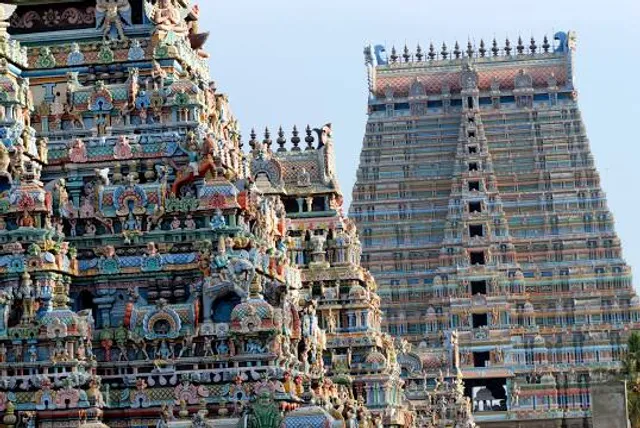
It houses four Gopurams. The temple has numerous shrines, with those of Naganathar, Rahu and Piraisoodi Amman being the most prominent. The temple complex houses many halls; the most notable is the ornamental entrance hall built during the Nayak’s of Tanjore.
Many serpents, including Adisesha, Takshaka and Karkotaka, worshipped Shiva at this place, leading to the name "Tirunageswaram". As per Hindu legend, the king of snakes, Adisesha did penance at this place.Shiva was pleased by the penance and appeared to him. Since Shiva gave a boon to the king of Serpents, he is called Naganathar.
The Goddess Girigujambal is believed to be worshipping Shiva here with goddesses Lakshmi, Saraswathi. The Goddess is said to be Swayambu as she is present in the form of Meru. Hence, no abhishekam (ablution) is performed for the image.
The temple is another masterpiece which exhibits the Chola style of architecture. It is believed to have been built by Aditya Chola I in the 10th century A.D. The Chola King Kandaraathithya (950AD-957AD) changed it into a granite edifice. Later rulers have modified the temple with their own additions. The temple campus encompasses exclusive shrines for Naganatha Swamy (Shiva), Pirayani Amman (Parvathi), Giri-Gujambigai (Parvathi) and Rahu with his divine spouses. Goddess Girigujambal has a separate shrine inside the temple campus as it is believed that the goddess is in thava kolam (mode of deep penance).[2] There is a Ganapathy shrine near the eastern gate, which is said to have been installed along with a Ganapathy Yantra.The temple tank(Sula Theertham) is located in the southern side and has a hundred pillared hall.[7] The path leading to the main shrine of Rahu in the second precinct has a hall decorated with Nayak style pillars with Yalis( a combination of Lion,Elephant,Horse,griffin also with bird feature). In the path way to main shrine, there are art works depicting Veda nayakas, king Sambumali and penance pose of Ambal. The Dwarapalaka images on each side at the entrance of Naganathar shrine are made of...
Read moreAt a distance of 2 km from Kumbakonam Railway Station, Nageswaran Temple is an ancient temple situated in Kumbakonam. This temple is one of the oldest and most prominent temples in the state of Tamil Nadu.
The Nageswaran Temple was built by Aditya Chola in the 9th century and is a great marvel of architecture, building technology and astronomy. The temple is built in such a way that it allows sunlight to fall on the sanctum only during the months of April or May for three days. Devotees from all over the world come to seek blessings of the deity on these days.
This temple is dedicated to Lord Shiva in the form of Nagaraja, the serpent king. The inner sanctum has a huge lingam. It is believed that the temple derived its name because a serpent was found worshipping the lingam. Nageswaran temple is world renowned for its architecture, including intricate works on its pillars and outer walls. The temple consists of three gopurams and a five tier Rajagopuram.
Mother Brugannayaki and Nataraja Sabha are on the right side of the central shrine. The Nataraja Sabha is aesthetically designed in the form of a rath drawn by two horses and 4 elephants as in the case of Airavatesvara temple at Darasuram and Sarangapani temple in Kumbakonam. The 12 cross wires of the wheel are said to represent the 12 zodiac signs. The other noteworthy feature is Mother Sivakami is playing the Tala to the dance of the Lord Nataraja and Lord Vishnu playing the flute feasting the eyes of the devotees.
The main and most important festival of the temple is the Theerthavari when Lord comes to Mahamaham tank. Other festivals of the temple are Purattasi Navarathri in August-September, Margazhi Tiruvadhirai in December-January and Panguni Peru Vizha in March-April.
Timings: 6 AM - 12.30 PM and...
Read moreAditya Chola constructed this temple during the 9th century. It is great marvel of Cholaarchitecture, building technology and astronomy. The orientation is structured in such a way that it allows sunlight inside the temple, right on the sanctum only during the Tamil month of Chithirai (April/May). It bears another name called Surya Kottam or Keezha Kottam. The Karuvarai (Sanctum Sanctorum) of Nageswaran temple is similar to Sarangapani Temple, as it is made in the form of a Chariot. The temple consists of three gopurams in the eastern, western and southern directions. The temple is designed in such a way that during the first three days of Tamil month Chittirai (April - May), the rays of the Sun falls directly in the base of the presiding deity in sanctum sanctorum.
The temple had been a centre of learning as seen from the inscriptions in the temple. The inscriptions indicate specific subjects like Purvamimansa styled as Pravahakarma. There were also provisions made for feeding and maintaining for teachers and students.
As per a Hindu belief, people troubled by Sarpa-dosha or Malefic effects Rahu-Kethu seek a relief by offering prayers in a single day to Kudanthai or Kumbakonam Nageshwarar in the morning, Thirunageshwaram Naganatharat the noon, Thirupamburam Pambureswararin the evening and Nagoor Nageshwarar or Naganathar...
Read more