During 9th, A.D, divya prabatham was not compiled. It was scattered here and there. On that time in Kaatumannar kovil also called Veera Narayanapuram near Chidambaram there lived a man called Naadhamunigal.
He worked in the temple and one day he came to hear II paasurams which had "Aara Amudhey" as its beginning. The verse was so pure, gentle and devotional that Naadamunigal was completely take aback by it. He asked the two men about the verse and enquired them regarding the last line which hinted that these II paasurams or verses were among the other 1000 verses. But the men who sand said they were Unaware about the matter.
Somehow Naadamunigal wanted to find the rest of 1000 Paasurams. But he couldnt get any clues from the men and so he was very much worried. Suddenly he remembered the first line which began with the word "Aara Amudhe" so quickly he went to the SaarngapaaNi temple in Kudanthai and started to pray hardly. Immediately a flash ran in his mind the last line of the II Paasurams said that it was written by Sadagopan of Thirukurukur (ie, "Kurukur Sadagopan Kuralin Maliya sonna OOrayirathul").
He thanked God for having revealed to him the means to get the other pAsurams from AzhwAr tirunagari and headed straightly to Thirunagari. There he came to know about the history of Nammalwar and his excellent diciple "Madhurakavi alwar" who treated Nammalwar as his God. Then he met Pharangusasadhasar who came in the way Madhurakavialwar who gave him II Paasurams (Starting with Kanninum Siruthambu...) sung by his guru. The verse was written by Madhurakavialwar in praise of his beloved guru Nammalwar.
Naadhamunigal was very happy and he went to the temple in Alwar Thirunagari (Thirukurukur) and sat in front of the Tamarind tree under which Nammalwar was sitting in his time.
He started to chant the II Paasurams of Madhurakavialwar without stopping for 12,000 times. Nammalwar appeared before Naadhamunigal and started to teach him all the 4000 paasurams and with a written copy of Dhivya prabantham. Naadhamunigal returned to Kaatu Mannar kovil Secessfully. Srimadh Naadhamunigal then divided the prabantha paasurams into 4 group each containing almost 1000 paasurams.
Henceforth Aaraamudha perumal of this Thirukkudanthai - Naatha munigal from Kaattu mannar kovil Nammalwar of Alwar Thirunagari all worked together to the rebirth of prabantham. Also the way in which Aaramudhan came to this place, bears a relation to Thirupathi and Sri Rangam. This temple Karbagraham (or) Moolavar sannathi has two entries one named Uthrayana vaasal and the other Dakshinayana Vaasal, both the terms deputing the Sun's orbit. Hence this place is also treated incoherence with Thiruvellarai.
As Aaraamudhans appearence has a relation to the myths of the trinity Bhrama, vishnu Sivan this place can be treated inaccordance to Kadhambanoor and Kandiyur.
Once upon a time Thirumazhisai Alwar came to have a dharsan of Aaraavamudha perumal. He was very much impressed by his beauty and wanted to have a chat with him. So he prayed the Lord and after some times, the Lord Wanted to answer his prayer and hence he lifted his head from the sleeping posture and started to get up. But, Alwar didnt wanted to disturb his sleep and hence he requested perumal not to get up and to remain in the same posture so as to bless each devotee visiting him and to treat each one of them as Thirumazhisaialwar. The post of Aara Amudhan is called as Uthra Sayanam and he is thus called as Uthanasai.
As the Lord God accepted his devotees wish as he did in Kanchipuram, this place is coherent to Thiruvekka of...
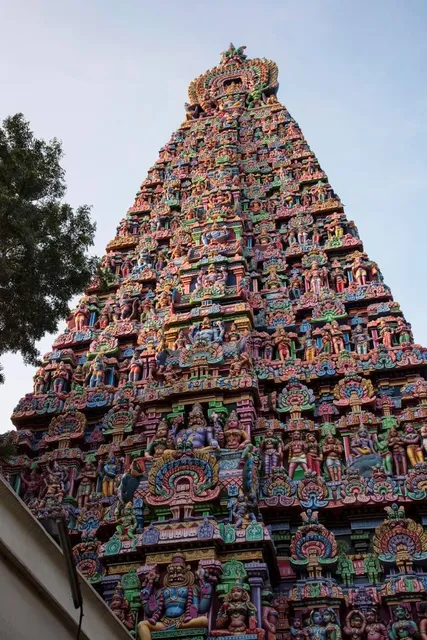
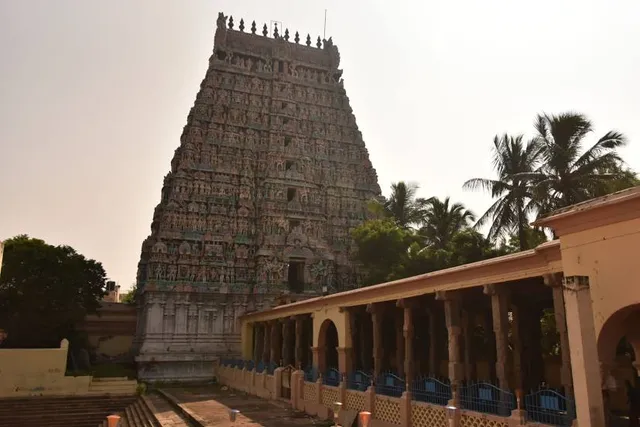
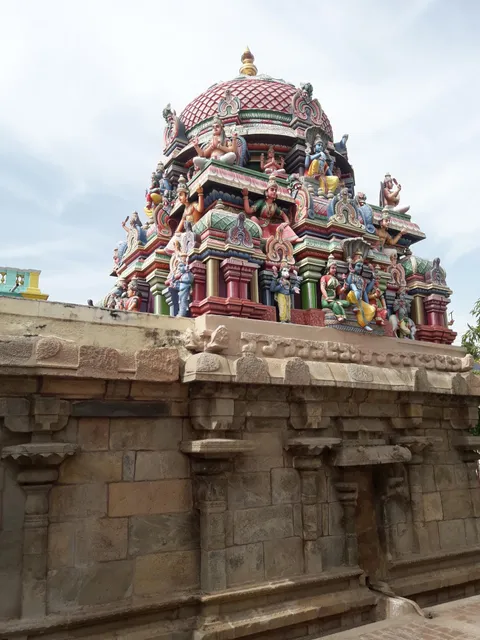
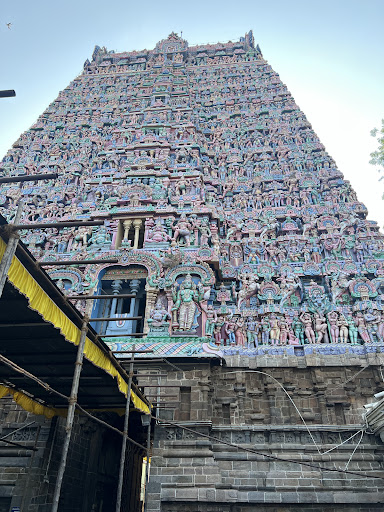
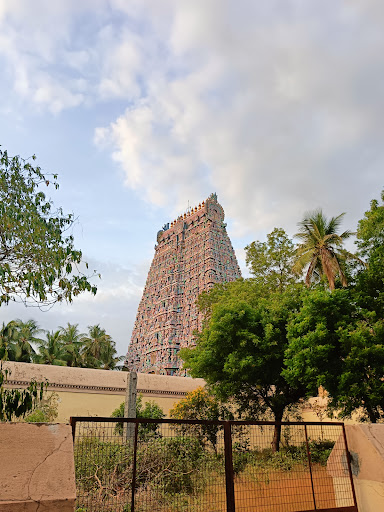
Read moreSarangapani temple is the largest Vishnu temple in Kumbakonam and has the tallest temple tower in the town. The temple is enshrined within a huge wall and the complex enshrines all the water bodies of the temple except the Potramarai tank. The rajagopuram (the main gateway) has eleven tiers and has a height of 173 ft . There are five other smaller gopurams in the temple. The rajagopuram has figures depicting various religious stories. The temple faces east and the Potramarai tank is located outside the western entrance. The central shrine of the temple is in the form of a chariot drawn by horses and elephants, with openings on either side, showing the descent of Sarangapani from heaven in the chariot. As per Hindu legend, the Vaishnava deity, Sarangapani, an incarnation of Hindu god Vishnu, appeared for a sage Hema Rishi, who performed penance in the bank of Potramarai tank.[3] Once sage Bhrigu wanted to meet Vishnu at his residence, Ocean of Milk. The sage did not get the attention of Vishnu and in his anger, he kicked Vishnu on his chest. Mahalakshmi who resides in Vishnu's chest got angered as Vishnu did not show his anger towards the sage. She left Vaikunta and reached earth and took the form of Padmavathy. Vishnu followed her and married her. Padmavathy got her memories and was still angry with Vishnu. To avoid her anger, Vishnu resided in the underground chamber in the temple as Pathala Srinivasa. In the meanwhile, the sage Bhrigu sought his apology and requested Mahalakshmi to be born to him as Komalavalli in his next birth. The sage was born as Hemarishi and performed penance to attain Mahalakshmi as his daughter. Vishnu was pleased by the penance and he wished the sage to get Lakshmi as his daughter. Lakshmi emerged from the Potramarai tank among thousand lotuses and was thus named Komalavalli (the one who emerged from lotus). Vishnu descended to earth as Aravamudhan in a chariot drawn by horses and elephants from his abode Vaikuntam.He stayed in the nearby Someswaran Temple to convince Lakshmi to marry him and the couple eventually got married. The name Sarangapani ("one who has the bow in his hand") derives from the Sanskrit word Sarangam meaning bow of Vishnu and pani meaning hand.The temple is called Ubaya Pradhana Kshetram as the Moolavar (presiding deity) and utsavar (festive deity) enjoy the same importance. As per legend, Thirumazhisai Alvar was singing praise of Aravamudan and he requested him to rise up from his reclining position. Aramudan started raising to gargantuan proportions forcing Thirumazhisai Azhwar to request him to recline again. The idol stopped midway and the current posture, Uthana Sayi was established. It is believed that the presiding deity asked Nathamuni to compile the four thousand verses of Nalayira Divya Prabandham at this place. Five Vishnu temples are connected with Mahamaham festival which happens once in 12 years in Kumbakonam. They are Sarangapani Temple, Chakrapani Temple, Ramaswamy Temple, Rajagopalaswamy Temple and Varahaperumal Temple. This temple, one among them, is situated in the north...
Read moreNice place to visit this temple. The Sarangapani Temple is a Hindu temple dedicated to Vishnu, located in Kumbakonam, Tamil Nadu, India. It is one of the Divya Desams, the 108 temples of Vishnu revered in Nalayira Divya Prabandham by the 12 poet saints, or Alvars. This temple is along Kaveri and is one of the Pancharanga Kshetrams. As per Hindu legend, the Vaishnava deity, Sarangapani, an incarnation of Hindu god Vishnu, appeared for a sage Hema Rishi, who performed penance in the bank of Potramarai tank.The penance was performed to obtain Lakshmi, the consort of Vishnu, as his daughter. Vishnu was pleased by the penance and he wished the sage to get Lakshmi as his daughter. Lakshmi emerged from the Potramarai tank among thousand lotuses and was thus named Komalavalli (the one who emerged from lotus). Vishnu descended to earth as Aravamudhan in a chariot drawn by horses and elephants from his abode Vaikuntam.He stayed in the nearby Someswaran Temple to convince Lakshmi to marry him and the couple eventually got married. The name Sarangapani ("one who has the bow in his hand") derives from the Sanskrit word Sarangam meaning bow of Vishnu and pani meaning hand.The temple follows Pancharatra Agama and Vadakalai tradition. The temple priests perform the puja (rituals) during festivals and on a daily basis. Like other Vishnu temples of Tamil Nadu, the priests belong to the Brahmin Vaishnavite sect, which is dedicated to Vishnu. The temple rituals are performed six times a day; Tiruvanandal at 8:00 a.m., Kala santhi at 9:00 a.m., Uchikalam at 12:30 p.m., Ntiyanusandhanam at 6:00 p.m., Irandamkalam at 7:30 p.m. and Ardha Jamam at 9:00 p.m.Each ritual comprises three steps: alangaram (decoration), neivethanam (food offering) and deepa aradanai (waving of lamps) for both Sarangapani and Thayar. The food offering during the six times are curd rice, Ven pongal, spiced rice, dosa, Ven pongal and sugar pongal respectively. The worship is held amidst music with nagaswaram (pipe instrument) and tavil (percussion instrument), religious instructions in the Vedas (sacred text) read by priests and prostration by worshippers in front of the temple mast. There are weekly, fortnightly and monthly rituals. Wednesday 7 am–12:30 pm, 4:30–9 pm Thursday 7 am–12:30 pm, 4:30–9 pm Friday 7 am–12:30 pm, 4:30–9 pm Saturday 7 am–12:30 pm, 4:30–9 pm Sunday 7 am–12:30 pm, 4:30–9 pm Monday 7 am–12:30 pm, 4:30–9 pm Tuesday 7 am–12:30 pm, 4:30–9 pm Please visit this temple when you...
Read more