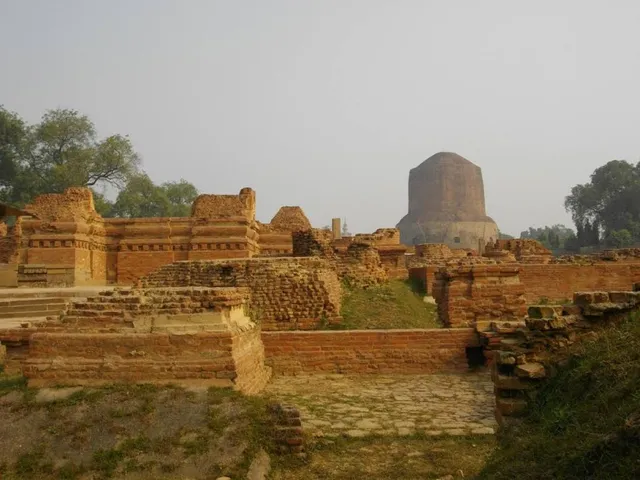
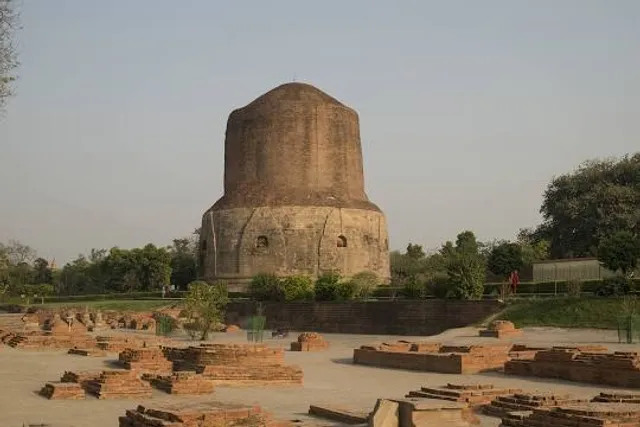
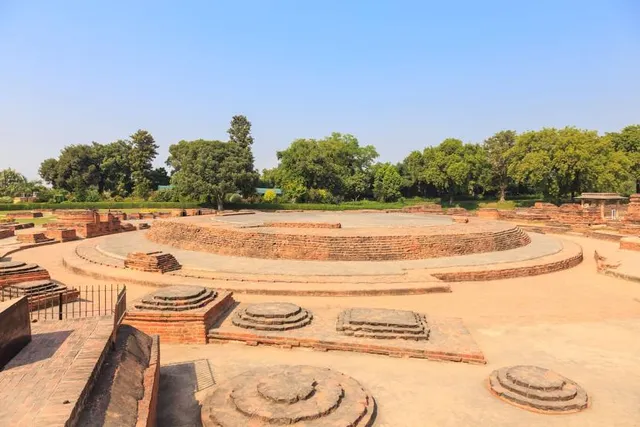
At a distance of 1.5 km from Sarnath Railway Station, and 9 km from Varanasi Junction, Archaeological Buddhist Remains or Monastery Ruins is an excavated site in Sarnath. Just Beside Archaeological Museum, it is one of the popular archaeological sites in India, and among the must-visit Sarnath Tourist Places.
The Archaeological Remains of Sarnath started attracting the scholars since the 19th Century. As a result excavation works of Sarnath started first of all by Sir Alexander Cunningham (1835-36), Major Kittoe (1851-52), Mr. C. Horne (1865), Mr. F.O. Oertal (1904-05), Sir Johan Marshal (1907), Mr. H. Hargreaves (1914-15), Mr. Daya Ram Shani (1927-32). Then after a gap of about 82 years once again excavation work is conducted by Sarnath Circle, Sarnath of Archaeological Survey of India.
The colossal ruins lie in the same compound as Dhamek Stupa. The excavation sites of Sarnath have impressive collections of monasteries, stupas, temples, inscriptions, sculptures, and other antiquities ranging in date from 3rd century BC to 12th century AD. These sites are now maintained by the Archaeological Survey of India. There are said to have been 28 stupas that were built by Ashoka, the 3rd century BC Mauryan king. Situated immediately north of the entrance are the ruins of Dharmarajika Stupa, a very small stupa originally, but later on, other parts being added to its structure and it became a huge, grand structure of bricks. This stupa was completely destroyed by the Diwan of Raja Chet Singh of Banaras to build temples from the material of this historical site edifice. Today, it is only a flat circular structure of bricks.
Near Dharmrajika Stupa, there is a small enclosure containing the famous monolithic railing that dates back to the Sunga period. This monolithic railing made of Chunar sandstone was discovered during an excavation in 1904-05. Each side of this square railing measures 2.54m in length and 1.45m in height. It was probably originally placed at the top of the nearby Dharmarajika Stupa. It bears two inscriptions dating from about the 3rd century BC which refer to the teachers of the Sarvastivadin sect.
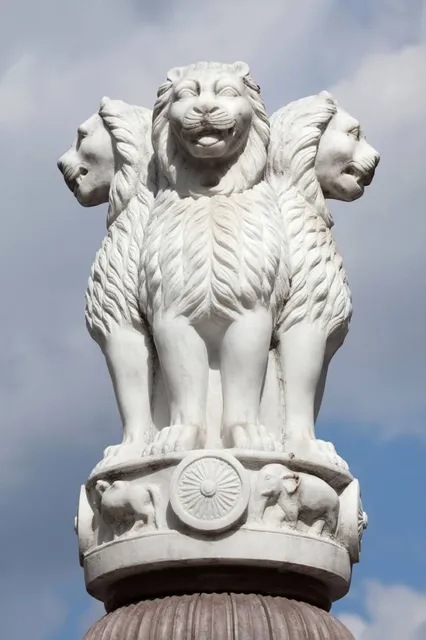
Few meters ahead of Monolithic Railing is the ruins of the Ashoka Pillar built in 250 BC by Mauryan emperor Ashoka. This pillar originally had a lion capital on its top where four lions seated back to back and is now the national symbol of our country. The pillar is in a broken state, but the four lion symbol is still safe in the Sarnath Museum. The wheel from the base of this lion capital is now placed onto the center of the National Flag of our country 'Tiranga'. The four lions from the lion capital of Ashoka Pillar are the symbol of Power, Courage, Confidence, and Pride.
Another prominent ruin in the monastic complex is the Moolgandha Kuti, situated just ahead of Asoka Pillar. This is the remnant of a huge temple probably represent the spots where Lord Buddha used to meditate. The roof has been collapsed and only the remains of thick walls supporting a lofty super-structure are there. In the area around the Moolgandha Kuti, there are many ruins of small stupas, Buddha Viharas, and a small temple. These small stupas are known as votive stupas which are basically built to commemorate visits of various acknowledged Buddhist masters or dignitaries.
Timings: 9 AM - 5 PM
Entry: Rs. 25 for Indians & Rs. 100...
Read moreSarnath (Hindustani pronunciation: [saːɾnaːtʰ]) is a place located 10 kilometres north-east of Varanasi near the confluence of the Ganges and the Varuna rivers in Uttar Pradesh, India. The Deer Park in Sarnath is where Gautama Buddha first taught the Dharma, and where the Buddhist Sangha came into existence through the enlightenment of Kondanna (Sanskrit: Kauṇḍinya).
Sarnath is one amongst the four holy places associated with the life of Lord Buddha. It is the place where Buddha, after attaining enlightenment at Bodhgaya, preached his first sermon to his five preceding companions. The Archaeological Survey of India (ASI) has been conducting excavations at Sarnath since 1907. The excavation sites have massive ancient collections of monasteries, stupas, temples, inscriptions, sculptures and other antiquities.
Singhpur, a village approximately one kilometre away from the site, was the birthplace of Shreyansanath, the Eleventh Tirthankara of Jainism. A temple dedicated to him is an important pilgrimage site.
Also referred to as Isipatana, this city is mentioned by the Buddha as one of the four places of pilgrimage his devout followers should visit. It was also the site of the Buddha's Dhammacakkappavattana Sutta, which was his first sermon after attaining enlightenment, in which he explained the four noble truths and the teachings associated with them.
Buddhism flourished in Sarnath due to its proximity to Varanasi. However, most of the structures were built by Mauryan Emperor Ashoka a couple of centuries after the religion was established. Guilt over his brutal invasion of Kalinga (present-day Odisha on India's east coast) caused him to convert to Buddhism and the practice of nonviolence, and he enthusiastically went about constructing stupas and pillars across India to promote the religion.
The most celebrated pillar is the one at Sarnath. The national emblem of India, featuring four lions and a dharma chakra (wheel that represents the Buddhist teachings), is derived from it. The chakra also appears on the Indian flag.
Subsequent rulers added to the stupas and monasteries that Ashoka built at Sarnath. During the reign of the Gupta dynasty in the 4th century A.D., Sarnath was an active center of art and Buddhist sculpture. By the 7th century, Sarnath had become a major center for the study of Buddhism and thousands of monks were living in monasteries there.
Unfortunately, Turkish Muslim invaders arrived in the 12th century and destroyed much of Sarnath, along with many other Buddhist sites in North India. Most of what remained of the Dharmarajika Stupa, made by Ashoka, was further demolished in the late 18th century by Jagat Singh (Dewan of Raja Chet Singh of Banaras) and used as building materials. However, this rediscovery of Sarnath prompted British archeologists to excavate the site in the 19th and 20th centuries.
The Indian government is now in the process of getting Sarnath permanently listed as a UNESCO World Heritage Site, and has plans to develop world-class facilities for pilgrims...
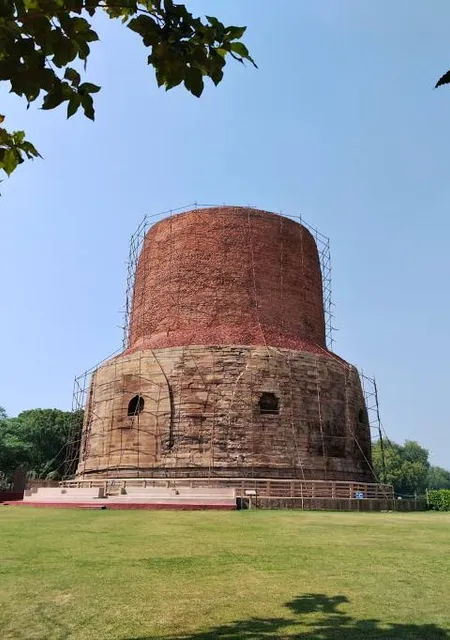
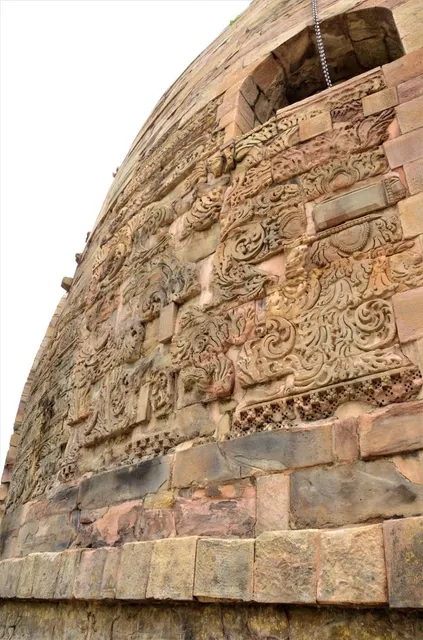
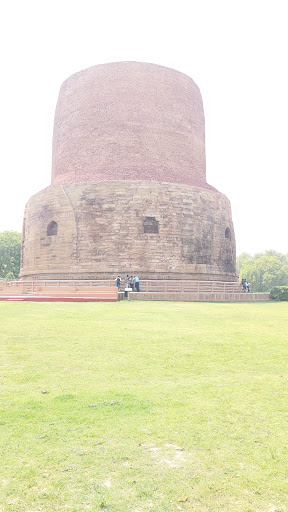
Read moreFirst of all, I bow to this place🙏🏻.Even though this place is now a tourist place, but it is the holy land where Gautama Buddha first taught the Dharma... When I went here, I was very excited about this place But then suddenly it came in mind that who will give information about every area here!... But after reaching there, I saw that there is a guide with every tourist… then I got rid of it. I entered first then saw the Dhamekh stupa...Then I looked at the guide and he understood that my question is now with him, who made it? Then he said... Emperor Ashoka Dhamek Stupa is said to have been built in the year 500 CE while the construction was ordered by Emperor Ashoka in the 3rd Century BC. There's a small museum right after the entrance which has a few basic details of the monument. Now my curiosity was growing more .... I asked him what is inside it? Then he started saying again
The main area of Dhamek Stupa in Uttar Pradesh India has been enclosed, and it consists of a labyrinth of ruined monasteries and stupas. Numerous dignitaries as well as devout Buddhist pilgrims from far and wide visit the Dhamek Stupa Sarnath for circumambulation of this sacred stupa.
I said... what's the importance !!??? He said Dhamek Stupa is one of the most important sights in Sarnath and its mostly due to its antiquity and significance of being the exact spot of Buddha's first sermon. It was here that he revealed the eightfold path leading to nirvana.... ...Ohh okay...
While talking to the guide, a lot of information was available about it....
Then I clicked photos and proceeded back to where DhammaChakkaPavatanaSutta was.... It is very beautifully written on the round cylindrical shape of copper.... Guide told.. The Dhammacakkappavattana Sutta is a Buddhist text that is considered by Buddhists to be a record of the first sermon given by Gautama Buddha...
Then from there we came to Buddha Temple... Wow...so beautiful ... There are many things but even if I write, how much should I write...😂
Overall....Enjoyed the whole trip....
I would like to say that there is a crowd but peace....😌
And thanks a lot to the guide Who got aware of so many things... a lot of knowledge... If the opportunity arises, then we should go to such places where we can get to know about our...
Read more