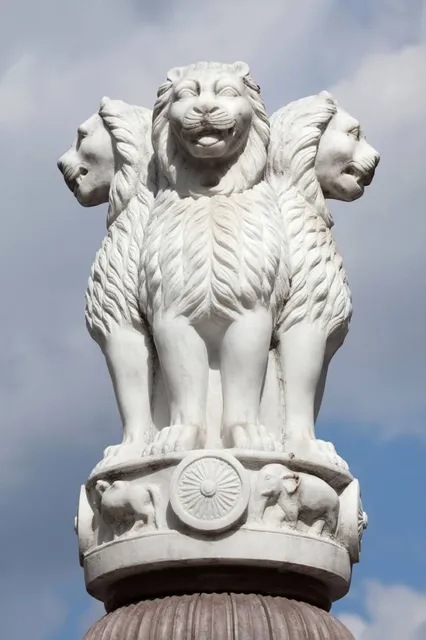
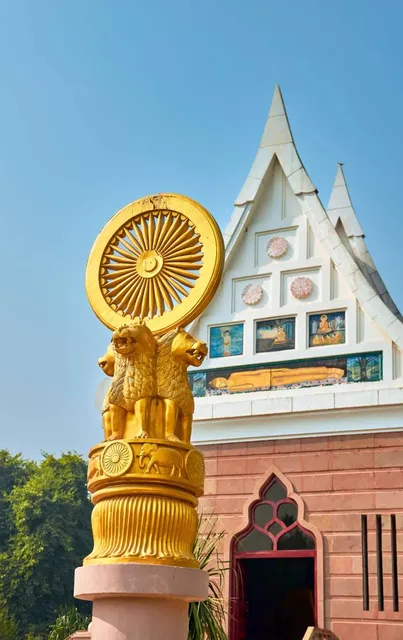
Gallery No 3 In this gallery no. 3 or main hall the lion capital made of Chunar sandstone measuring 2.31mtr, and glittering with Mauryan polish stands gracefully. Earlier, it was crowning the Asokan pillar erected at the deer park. It consists of four parts each having symbolical significance. (i) The base is made as bell or inverted lotus of sixteen petals, symbolizing the creativity, it is followed by (ii) A round abacus carved with four animals including an elephant, galloping horse, bull and lion in high relief symbolizing the four quarters of Anotatta Lake or the life events of Lord Buddha himself. (iii) On this abacus are four lions seated addorsely with their mouths wide open and tongues slightly protruding. In turn these lions were surmounted by (iv) a wheel of 32 spokes symbolizing the Lord Buddha (having 32 superhuman qualities). Wheel, now in pieces is displayed at the back of lion capital. To the left of the lion capital stands a colossal Bodhisattva image made of red sandstone. It was donated in 3rd reignal year of Kanishka by friar Bala of Mathura. The figure bears inscriptions of Kushana period at pedestal and on back in Brahmi script. The image is heavy and powerful. The image was dedicated under the shade of a huge umbrella fixed on an octagonal shaft standing just behind. To the left of this figure near entrance of gallery no. 2, there is another Bodhisattva figure made by locally available Chunar sandstone. The only difference occurs in size and a figure of dwarf Yaksha (now damaged). To the east & south east of the gallery, there are eight standing Buddha figures characterized by classical Gupta period characteristics. In most of the figures, right hand is in abhaymudra (protection giving attitude) while only in one figure it is in bhumisparsha mudra (earth touching attitude). The other important figure displayed in this gallery is standing Tara whose both arms are broken at elbow. She is putting on a lower garment and adorned with ornaments of Medieval period and at the base she is flanked by Marichi on her right & Ekjata on left. Besides, there is a significant fragment of an umbrella kept in a showcase towards right side of the entrance; it is carved with an inscription of Kushana period mentioning the four noble truths (chatvari arya satyani) of Buddha's first sermon at Deerparkle sorrow origin of sorrow. cessation of sorrow and the way leading to the cessation of sorrow. LION CAPITAL Built by Emperor Asoka (272-232 B.C.E.). This Capital is the noblest creation of the mauryan art and forms the national crest of India. It surmounted the inscribed “Asokan pillar” (preserved at the site in pieces) and was originally crowned by dharma-chakra symbolizing the turning of the wheel of law by Lord Buddha. The four addorsed lions looking in the four directions represent the pervading influence of the "sakyasimha" Buddha and his religion and order. The abacus supporting the lions is carved with four "great animals", elephant, lion, horse and bull with intervening wheels, suggesting the ever-active potency of law. This capital represents an artistic emblem of the first sermon and the establishment of the Buddhist order by Lord Buddha at Sarnath. Details of wheel of lion capital This wheel (The symbol of the Buddhist law), originally adorned the 'Lion Capital' as a crowning member, supported on a short stone shaft. The stone shaft was not discovered from excavation but the thickness can be estimated from the mortice hole, 20.5cms, in diameter, drilled into the stone between heads of the four-seated lions. Four fragments of the rim portion of the wheel and spoke remains were found. The total number of spokes was presumably 32. These 32 spokes perhaps are indicative of the 32 chief signs of a Great Man (Mahapurusha Lakshana) as described in the Buddhist text Lakkhan sutta...
Read moreMemories never ends, history also
Sarnath (along with Bodhgaya and Kushinagar in India and Lumbini in Nepal) is one of the four most important Buddhist pilgrimage destinations in the world. It has special significance because it's the place where the Buddha gave his first sermon. However, you don't have to be Buddhist to enjoy visiting it. Sarnath also makes a peaceful and refreshing side trip from Varanasi. Many people are surprised to discover Sarnath has Jain and Hindu connections too. Find out what you need to know to visit in this guide.
A long time ago, around the 5th century B.C., a young prince named Siddhartha Guatama was born in Lumbini. He led a very sheltered and lavish life. However, just before he turned 30, he ventured out into the countryside, where he encountered illness and death. This prompted him to give everything up and search for liberation from suffering.
Eventually, he realized that liberation comes from disciplining the mind. He then sat down to meditate under a sacred fig tree and resolved not to get up until he became enlightened. It happened profoundly on one full moon night. The tree (which came to be known as the Bodhi tree in reflection of his awakening) was located at the site of the magnificent Mahabodhi temple in Bodhgaya.
The Buddha didn't start preaching at Bodhgaya, though. There were five people he wanted to teach first. He'd previously practiced physical discipline with them as a means to liberation. They'd left him in disgust after he decided it wasn't the right path to liberation. The Buddha heard they were dwelling in a deer park at Sarnath, so he headed there. They were so impressed with his newfound wisdom and Four Noble Truths that they became his first disciples.
Buddhism flourished in Sarnath due to its proximity to Varanasi. However, most of the structures were built by Mauryan Emperor Ashoka a couple of centuries after the religion was established. Guilt over his brutal invasion of Kalinga (present-day Odisha on India's east coast) caused him to convert to Buddhism and practice nonviolence. He enthusiastically went about constructing stupas and pillars across India to promote the religion.
The most celebrated pillar is the one at Sarnath. The national emblem of India, featuring four lions and a dharma chakra (the wheel representing the Buddhist teachings), is derived from it. The chakra also appears on the Indian flag.
Subsequent rulers added to the stupas and monasteries that Ashoka built at Sarnath. During the reign of the Gupta dynasty in the 4th century A.D., Sarnath was an active center of art and Buddhist sculpture. By the 7th century, Sarnath had become a major center for the study of Buddhism, and thousands of monks were living in monasteries there.
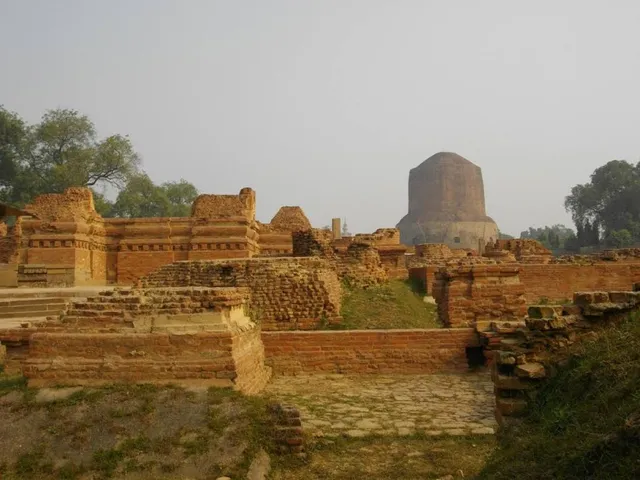
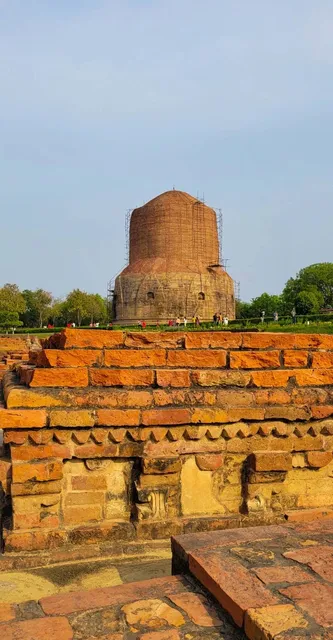
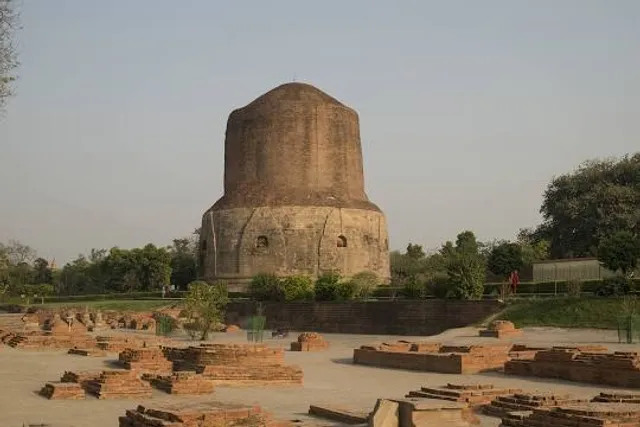
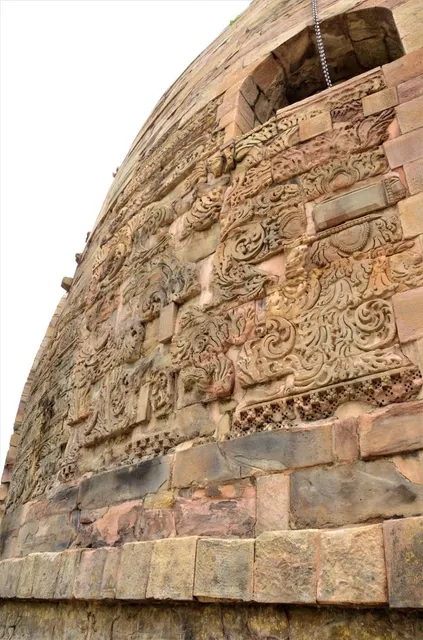
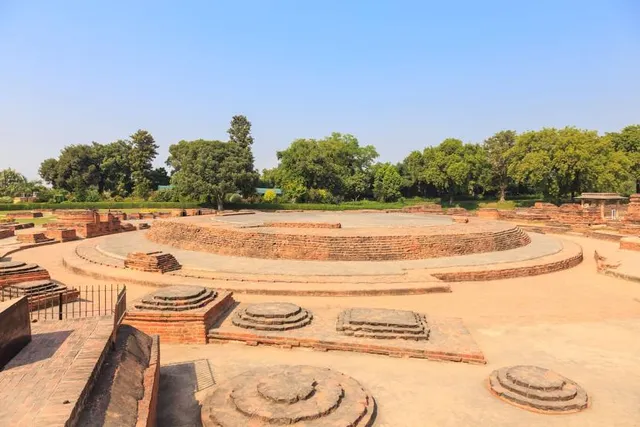
Unfortunately, Turkish Muslim invaders arrived in the 12th century and destroyed much of Sarnath and many other Buddhist sites in North India. Most of what remained of the Dharmarajika Stupa, made by Ashoka, was further demolished in the late 18th century by Jagat Singh (Dewan of Raja Chet Singh of Banaras) and used as building materials. However, this rediscovery of Sarnath prompted British archeologists to excavate the site in the 19th and 20th centuries.
The Indian government is now in the process of getting Sarnath permanently listed as a UNESCO World Heritage Site and has plans to develop world-class facilities for pilgrims...
Read more🏛️ Exploring the Rich Heritage at Sarnath Museum 🏛️
Nestled in the serene city of Sarnath, India, lies a treasure trove of ancient artifacts and relics - the Sarnath Museum. Stepping into this cultural sanctuary is like stepping back in time, as it houses a remarkable collection that narrates the rich history of the region.
🔍 Exploring the Exhibits: The museum boasts a diverse array of exhibits, ranging from sculptures and statues to archaeological findings dating back to the 3rd century BCE. Each artifact tells a story, providing invaluable insights into the art, culture, and spirituality of ancient India.
🗿 Buddhist Heritage: Sarnath holds immense significance in Buddhist history as the place where Lord Buddha delivered his first sermon, known as the Dhammacakkappavattana Sutta. The museum preserves numerous Buddhist artifacts, including the famous Lion Capital of Ashoka, a symbol of India's national emblem.
🎨 Artistic Marvels: Visitors are treated to a visual feast of exquisite sculptures crafted by skilled artisans centuries ago. The Gandhara and Mathura schools of art are prominently represented, showcasing the artistic prowess of ancient India.
📜 Historical Significance: Sarnath has witnessed the rise and fall of empires, making it a melting pot of history. The museum chronicles the region's journey through various epochs, from the Mauryan and Gupta periods to the medieval era.
🤔 Reflection and Contemplation: Walking through the halls of the Sarnath Museum evokes a sense of reverence and awe. It's not just a repository of artifacts but a place for introspection and contemplation, where visitors can connect with the spiritual essence of Buddhism.
🌟 Preserving Heritage for Generations to Come: The efforts of the museum authorities in preserving and showcasing these invaluable relics deserve commendation. By safeguarding our cultural heritage, they ensure that future generations can continue to marvel at the wonders of the past.
👣 Plan Your Visit: Whether you're a history enthusiast, an art aficionado, or simply seeking tranquility amidst ancient ruins, a visit to the Sarnath Museum is a must. Immerse yourself in the splendor of India's glorious past and embark on a journey of discovery like no other.
📌 Location: Sarnath Museum, Near Thai Temple, Sarnath, Varanasi, Uttar Pradesh, India.
Uncover the mysteries of the past and embrace the timeless beauty of Sarnath at this remarkable museum. Let history come alive as you delve into the wonders that await within its...
Read more