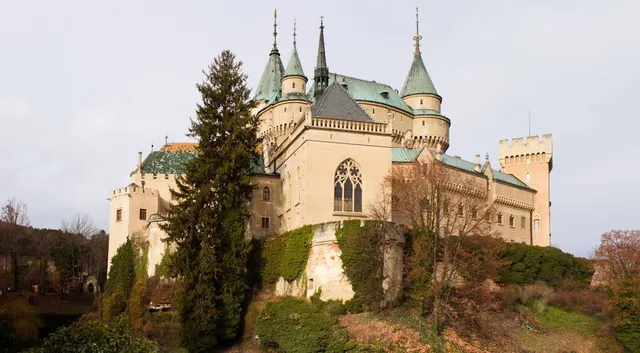
Bojnice Castle belongs to the oldest and the most important monuments in Slovakia. It stands on a travertine hill over the town. The first written record of the existence of the castle comes from 1113 in the document of Zobor Abbey. It was originally a wooden castle developed from an older rampart. It was gradually built up from stone as the property of the Poznan family in the 13th century. At the end of the 13th century the Ugrian lord Matus Cak Trenciansky seized Bojnice and the castle belonged to him until 1321. After Matus Cak Trenciansky the castle was in the 14th and 15th century owned by these aristocratic families: the Gileths, Leustachs and Noffrys. In 1489 King Matej Korvin gave Bojnice estate to his illegitimate son Jan Korvin. After the death of King Matej the castle was seized by the Zapolsky troops which inhabited it up to 1526. In 1527 the King Ferdinand I. gave castle to Alexej Thurzo. The castle was rebuilt by the Thurzos into a convenient Renaissance residence. The original Gothic Castle was given the character of a Renaissance castle. After the Thurzo family died out (in 1636) the castle reverted to the crown. A year later, in 1637, the Emperor Ferdinand III. gave Bojnice estate to Pavol Palfi in pledge for 200 000 of gold. In 1643 the Palfies got Bojnice castle as a patrimony. Building rush dominated in Bojnice and the castle got Baroque image. The building activity died down at the end of the 17th century. During the 18th or 19th century the castle was not significantly changed. After the long period of stagnation and recession in 1852 the last aristocratic owner Count Jan Frantisek Palfi got the Bojnice estate with the castle. Count Palfi decided to rebuild the castle into a romantic castle. As a model he used the French Gothic castles from the valley of the river Loire, the papal palace in Avignone, the Gothic Tyrolean castles and the early Renaissance Italian architecture. The architect of the Neo-gothic rebuilding was Jozef Hubert. But the architect became only an instrument in the hands of his customer with a highly cultivated artistic taste. Palfi himself drew, projected and controlled the whole work. This last Neo-Gothic rebuilding took 22 years (from 1889 till 1910). Count Palfi did not see the castle after the reconstruction He died in Vienna on 2 June, 1908 as a bachelor. As he did not have any heirs of his body, soon after his death the conflicts broke out between the relatives for the heritage. In 1923 there was an amicable agreement made between the heirs of Count Palfi and the Czechoslovakia, which specified the collections not for auctions. The auctions of the art collections of Count Palfi took place since 1924 to 1926. In 1939 the castle and its estate were bought by the Bata company. After the Second World War Bojnice estate fell to the state based on Benes decrees. Since 1950 Bojnice castle is a part of Slovak...
Read moreWe did the children’s tour with the story about the prince. We expected it to be shorter than the regular tour, but we didn’t expect to see only four rooms and watch a 12-minute pre-recorded story on a screen – without even any chairs to sit on. The acting of the “live” guides was another story. I can imagine that repeating the same script again and again can be boring for them, but it’s still part of their job. The “actors” looked bored, surprisingly shy, spoke very quietly, and didn’t know anything about the castle beyond their lines. The princess and prince guiding the tour were different from the ones on the screen (but even with different outfits so not so easy to guess on that basis), which is natural and would have been perfectly fine if they had just introduced themselves. It actually took me two rooms to realize they weren’t playing different characters.
The castle itself is beautiful, and it’s a pity that the museum management isn’t doing a better job. I remember attending this type of children’s tour in the past, and it was actually amazing. At this point, however, I would not recommend it.
It’s nice that there are falconers in front of the castle, but it seems they are not officially organized with the museum, because they are asking visitors directly for money. Honestly, it feels a bit uncomfortable and strange – you’re walking to the castle after already paying for your ticket and parking separately and then there are musicians and falconers all asking for even more money. On top of that, if you want to see the zoo, do the treetop walk or basically visit anything else around, it’s another €10 per person everywhere for any activity.
I truly hope we can do...
Read moreWe visited the Castle on 8th September 2019. There is good transport facility from Prievidza Aut. St. to the Bojnice Castle. Bus No 51 (Operated by SAD) (yellow coloured bus) offered us a free ride to the castle from here ( I'm not sure why they did not charge the ticket fare) If anyone is aware please let me know. The castle is one of its kind. This castle tickets cost 10€ per person if we choose a tour for only Castle or only the gallery. The tickets are 13€ per person if we want to see the entire castle and Gallery (where the antique furniture collection is displayed to public). This Castle has 184 rooms out of which only few are open for visitors. These tours have guides who takes us through the history of the castle. Maximum tours are in Slovak language however we were lucky enough to make it to the time for English Guided Tour (13.00 hrs) which lasts for maximum 1.5 hrs. The ticket counter is closed for lunch from 12.00 to 12.30 hrs. There are few ice-cream shops near the castle and a coffee vending machine behind the shops. There is a beautiful garden surrounding the Castle and a beautiful place to relax after a tour in the castle. Tips for anyone with joints / knee pain or baby strollers - there is no elevators and we need to climb almost 5 floors. There are Good Restaurants near the castle. (Did not try any as we Don't eat Beef n pork we always carry our own lunches). Overall a good experience and a budget friendly one day tour which did not cost more than € 50...
Read more