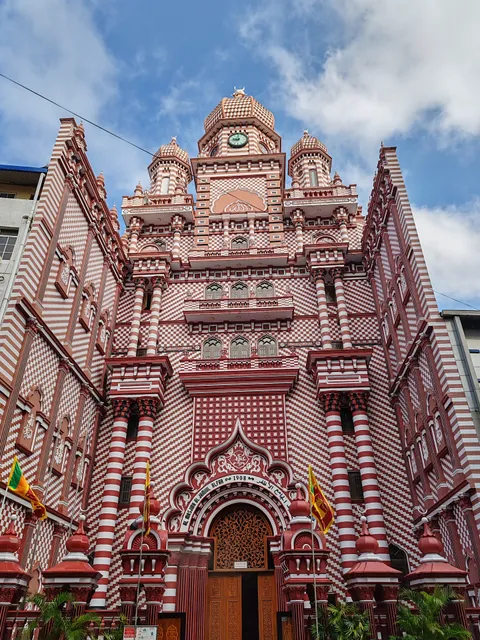
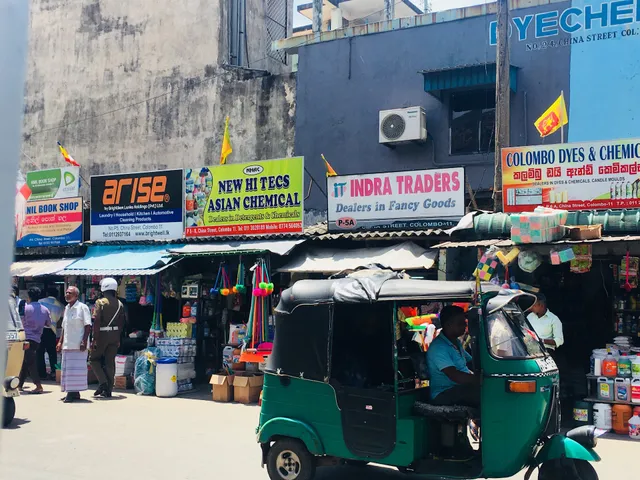
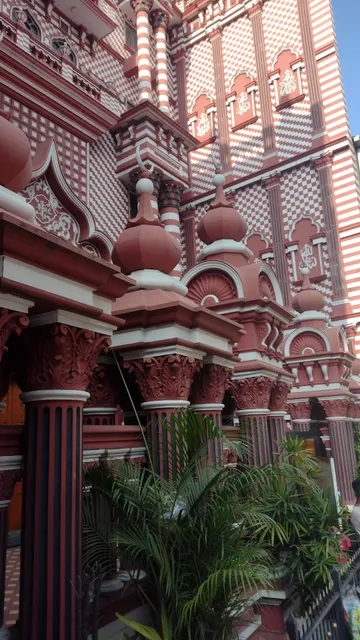
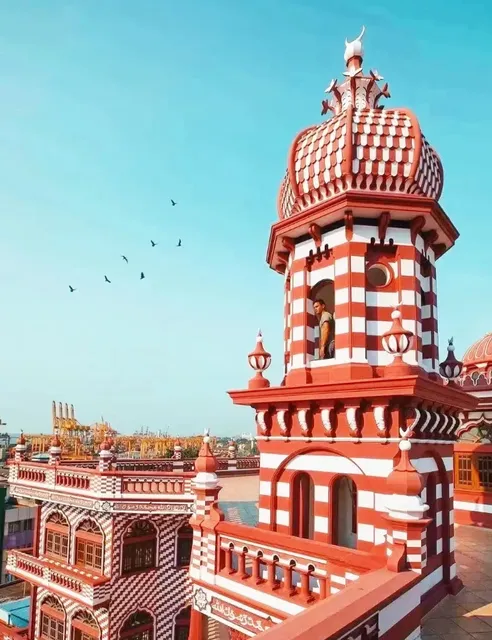
In the hustle and bustle of Pettah, Colombo’s core commercial district, is situated a most striking building, a spiritual haven called Jamiul Alfar Masjid. This mosque is remarkable because the architecture is Indo-Saracenic, incorporating pomegranate-shaped domes. But the most extraordinary feature is that each brick is painted red or white and used in contrasting designs, which gave rise to its common name, the Red Mosque
During the 18th and 19th Centuries, Javanese and Malaysian Muslims brought by the Dutch and British contributed to the Islamic mix (their descendants are called Sri Lankan Malays). Members of the Borah community (Borah means “trade”), a Yemen-evolved Muslim sub-sect from Gujarat, North India, also arrived during this period, together with descendants of Arab traders who had settled in the state of Tamil Nadu, South India.
The designer and builder was H L Saibo Lebbe and the two-storeyed mosque, incorporating a clocktower, was commenced in 1908 and completed the following year. Lebbe was influenced by the Indo-Saracenic architectural style, which was devised by British architects in the late 19th Century India. Essentially it’s a hybrid style that draws elements from native Indo-Islamic and Indian architecture, and combines it with the Gothic revival and Neo-Classical styles favoured in Victorian Britain (witness the Houses of Parliament).
The Jamiul Alfar Masjid as it was named – Masjid is Arabic for mosque – is also known in Tamil as Samman Kottu Palli (“Mosque for Muslims of Indian origin”), and in Sinhala as Rathu Palliya (“Red Mosque”). The latter name describes the dominant colour; a colour interrupted on most surfaces by the inclusion of the white-painted bricks in four main designs: striped, checkered, jagged, and spiral. Viewed together, they provide an optical delight that enhances the awesome architecture.
Architects claim the Jamiul Alfar Masjid to be reminiscent of the Jamek Masjid in Kuala Lumpur, Malaysia, built during the same year. Locally, it has architectural similarities with, surprisingly, the old section of the National Eye Hospital, established in 1906. This bizarre mosque-like red-brick institution with yellow horizontal stripes was also designed in the Indo-Saracenic style by Edward Skinner.
These were some thoughts I had as I travelled through Pettah to the Jamiul Alfar Masjid to witness Jummah, or Friday prayers, and discover the renovation and expansion that will make this the mosque with the largest congregational capacity in Sri Lanka. The Masjid’s beautiful minarets and domes are visible a couple of miles away, rising far above the offices and shops, announcing its presence in no uncertain terms. And when I made the approach down Second Cross Street and saw this extraordinary building for the first time, I was astonished. The pictures tell the story.
I was warmly welcomed by Jafar Ali Farook, Treasurer of the Mosque, who told me the domes were not based on the customary shape of the onion: “the architect used the pomegranate as the shape of the domes—and gave them their natural colour, red!” He showed me how the floors and lower walls had been refurbished with period-looking tiles, and introduced me to an astonishing original feature—four massive teak trees from Puttalam used as supporting columns that pass through the two lower floors.
At a time when it is crucial for non-Muslims to become more aware of Islam, it is encouraging that the Masjid welcomes visitors. Visiting a mosque is a learning experience. The best time is between 10 in the morning and 12noon. At other times the Masjid is crowded with worshippers. Men should wear trousers and plain shirts with the sleeves buttoned. Women should wear modest ankle-length skirts or non-clingy trousers and tops with sleeves. Hair should be covered by...
Read moreColombo Red Mosque, Also known as Jami Ul-Alfar Masjid, is literally an architectural wonder for the world that would stun you with its unusual color patterns and unconventional yet amazing design. Located in Pettah district, this oldest mosque towers over the buildings and streets in the neighborhood with its tall minarets and had been once a reliable landmark for the sailors coming towards Colombo port. Here both men and women are granted access, but you have to be clad in decent clothes and cover your head and respect the customs. The unconventional red tone has won the name,' red mosque', for this beauty.
Tourist Attractions At Colombo Red Mosque Whether done by a qualified or unqualified constructor, its strange architecture, quite untypical of normal Muslim mosques, is what put Colombo Red Mosque in the lame light. Deviating from normal onion-shaped domes, the mosque presents pomegranate-look-liking ones with hybrid structure. This religious edifice, made with Indi-Saracenic architecture, has Persian touch in many places, like minarets. When combined with even-stranger color patterns of red and white in swirling form, this oldest mosque of Colombo is literally being an interesting tourist destination.
History of Colombo Red Mosque Colombo had always been a welcoming hub for international trade where Arabs frequented and populated enormously. They had to perform their five-times compulsory daily rituals. For that reason, the Indian Muslim Community was commissioned to put up a mosque in Pettah. Works commenced in 1908, the construction of the Colombo Red Mosque (Jami-Ul-Alfar Mosque) was finished in just a year. Habibu Labbe Saibu Labbe was the chief designer of the building who relied on Indo-Saracenic and Neo-classical architectural styles. In 1975, the Mosque's capacity was extended as much as 10,000.
How To Reach Colombo Red Mosque Jami-Ul-Alfar Mosque is located in a busy town called Pettah which is less than 4 kilometers away from the heart of Colombo city. The mosque can be easily reached by both bus and tuk-tuk. If you are taking the bus, you need to get off at Petta Central Bus Station and after getting down take an 800-meters walk down the 2nd Cross Street. If you are getting into a tuk-tuk, they would directly drop you off in front of the mosque. Remember prayer times and Fridays can be too...
Read morehistorical landmark and recognized as one of the oldest mosques in Colombo. I did a bit of reading up and stumbled upon a snippet which stated that it was used as a landmark by sailors who came to Colombo from afar. Fun fact: this snippet could have been confirmed or sourced properly had any of the mosque employees thought it okay to divulge information about its history, instead of telling me that they're not allowed to say anything about it. SUSPICIOUS.

Anyway, the mosque's been going through a series of expansions over the last few years, and will, in time, be large enough to accommodate 10,000 people (research revealed that it initially accommodated only 500).

Imaad reconnoitred the area and was surprised to find an escalator being installed as well. Given how tall it is (we estimate it to be about six stories high), this makes sense.

The architecture and design are what makes it stand out in a highly industrialized area. The uniform contrast of red and white bricks next to each other, topped off with a couple of bulbous domes are what gave it its more commonly known identity as the 'Red Mosque'.

Its actual name is the Jamiyul Alfar Jummah Masjid or the Samman Kottu Palli, but eh. In Sinhala, it's simply called the rathu palliya akin to what it's called in English. Strangely (or not so strangely), the domes were designed to take the shape of a pomegranate — and it's also the pomegranate's bright colouring which lead to the mosque being predominantly red. You can read more about its architecture here.

However, what's weird is that women aren't allowed in. Or at least, local Muslim women (as of when I went earlier this week), because my tourist friends and non-Muslim female friends have been in and shown around the place. I mentioned this at the counter area repeatedly ("why can't I go in?") only to be told that sorry, no women allowed. WHAT the what. They also have a board in the lobby saying that "brothers" can donate Rs 5000 towards constructing a square foot of the mosque in order to be granted a place in eternal paradise. In case it isn't clear, I strongly resent this sexism. Pictured below is a sad me standing forlornly in the lobby as Imaad ventured in on his own.

Or...
Read more