We use cookies to ensure you get the best experience on our website. For more information on how we use cookies, please see our cookie policy.
By clicking "Accept", you agree to our use of cookies.
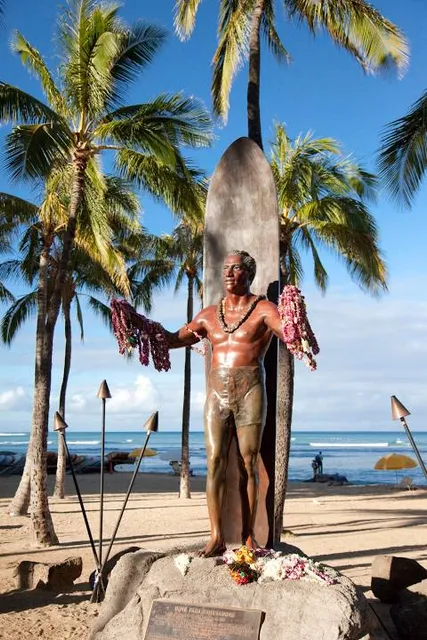
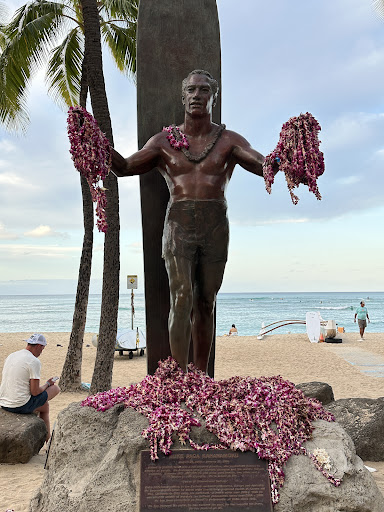
Learn moreStanding nine feet tall against Waikiki Beach's cerulean backdrop, Jan Gordon Fisher's bronze tribute to Duke Kahanamoku commands attention through sheer presence rather than sculptural finesse. Unveiled in 1990 on the surf legend's centennial, this monument has become as much a cultural lightning rod as tourist magnet.
Fisher, the late BYU-Hawaii professor, approached his subject with earnest reverence but limited artistic sophistication. The statue depicts Duke in classical heroic pose—arms outstretched, chest forward, standing before his iconic surfboard. The bronze work captures Duke's physique competently, if unremarkably, rendering him as a Polynesian Adonis frozen in perpetual greeting.
Yet it's precisely this orientation that sparked enduring controversy. Duke faces inland, his back to the Pacific—violating fundamental Hawaiian cultural principles about respecting the ocean. Local surfers have long criticized this decision, arguing Duke would never have turned his back on the sea. The explanation is disappointingly prosaic: the statue was positioned to provide tourists with ocean backdrops for photographs, a concession to Instagram aesthetics over cultural authenticity.
More troubling are technical inaccuracies plaguing Fisher's work. The surfboard displays backward curvature and misplaced grip scratches—details that may seem trivial but speak to broader lack of research and cultural consultation. These errors transform what should celebrate indigenous Hawaiian watermanship into an unwitting monument to mainlander misunderstanding.
The statue's most poignant element may be its unintended evolution into a living shrine. Daily, visitors drape Duke's bronze arms with fresh lei—a touching gesture that slowly corrodes the sculpture through floral acidity. This beautiful paradox encapsulates the complex relationship between tourism and Hawaiian culture: love that literally wears away its object of devotion.
Artistically, Fisher's work suffers from earnestness that often befalls public commemorative sculpture. There's little psychological depth or formal innovation—just competent representational bronze work prioritizing likeness over artistic interpretation. The statue functions more as historical marker than art object, a three-dimensional Wikipedia entry cast in metal.
Yet within Waikiki's hyper-commercialized landscape, Duke's bronze presence carries undeniable power. The work succeeds in its primary mission: keeping Duke's revolutionary contributions to global surf culture visible and relevant.
Fisher's statue may not be great art, but serves as an effective focal point for cultural memory and tourist pilgrimage. The real tragedy isn't the sculpture's artistic limitations—it's that Hawaiian artists weren't given the opportunity to interpret their own cultural hero on their own terms.
Standing amid Waikiki's daily circus, surrounded by selfie-taking visitors and perpetually adorned with wilting flowers, Duke's statue endures as both tribute and cautionary tale about whose stories get...
Read moreOh, stumbling upon the Duke Paoa Kahanamoku Statue on Waikiki Beach? It’s like the universe handing you a slice of Hawaiian magic on a silver platter—complete with a side of history and a whole lot of heart! Picture this: you’re wandering that iconic stretch of sand, surfers shredding waves like pros, tourists snapping selfies with the ocean as their backdrop, and then bam—there he is, this bronze legend standing tall on his surfboard, arms wide open like he’s ready to hug the entire island. I mean, who wouldn’t fall head over heels for that vibe? What really stole my heart (and had me grinning like a fool) was seeing so many leis draped all over him—flowers bursting in every color of the rainbow, from fresh plumeria to vibrant orchids, like the whole beach had thrown a perpetual luau in his honor. Surfers fresh from the waves, families on vacation, even the locals pausing mid-stroll to add their own garland… it was this beautiful, unspoken ritual that made me feel like I was part of something bigger. I couldn’t resist snapping a pic and whispering a quick prayer for safe travels and good vibes—because, honestly, with all that floral love piled on, it felt like Duke himself was sprinkling blessings right back at us. Pure aloha overload! And let’s not gloss over the man behind the statue, because Duke Kahanamoku? Total icon. Born right here in Honolulu in 1890, this guy grew up swimming and surfing the very waters of Waikiki that you’re soaking in today. He wasn’t just a beach bum—he shattered world records left and right, snagging five Olympic gold medals in swimming (hello, 1912 Stockholm and beyond!) and basically inventing modern surfing as we know it by introducing the sport to the world during his globetrotting tours. Talk about a legacy: he turned Waikiki from a sleepy lagoon into the global surf mecca it is now, and even moonlighted as an actor and goodwill ambassador, spreading Hawaiian spirit far and wide. The statue, unveiled in 1990 by artist Jan Gordon Fisher, captures him in his prime—young, muscular, and forever poised to ride that next wave. It’s not just bronze; it’s a time capsule of resilience, joy, and that unbreakable ohana connection. If you’re hitting Waikiki (and trust me, you must), swing by this spot around sunset—grab a Mai Tai from a nearby bar (pro tip: the locals swear by it for that perfect golden-hour toast), watch the crowds pay their respects with more leis, and let the energy sink in. It’s equal parts humbling and exhilarating, like Duke’s whispering, “Eh, brah, life’s too short—catch the wave!” I left feeling lighter, luckier, and already plotting my return. Mahalo, Duke—you’re the big kahuna...
Read moreThe Duke Paoa Kahanamoku Statue stands as an iconic tribute to one of Hawaii's most legendary figures, Duke Kahanamoku. Positioned prominently along the bustling Kalākaua Avenue in Waikiki, this majestic bronze statue pays homage to a man whose legacy extends far beyond the shores of Hawaii.
As you approach the statue, you'll immediately notice the sheer presence it commands. Duke Kahanamoku, known as the "Father of Modern Surfing," is depicted with his surfboard in hand, ready to ride the waves. His powerful yet graceful stance captures the essence of his legendary surfing skills.
Duke Kahanamoku's impact on Hawaiian culture and the world of surfing cannot be overstated. Born in Honolulu in 1890, he rose to prominence as an Olympic swimmer, winning numerous medals and breaking world records. However, it was his role as a surfer and ambassador of aloha that truly defined him.
Duke's passion for surfing and his ability to ride the waves with unparalleled skill helped introduce the sport to the world. He famously introduced surfing to places like California and Australia, spreading the stoke and culture of wave riding. His influence played a pivotal role in shaping modern surf culture.
Beyond his athletic achievements, Duke Kahanamoku embodied the spirit of aloha—Hawaii's philosophy of love, peace, and harmony. He welcomed visitors to Hawaii with open arms, sharing the warmth and hospitality of the islands. His generous and friendly nature left an indelible mark on all who had the privilege of meeting him.
The Duke Paoa Kahanamoku Statue serves as a reminder of Duke's enduring legacy and the values he represented. It's a place where visitors and locals alike can pay their respects to a man who bridged cultures through the universal language of surfing and the spirit of aloha.
Surrounding the statue, you'll often find leis and offerings placed by admirers, a sign of the enduring affection and reverence people hold for Duke. It's also a popular gathering spot for surfers and beachgoers, a place to reflect on the waves and pay homage to the sport's pioneer.
In conclusion, the Duke Paoa Kahanamoku Statue is more than a monument; it's a symbol of Hawaii's rich cultural heritage and the enduring legacy of a remarkable individual. Whether you're a surfer paying tribute to the sport's origins or a traveler seeking to connect with Hawaii's history, the statue stands as a testament to the enduring spirit of aloha and the profound impact one person can have...
Read more