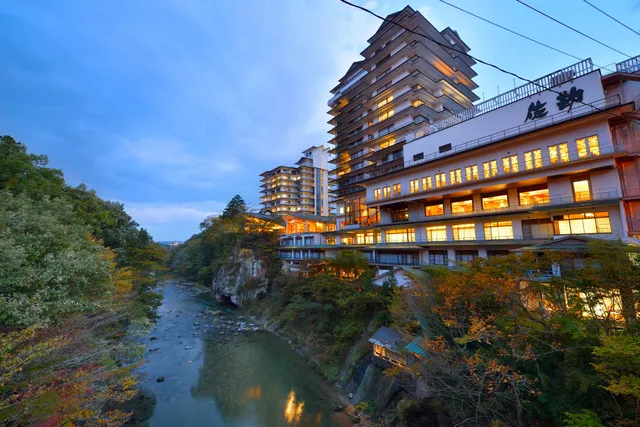
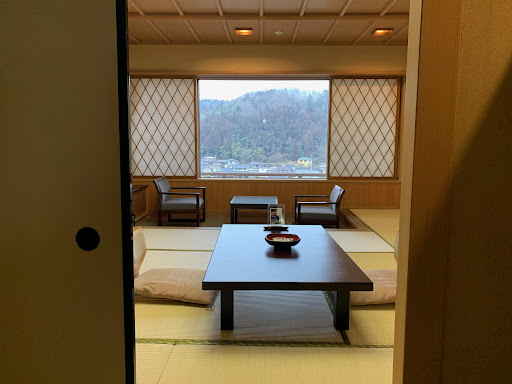
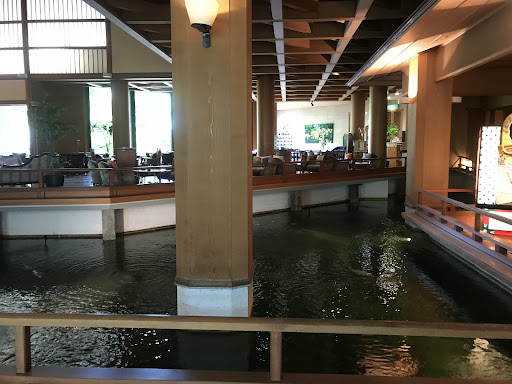
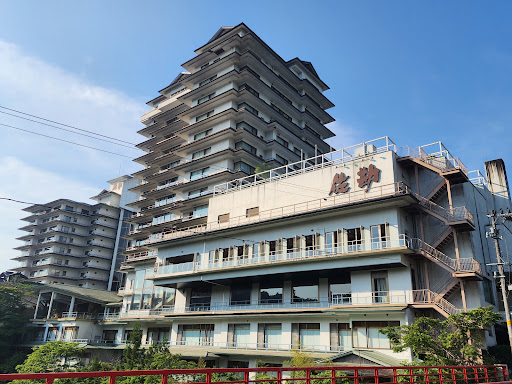
My colleague booked this place for us, because he felt it was a uniquely Japanese experience and his favorite ryokan and onsen in the area. The place did not disappoint. This is a 1,000 year old traditional Japanese ryokan, although only documented for the past 500 years? It is beautifully and elegantly furnished. When you enter, you feel like you are in a Japanese version of a Ritz Carlton. The lobby area is spacious, and carpeted, this is an indoor pond with koi, and even a museum! There are several levels of rooms. We were booked into a room in the Sansui tower, which seems to be a mid priced room. It had one large room with adjoining kitchenette and bathrooms. The room itself was a traditional ryokan room with tatami mats (so no slippers on tatami!). By day, there is a low table and floor cushions. By night, they roll out the futons to sleep on. There is a TV and A/C, so the place has modern amenities, in case you might be concerned. Like many ryokan, there is a dinner service in the room. We had a lovely spread of wagyu beef, sea urchin, sashimi, vegetable and chicken stew. They had a child's version for our son, which consisted of a curry taco, potato croquettes, fries, fresh fruit and sashimi. The morning breakfast was a buffet with mostly Japanese, but some Western foods. The buffet items featured local foods and specialty items such as organic greens. Eggs and grilled fish made to order. The quality of the buffet food was truly top notch! There was even ice cream! The highlight of any visit here is a soak in their onsen (hot springs). They call them public baths, but not because they are open to the public. They mean that several people could be onsen-ing with you (albeit by gender). There are different onsen to visit, and some are always for women or men, whereas another one seems to change from women's use to men's depending on the time of day. The onsen I visited had two baths, one with slices of Japanese cedar wood (hinoki, lovely smell) and the other with lemons. What a luxury! It would be good to brush up on onsen visiting etiquette before visiting (not enough space here to describe). There is a beautiful garden surrounding the hotel. Service is top notch! It doesn't get better than this, even for Japan! The only potential downside is that English language support is limited. Signage, including that on the onsen, is in Japanese. The verbiage used to indicate women's vs. men's onsen is extremely polite and does not use the standard 'men' and 'women' characters that one might see elsewhere. Clues as to the gender of the onsen is that women's onsen tends to be decorated in pinkish colors, whereas men's onsen are darker colors such as blue or green. Then there is the problem with the multi use onsen. Most hours are set aside for women's use, though.Cotton kimonos are provided, called yukata, and you can wear them anywhere in the ryokan--even to breakfast! No wifi in the rooms, but available in the lobby (why would you need wifi for a getaway type of resort like this, anyway?) By the next morning, there was one clerk who spoke good English, but he was not available during the evening hours. I would...
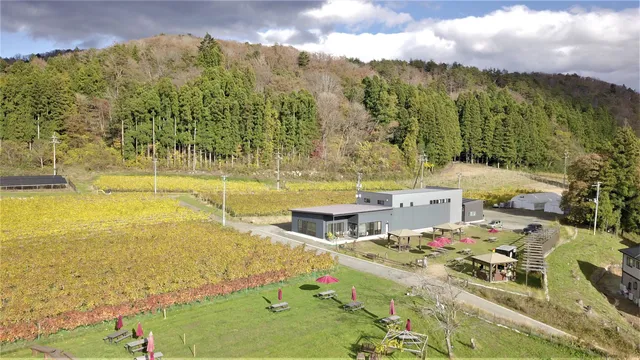
Read moreAmazing Christmas stay at an onsen spa with incredible history. The room felt like an authentically traditional Japanese apartment, with multiple rooms separated by shoji screens, very comfortable beds, and nice views of the serene courtyard. They are amazing for those unfamiliar with the arrangement. You're provided with heavy metal keys attached to blocks showing the room number. Most of the modern facility appointments (like carpeting and electrical) seem from the 80s or 90s, but everything is well maintained and highly functional.||Staff was very kind and polite, although their limited English made understanding some of the etiquette and procedures challenging (but not impossible). For the benefit of non-Japanese guests, we discovered a few things that may make the experience more seamless for others:||* Dinner is optional, and well worth the modest cost. You present your room key to check in. It's a private cubicle dining experience with a main course supplemented by an expansive buffet. Breakfast is included and has a similar layout but without a main course selection. Recommend wearing the spa-provided kimono and haori (they're in the room closets) to add to the ambiance.|* Hot baths are exclusively male/female. The hot baths in the Kagetsu tower rotate by time of day, but they are color coded at the entrance or indicated in posters around the lobby. Go to all of them if you can. The cedar bath in Hiten tower (at least the men's side) was behind a shoji screen with a noren divider that I initially missed, so keep an eye out. |* Wear the kimono, haori, and slippers to all onsen, and bring your towel basket, which will contain a small and large towel, as well as your key. You will leave slippers at the entrance in a cubby, then check out a free locker to store everything else. Take the small towel with you (carry by folding it and laying it on top of your head) so you can use it to dab off while in the baths.|* Before entering any bath, use the provided showers to either sit down and ritually rinse or shower and wash down.|* Move slowly and be quiet in the spas. I did not encounter any adults talking when there.|* When exiting the bath, towel off with the small towel before entering the locker room to keep things moderately dry.|* If you use the sauna, grab a bamboo butt pad before entering them. They're between the hot and dry saunas.||The town itself is really charming and walkable, with many rural elements and a helpful map. Akiu Craft Town was mostly closed when we were there and it was quite cold, but we nevertheless had wonderful experiences with two shops, particularly the first one on the right entering the town, where a delightful elderly lady showed us all her kokeshi dolls, bowls, and other woodcraft. There's a winery with surprisingly good wine and delicious snacks...
Read more