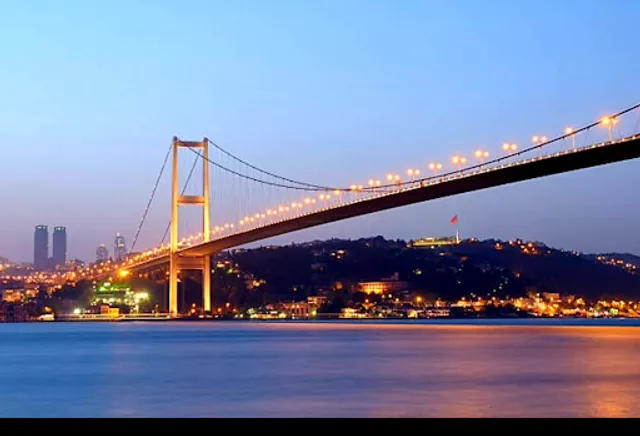
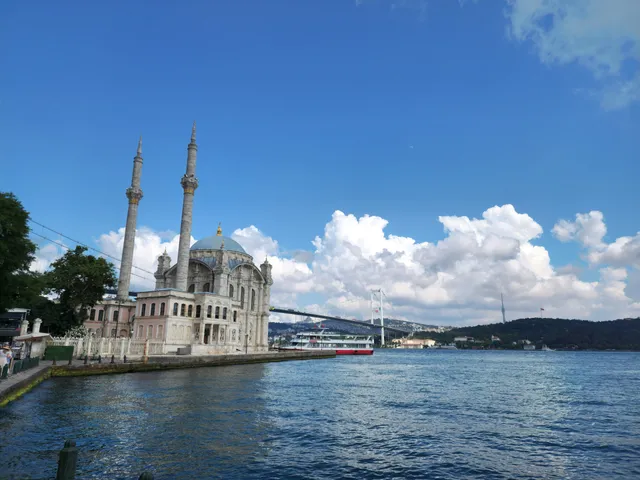
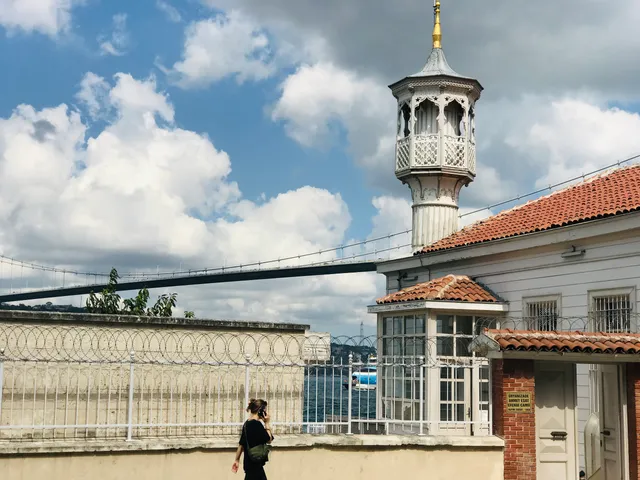
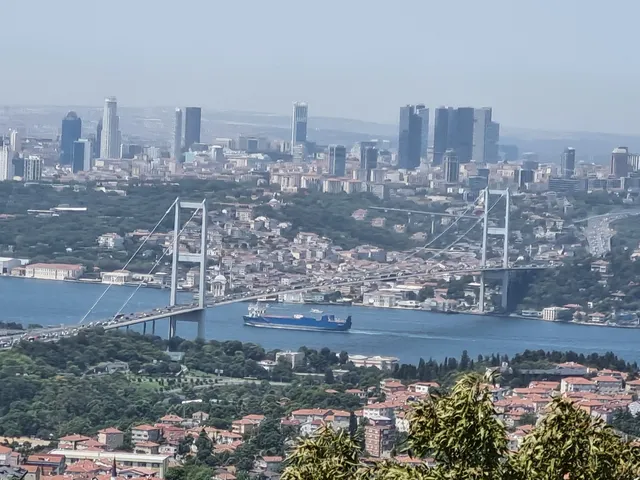
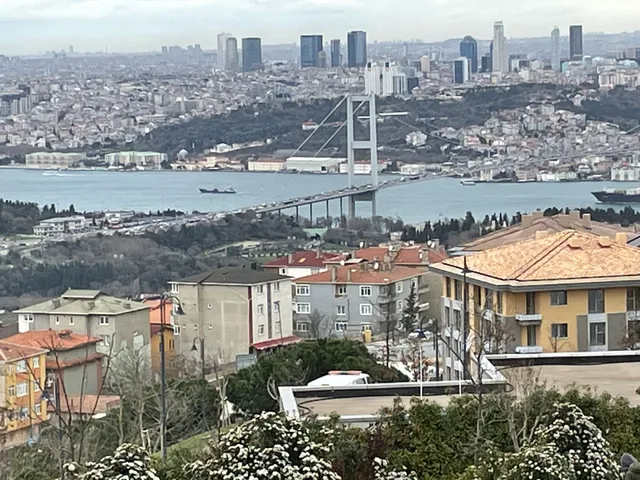
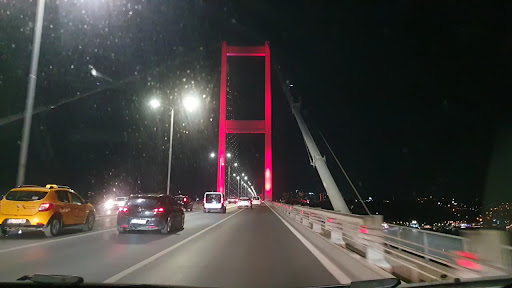
The Bosphorus Bridge (Turkish: Boğaziçi Köprüsü), known officially as the 15 July Martyrs Bridge (Turkish: 15 Temmuz Şehitler Köprüsü) and unofficially as the First Bridge (Turkish: Birinci Köprü), is one of the three suspension bridges spanning the Bosphorus strait (Turkish: Boğaziçi) in Istanbul, Turkey, thus connecting Europe and Asia (alongside Fatih Sultan Mehmet Bridge and Yavuz Sultan Selim Bridge). The bridge extends between Ortaköy (in Europe) and Beylerbeyi (in Asia).
It is a gravity-anchored suspension bridge with steel towers and inclined hangers.1] The aerodynamic deck hangs on steel cables. It is 1,560 m (5,118 ft)[1] long with a deck width of 33.40 m (110 ft).[1] The distance between the towers (main span) is 1,074 m (3,524 ft)[1] and the total height of the towers is 165 m (541 ft).[1] The clearance of the bridge from sea level is 64 m (210 ft).[1]
Upon its completion in 1973, the Bosphorus Bridge had the fourth-longest suspension bridge span in the world, and the longest outside the United States (only the Verrazano-Narrows Bridge, Golden Gate Bridge and Mackinac Bridge had a longer span in 1973).[3 The Bosphorus Bridge remained the longest suspension bridge in Europe until the completion of the Humber Bridge in 1981, and the longest suspension bridge in Asia until the completion of the Fatih Sultan Mehmet Bridge (Second Bosphorus Bridge) in 1988 (which was surpassed by the Minami Bisan-Seto Bridge in 1989). Currently, the Bosphorus Bridge has the 33rd-longest suspension bridge span in the world.
After a group of soldiers took control and partially closed off the bridge during the military coup d'état attempt on 15 July 2016, Prime Minister Binali Yıldırım announced on 25 July 2016 the decision of the Cabinet of Turkey that the bridge will be formally renamed as the 15 Temmuz Şehitler Köprüsü (July 15th Martyrs Bridge) in memory of those killed while resisting the attempted coup.
The decision to build a bridge across the Bosphorus was taken in 1957 by Prime Minister Adnan Menderes. For the structural engineering work, a contract was signed with the British firm Freeman Fox & Partners in 1968. The bridge was designed by the British civil engineers Gilbert Roberts, William Brown and Michael Parsons, who also designed the Humber Bridge, Severn Bridge, and Forth Road Bridge. Construction started in February 1970 and ceremonies were attended by President Cevdet Sunay and Prime Minister Süleyman Demirel. The bridge was built by the Turkish firm Enka Construction & Industry Co. along with the co-contractors Cleveland Bridge & Engineering Company (England) and Hochtief AG (Germany). Thirty-five engineers and 400 men worked on the project.
The bridge was completed on 30 October 1973, one day after the 50th anniversary of the founding of the Republic of Turkey, and opened by President Fahri Korutürk and Prime Minister Naim Talu. The cost of the bridge was US$200 million ($1.15 billion in 2019 dollars[11]).
Upon the bridge's opening, much was made of its being the first bridge between Europe and Asia since the pontoon bridge of Xerxes in 480 BCE. That bridge, however, spanned the Hellespont (Dardanelles), some distance away from the Bosphorus, and was the second bridge after the above-mentioned bridge built by Emperor Darius I The Great across the...
Read moreBack in 2013. I visited Turkey. Honestly, I don’t really like urban area here. I packed people, and busy traffic. I had another few days in Capadocia. It was quiet, but if you are a single woman like me, be very careful of some men here. It is totally different culture from MUSLIM.
The Bosporus Bridge, a symbol of Istanbul’s unique identity as a city bridging two continents—Europe and Asia. Stretching gracefully over the Bosporus Strait, it offers both locals and visitors a sense of awe and a connection to Istanbul’s rich history and modern vibrancy.
Design and Structure
Completed in 1973, this suspension bridge is a marvel of engineering. With a total length of 1,560 meters (5,118 feet), it spans one of the most significant waterways in the world, providing a critical link for vehicles and pedestrians. Its sleek design blends harmoniously with the natural beauty of the Bosporus, and its night-time illumination transforms it into a glowing ribbon over the water.
Experience
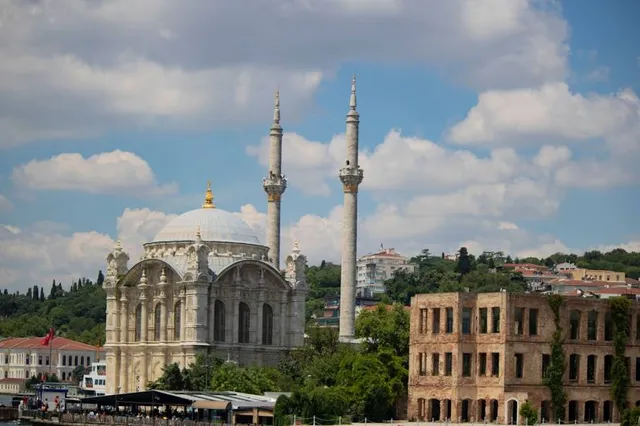
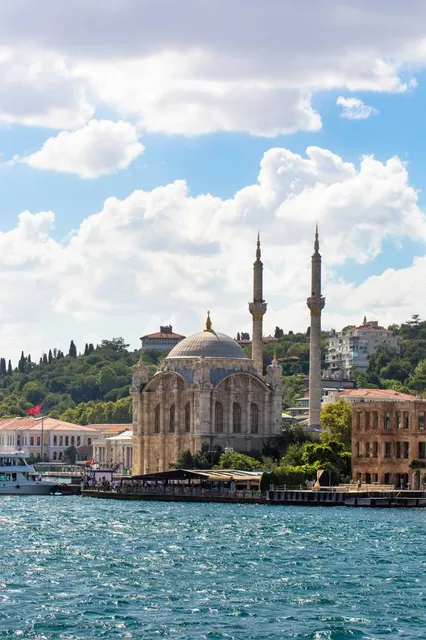
Crossing the Bosporus Bridge is not just a commute—it’s an experience. Whether you drive across it or view it from a boat on the Bosporus, the sight of this bridge against the backdrop of Istanbul’s historic skyline is breathtaking. The contrast between the modernity of the bridge and the timeless domes of mosques and ancient palaces creates a visual harmony.
Historical and Cultural Significance
The bridge represents much more than just infrastructure; it is a symbol of unity, connecting two continents and diverse cultures. Renamed in memory of those who lost their lives during the failed coup attempt of 2016, it stands as a poignant reminder of resilience and solidarity.
Best Ways to Experience the Bridge • Boat Tour: A cruise along the Bosporus provides the best views of the bridge and its surroundings. Sunset tours are especially magical. • Night Views: The bridge’s colorful LED lighting at night is a must-see, offering a mesmerizing spectacle against the city lights. • Nearby Attractions: Combine your visit with stops at Ortaköy, a vibrant district on the European side, or Beylerbeyi Palace on...
Read moreThe 15 Temmuz Şehitler Bridge, formerly known as the Bosphorus Bridge, is not only a magnificent feat of engineering but also a symbol of cultural and historical significance in Turkey. Spanning the Bosphorus Strait in Istanbul, this suspension bridge connects Europe and Asia, serving as a vital transportation link and a testament to modern Turkish achievements.
One of the bridge's most striking features is its architectural design. Its sleek, elongated form, supported by imposing towers and robust cables, presents a picture of modern elegance and strength. At night, the bridge is illuminated, creating a stunning visual spectacle that adds to the city's already vibrant nightscape.
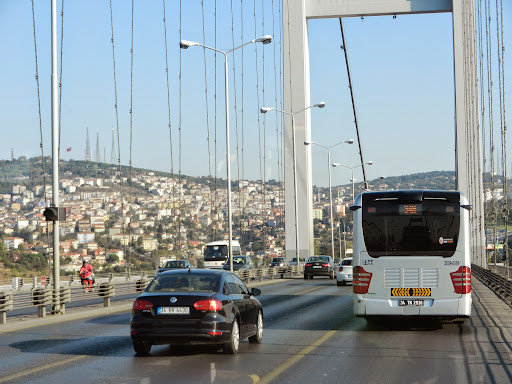
Functionally, the 15 Temmuz Şehitler Bridge plays a crucial role in easing Istanbul's notorious traffic congestion. It facilitates the movement of millions of commuters between the two continents daily. The bridge also offers pedestrian lanes, allowing for a unique experience of walking between two continents while enjoying breathtaking views of the Bosphorus.
Beyond its utility and beauty, the bridge holds deep symbolic value. It was renamed to "15 Temmuz Şehitler Bridge" (July 15 Martyrs Bridge) in honor of the civilians who lost their lives during the failed coup attempt on July 15, 2016. This act of renaming transformed the bridge into a memorial and a symbol of democracy and resistance for the Turkish people.
In summary, the 15 Temmuz Şehitler Bridge is a marvel of engineering, a vital transportation artery, and a poignant symbol of resilience and unity. It stands not only as a physical link between two continents but also as an emblem of Turkey's historical depth, cultural diversity, and contemporary strength. A visit to Istanbul is incomplete without experiencing the majestic presence of this bridge, whether by driving across it, walking along its lanes, or simply admiring it...
Read more