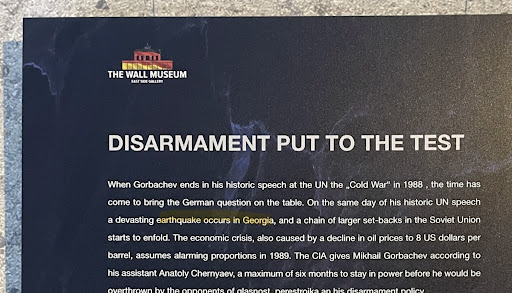
near the historic Checkpoint Charlie border crossing point between East and West Berlin during the Cold War. Here's some information about The Wall Museum:
History and Purpose: The Wall Museum was established in 1962 by human rights activist Dr. Rainer Hildebrandt. Its primary purpose was to document the history and significance of the Berlin Wall and to raise awareness about the division of Berlin during the Cold War era.
Location: The museum is situated in the Friedrichshain-Kreuzberg district of Berlin, close to the former border crossing point at Checkpoint Charlie. It occupies a prominent position along Friedrichstrasse, a major street in the city.
Exhibition: The museum's exhibition provides a comprehensive overview of the history and impact of the Berlin Wall. It features photographs, documents, artifacts, and audiovisual presentations that depict the construction, division, and eventual fall of the Wall. The exhibits highlight personal stories, escape attempts, and the efforts of individuals and organizations to promote human rights and freedom during this period.
Focus on Human Rights: The Wall Museum places a significant emphasis on human rights issues, as it seeks to shed light on the political and social consequences of the Berlin Wall. It showcases the struggles and stories of those affected by the division and oppression, both in East and West Berlin.
Checkpoint Charlie: The museum is located near the historic Checkpoint Charlie border crossing, which was one of the most well-known and heavily guarded crossing points during the Cold War. The checkpoint and its surroundings are also part of the museum's exhibition, providing visitors with a deeper understanding of the checkpoint's significance and the events that took place there.
Documentation and Education: The Wall Museum serves as a documentation center, preserving historical materials and providing educational resources for visitors. It aims to foster dialogue and reflection on the history of the Berlin Wall and the broader context of the Cold War, with the goal of promoting understanding, tolerance, and the protection of human rights.
Visitor Experience: The museum offers an interactive and informative experience for visitors. Alongside the exhibitions, there are audio guides available in multiple languages to provide additional context and narration. The museum also has a shop where visitors can purchase books, souvenirs, and memorabilia related to the Berlin Wall and the Cold War.
The Wall Museum (Museum Haus am Checkpoint Charlie) stands as a testament to the historical significance of the Berlin Wall and the impact it had on the lives of people in Berlin and beyond. By preserving the memory of this period, the museum contributes to the understanding of the struggles for freedom and...
Read moreyoung guy that works there with the blonde pony tail is nice. old guy with mustache is RUDE as hell. To me as well as other customers. I wish I didn't buy a souvenir there. Will recommend people to not go there. There is a better one called Mauermuseum down the street from this one!
Edit: Since Karsten Historiker (the old man who was rude) decided to reply with LIES to my review, I have decided to edit with the full story. I did not leave the museum happy at ALL.
First of all, it is a video-based museum but many headphones were fully broken or ripped in half! A few screens, including the big room where the fall of wall is shown, were also malfunctioning. So, the museum in itself was poor in quality.
Second of all, I already noticed how rude Karsten was when I entered the souvenir shop. Customers in line at the register who CLEARLY wanted entrance to the museum were ignored as he talked to the other employee, until they spoke up.
Third of all, when I went to pay for the two souvenirs I bought (the total being €8,49) he refused to accept the €10,50 I gave. Instead, he gave me €1,50 and my €0,50 back. When I insisted to accept the €0,50 because I don't need the extra change, he became rude and refused! I have worked a till in the past and could see the money laid out, so I know it's also easier for him to accept. Weird behaviour?
Third of all, I went to return the cheapest souvenir after calling my friend who said they would prefer a different souvenir. There was approximately 3 minutes between buying and returning. Karsten laughed at me and tried to treat me like a dumb foreigner. Telling me in a condescending tone that you cannot return anything unless it's damaged because "this is not how it works in Germany" and that it is "impossible". I understand German. I live 20 minutes away from Germany. I shop there regularly & I have returned items in Berlin before, including in a souvenir shop. I know its possible & I know how it works in Germany. If there is a No Return Policy, customers should be informed before buying.
Now, I decided to let it go and walk away from the situation. However, I could not because I heard him talk rudely about me in German when I walked away! He thought I could not understand him LOL. So, I decided to e-mail the museum and the response I got was many days later when I had left Berlin. They barely apologised for the situation, but did mention I could return the item if I wished. That e-mail is very contradictory with Karsten's actions in the shop and his own response below though, so it seems the internal organisation is also not well done lol.
There are many good museums in Berlin if you wish to educate yourself more. Unfortunately, due to the quality of museum and staff, this is not...
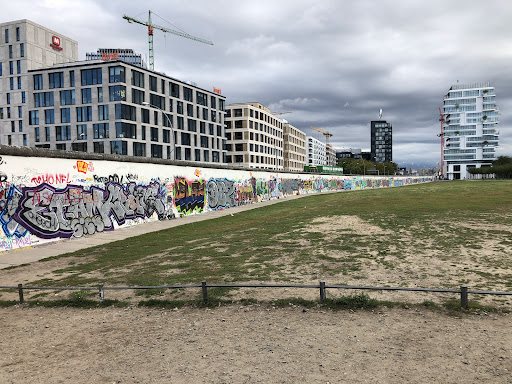
Read moreThe word "wall" does not describe the full extent of the barrier which cut Berlin into two halves from 1961 to 1989. The Berlin Wall was, in fact, a wide corridor between two walls. One wall marked the actual border on the west side of the corridor, while a second wall closed off the corridor to the east. The death strip, which included a narrow sentry path for the border guards of the GDR, lay in between. In the inner city, the corridor separated the old city centre along its northern, western and southern boundaries from the West-Berlin districts of Wedding, Tier garten and Kreuzberg. Today a twin row of cobble-stones stretching several kilometres marks the exact location of the former border wall, and is being gradually extended.
The Wall that encircled West-Berlin for almost thirty years had a total length of 160 kilometres. Of these, 45 kilometres separated the west from the east part of the city, while a stretch of 115 kilometres cut it off completely from the neighbouring Land of Brandenburg. More than 100 sites commemorating the victims and particular Wall-related incidents are spread along this route today. In 2001, the Berlin Senate launched its "Berlin Wall Trail” project with the aim of gradually making the entire 160 kilometres of the former Wall accessible to pedestrians and cyclists. Signs indicate the direction, aerial views afford an overall perspective, and information points highlight historically significant sites, thereby complementing the information boards installed by the Geschichtsmeile Berliner Mauer (Berlin Wall History...
Read more