Honestly, I can't give a low enough rating for this place and not even for the art. In a nutshell for those who don't want full details: gallery attendants will not inform you of rules and they are only displayed on a piece of glass outside, off to the side of the door. Very unprominently and unnoticeable. attendants are rude, uncommunicative and uncooperative, they are mute and uncaring. organization of the art both for the audiences viewing and marking of minimum distance is severely lacking. organization of the art for the purposes of finding a particular media or style is null and void entirely. There's an upper level sign staying what's up there entirely, no signage pointing towards anything. don't go for the full price if you can avoid it, it's not worth it. Better galleries like Haus der Kunst.
The staff was horrible. We came on a Sunday for one euro, maybe everybody else who paid full price on different days are the 5 star viewings, or they're fake. There is one sign, which we found and saw fully on the door on our way out, stating no food or drink, even water bottles during the summer; no backpacks or rucksacks, although apparently a woman's purse who was larger than my not one foot by 3/4 foot travel purse was allowed while mine wasn't??, At the desk while paying for our tickets are backpacks were displayed as we had all pulled them up to get our cash, water bottles on the outside also quite obvious, not a word from the attendant taking our money and giving us our arm bands and tickets. It wasn't until we tried to go to the actual displays someone put their hand up in front of us and said we couldn't enter, not in English and we couldn't understand them, and they didn't seem inclined to speak English or assist but more aggressively stating we couldn't enter because of our bags, not mentioning the water bottle and it's roughly 30degrees that day. We find the lockers which require a 2 euro deposit which you get back, it only takes a 2 euro coin so if you don't have it you have to pay for a bag check or get some, And go back up to try again to be told no water either. Again at this point in time nobody had said, nor where there signs going into the museum that we werent allowed either of our purse bags or our bottles. The staff despite being told we didn't understand them just switched between German, Italian and french. Whom were also smiling after we threw our bottles away to avoid trecking downstairs to deposit them. Entirely snobbish and amused that their lack of cooperation was unprofessional and rude. And as I stated before, almost every other woman there besides us three had their purse, most were larger than our little travel bags of not a foot in height by a foot in length. I'm willing to bet had we not worn them as backpacks but switched the straps to the purse style there wouldn't have been an issue. So why did they make one? From what I can tell is because it amused them.
The art was an alright selection, but it wasnt displayed as well as it could have been, large pieces placed into the upper balcony areas with barely enough viewing space. All the while you're not allowed to get closer than a meter to each piece, although it says that nowhere in the gallery and no attendant will inform you of that upon entry to rooms o lr the museum, and there's no barriers to stop you from getting closer, or lines/rope indicating a distance. If you get closer than that the alarm will sound; let me tell you it was going off every minute we were there.
As an art student, I couldn't recccomend this place at all, the gallery displays no concious effort to organizing the art in a thoughtful way, or promoting positive viewing experiences either with the art, or with the service. I'm just glad we didn't go the Saturday and pay the full 20 euroes to be treated like...
Read moreI have always loved the Pinakothek der Moderne, but today's visit turned out to be the most absurd experience of my life, especially as a mother with a one-year-old child in a stroller.
We bought tickets at the entrance and spent some time in the lobby. However, when we decided to go down to the basement to look at the design icons, a museum employee demanded we check in our diaper bag. It turned out that you can't bring food or drinks for children into the museum. Even airplanes allow baby food bottles! Fine. We checked the bag in the cloakroom and went back.
To reach the basement, we were directed to a lift hidden outside the lobby behind a heavy iron door. To get into the lift, you had to open the door with both hands, press the button, and quickly pass through the rapidly closing doors with a stroller, trying not to get caught by the closing iron door. The basement floor had the same complex procedure for getting back upstairs.
These difficulties show that the museum's management clearly does not consider the interests of visitors with children, let alone people with disabilities.
In response to my complaints, the staff said: "You should go to the Deutsches Museum with a child," "Those are the rules. File a complaint on the website," and "All mothers manage, and you should be okay." This is not okay, and it's worth speaking up and filing complaints. As long as mothers stay silent about such situations, the conditions will not improve!
And come on. Museums aren't just for older people or those without children. They should be dynamic places that encourage experimentation and action, not static spaces like cemeteries.
The last straw was an incident on the first floor. As we were exiting the elevator, a museum employee demanded that we remove a paper wrapper with pretzel leftovers from the stroller, which we had been carrying around without issue on the basement and ground floors of the museum. There was no trash can next to the elevator, so we had to go back down again.
We went back to the cloakroom, took our diaper bag, and went for a coffee to return to our zen state. Then we returned the bag to the cloakroom, threw away the wrapper, and went back up to the first floor.
Now, the employee noticed a baby water bottle I had accidentally left in the stroller during the time in the cafe. That was my mistake. Fine. I went back to the cloakroom again and returned.
But then the employee told me I needed to return to the cloakroom and remove all items from the stroller. When I asked for the employee's name, he refused to give it and hid his badge. Such rudeness is hard to find.
The museum staff outdid themselves today, and no one apologized for the inconvenience.
A museum that positions itself as a leader in the art world should be able to provide basic amenities for all its visitors, especially mothers with young children. Despite its claims of modernity, the Pinakothek der Moderne fails to accommodate the needs of families and other visitors who require more...
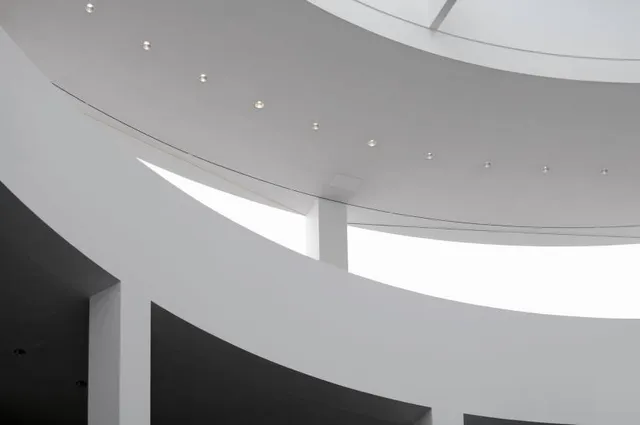
Read moreThe Pinakothek der Moderne in Munich is not just an art museum—it’s a place where different but connected disciplines come together. Rightly described as four museums in one, it encompasses painting, graphic art, industrial design, and architecture, all accessible with a single ticket. This multifaceted approach makes it a uniquely comprehensive space for experiencing the breadth of modernism.
What sets the museum apart is its conceptual depth. The integration of architectural models and industrial design artifacts—alongside traditional paintings—speaks volumes about Germany's foundational role in the early development of modernism. Engineering products such as turbine blades, fins on air cooled engines, ship hulls that minimize hydrodynamic drag all follow forms derived from fundamental scientific principles that has dtiven the fast paced progress of technology to this day. Early modernists such as Le Corbusier embraced this and they thought that few physical objects could evoke the spirit of modernist innovation more vividly than an aircraft engine, and in many ways, this museum feels like a space Le Corbusier would have admired—or even curated himself.
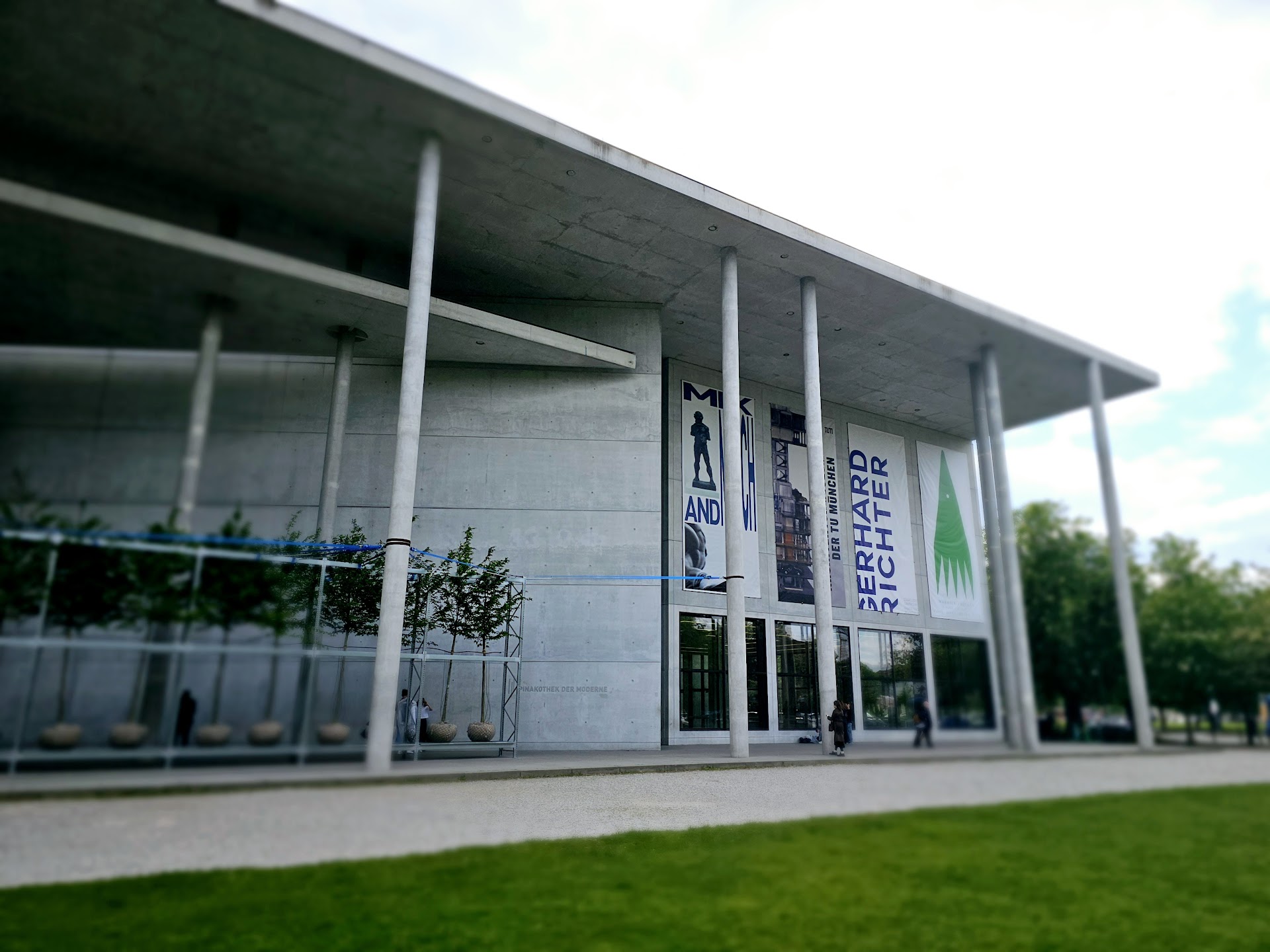
Adding to its dynamic atmosphere, the Pinakothek der Moderne frequently hosts temporary exhibitions. During my last visit, I had the pleasure of seeing a beautifully curated exhibition of Gerhard Richter’s work, which perfectly complemented the museum’s permanent collections.
Occasionally, visitors are also treated to live classical music performances, such as string quartets playing in the grandeur of the main entrance hall—an experience that adds a sensory richness to the museum’s already immersive environment.
Before leaving, be sure to explore the museum’s exceptional bookstore. Stocked with carefully selected titles on art, design, and architecture (in both German and English), it’s a treasure trove for enthusiasts and scholars alike, offering publications that are often difficult to...
Read more