I have been to many museums in my day. Some of the greatest in the world, The British Museum, Rijksmuseum, The Met, the Smithsonian, etc... Very, very few I have been to even come close to the experience I received. To be clear, the museum is not for the faint of heart. The subject matter covered is rough to say the least, being Budapest’s constant reminder of the various dictatorships rulling over the city in the twentieth century.
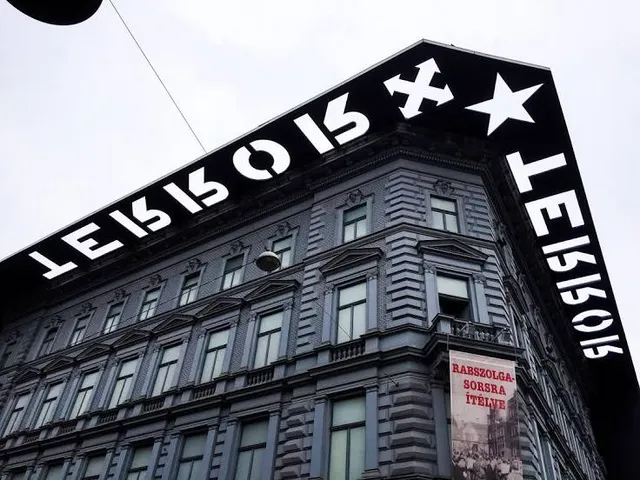
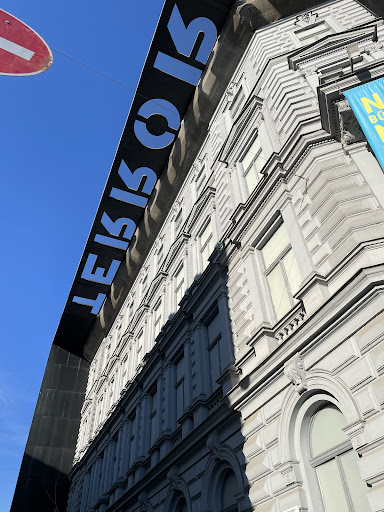
First, the “house” itself is the perfect spot for a museum on this subject. Andrassy ut 60, 1062 has been the center for both the Arrow Party (the Hungarian Fascist party during the Second World War), and the AVH (the hungarian state police during the Communist control of the country.) Now, the museum is based around both the fascist and communist dictatorships and their rule over the country.
The very first thing the prospective viewer sees is one of the tanks used to crush Hungarian citizens during the 1956 rebellion. From there, an extremely in deapth exploration of the later twentieth century from the Hungarian perspective. The table where Arrow Party members agreed to send Jewish Hungarians to death camps in the same place it stood. Another room sees a perfectly preserved AVH office, still adorned with Stalin portrait and death warrants lying on the table. The museum is filled with fascinating artifacts, from items as mundane as fur lined boots from the second world war and communist canned milk; to the clerical uniform of a Hungarian bishop sent to death by the communist government.
This alone would have made the terror haza one of the best museums I had ever been to... but then one gets to the elevator. The entire museum had been guided by an E-guide, providing meaningful context in the English language. The elevator you walk into ends this. As you begin on what feels like a 30 minute decent down to the basement, the only thing piercing the pitch black is a small television screen. An interview with a former janitor of the Terror Haza plays, recounting the procedure of mopping up AVH-conducted executions. Suddenly, the smell of sterile halways and artifacts makes way for the stagnant pools of blood that haunt every stone of the building.
I struggle to rethink the basement in my mind. Not that its not very resonant... rather it expresses the feeling of pure dread only execution cells can convey. The basement is damp and cold, the rooms cramped and confined building fear. And when you walk into the end of the hall, the looming gallows end all dread, turning to sheer despair.
This is not to say the museum is purely for misery, however. Rather, the feeling of defiance in the face of unimaginable tragedy is apparent. Few images remain in my mind quite as strongly as the Hungarian Revolution flag, symbol of oppression removed by the blade, the righteous fist of the people waving high against the forces seeking to destroy Hungary.
I highly recommend the terror haza....
Read moreI want to be as nuanced and sensitive as possible with this review. I came to the museum about 80mins before closing so understandably I wasn’t able to get the whole experience including the audio tour, however with that being the case it would have been good if there was a reduced ticket price. I paid £9. Luckily they have an app that you can use to follow along as you move through the museum, so for English speakers you still won’t miss out on the information. The layout of the museum was well done and it was easy to move through each of the exhibits. As a history nerd I particularly liked the inclusion of specific memorabilia, videos and photographs from the eras being discussed.
Now for my review of the museum content. I have to say that I was not a big fan of the content of this museum. As many other reviewers have shared, it felt as though the museum was simply created to propagate anti-Communist and anti-Socialist propaganda. First of all, the comparison of communism with Nazi fascism is politically incorrect as they are two completely separate ideologies which exist on complete opposite ends of the political spectrum. While Sovietism and Nazism were both totalitarian regimes, only Nazism is definitively fascist. Also, they frequently use the words communism and socialism interchangeably despite that fact that although they share some ideological similarities, they are again two distinct political concepts. The vast majority of the museum focuses on the Soviet era whereas there is barely any deep focus on the Nazism that infiltrated Hungary (I would say like 80% of the museum is focused on the Soviet era vs 20% on WW2. Although I understand this might just be because the Soviet era lasted longer). ALSO, they completely frame Hungarians as being solely victims of Nazi Germany when there is well documented evidence that there were Hungarians who were active and (dare I say) willing participants in Nazism! It is interesting how the museum is able to highlight the Hungarians who actively participated in Sovietism, yet does not throughly mention/acknowledge the ones who participated in Nazism. Finally, I found the complete conflation of communism with sovietism quite problematic, as the methods used to enforce communism during the Soviet era are not accurately representative of the entire political ideology. Unfortunately many people lack an understanding of communism outside of the imperialist Soviet Union and red scare tactics, so this only reinforces this miseducation. If you want a more nuanced understanding of the ideology, you are better off doing independent research outside of the museum.
I say all of this whilst acknowledging the importance of demonstrating the horrors that occur under any totalitarian regime. I am not reducing the harm caused by Sovietism to Hungary, I am however critiquing the biased portrayal...
Read moreToday, after a debacle with the open top bus, my dad and I decided to visit the House of Terror. Having visited many museums in other countries, including KGB museums which offer a similar experience, we were pretty excited for what should be a great museum - oh how wrong we were.
The first incident was a very rude woman (who more resembled a snarling guard dog) with relatively long black hair on the reception desk. She abruptly and rudely told us they don’t do senior prices, or student prices for people from England (first place I’ve ever experienced this in 20 different countries) and then decided to say “it’s not difficult to understand” multiple times to us. But this was just the beginning. After this, we entered the museum, and after twenty paces were shouted at by a security guard telling us we can’t take our rucksack in, despite other people taking their bags in. Why did the woman on the desk not tell us? I then had to wait ten minutes at a “locker room” (a room with an elderly woman placing bags on hooks) before said elderly woman returned to the room and dealt with the long queue of people waiting to drop off their bags. She had been sitting at a table just outside the room, watching the queue get longer and longer.
The woman on the front desk had already ruined it for us entirely, and I can see a lot of reviews about her but, once we entered the museum, it went from bad to worse. The museum is almost entirely just small videos playing on the walls, with no English captions, and the sound all overlaying one another. There aren’t really any actual exhibits, and the ones that are there don’t have English translations.
They offer paper sheets every so often with a translation, but if you have left your glasses in the rucksack (assuming there would be properly labelled exhibits) then you’re stuffed (like my dad was). There aren’t really any signs saying what anything is, no dates so no sense of time period etc… You then reach the end of the exhibition, with a lift to go to the underground exhibition. This lift however, takes 4 minutes to go down, due to an actually interesting video playing in it. People waiting are stuck in a small room with another un-captioned video playing. The underground exhibition whilst interesting to look at, is equally disappointing: it has no signs to tell you what any rooms are, no signs saying what anything is etc… Once you reach the end, you’re told you can’t use the lift to go back up, and have to walk all the way through the exhibition again to use the stairs.
Complete shambles. For the quality it is, it should be free. They should Visit similar museums such as the KGB museums in the Baltic states to see how to portray these...
Read more