History:The Sri Kadu Malleshwara Swamy Temple, located in Malleshwaram, Bangalore, is one of the city’s most historic and culturally significant temples with a heritage spanning several centuries. This temple's origins trace back to the era when the Bangalore village was part of the Bijapur Sultanate, granted to Shahaji, the father of Maratha founder Shivaji Maharaj, as a 'jagir' (land grant).
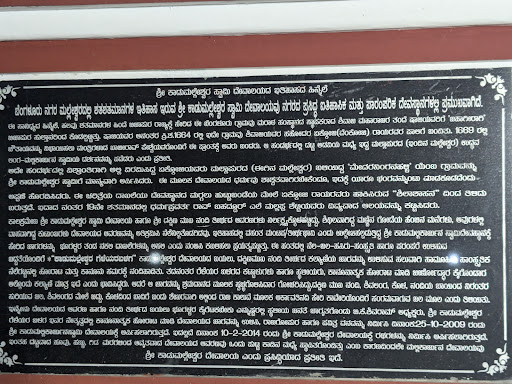
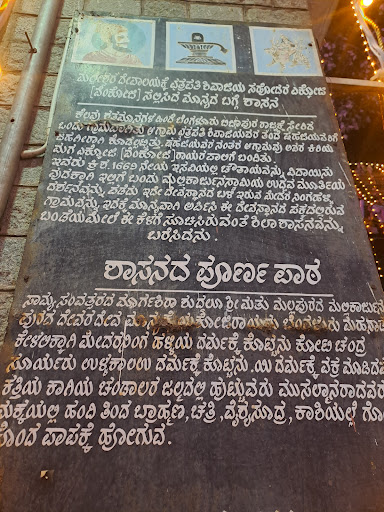
Later, in 1664, after Shahaji’s passing, the village was passed on to Shivaji's brother Venkoji (Ekoji). In 1669, Venkoji, accompanied by his minister Bajirao Pingle, arrived in the region to oversee administrative matters. During this period, they visited the deity Anga-Mallikarjuna Swamy in what was then a dense forested area known as Mallapura (now Malleshwaram). Legend holds that they were deeply moved by the deity's presence.
While resting there, Venkoji granted the nearby village of Medaraninganahalli as an offering to Sri Kadu Malleshwara Swamy. He declared that the temple should remain forever sanctified and that no harm should come to its existence. A stone inscription by Venkoji, placed at the temple, records this historical event.
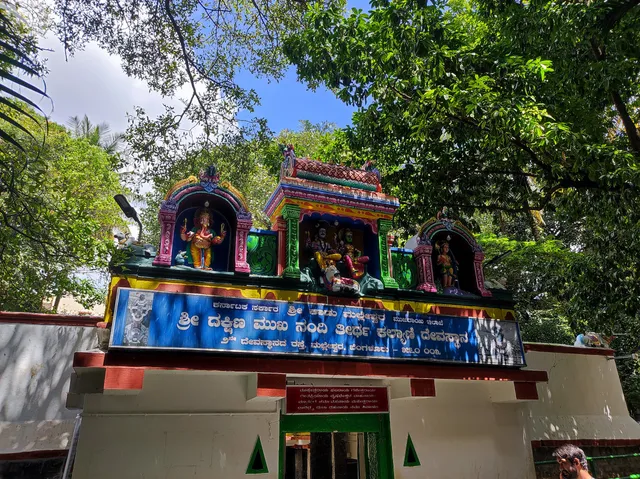
In the 19th century, philanthropist Dharmapravarta Rao Bahadur Ele Mallappa Shetty constructed the divine temple structure. Over time, however, the temple premises and the adjoining Nandi Teertha area fell into neglect, with mud walls and structures around the temple being encroached upon. In recent history, a group of land grabbers even attempted to usurp temple land by presenting fake documents as genuine records. In response, a group of dedicated locals formed the Kadu Malleshwara Geleyara Balaga (Friends of Kadu Malleshwara) to protect and preserve the temple’s premises, the sacred well (Teertha), and surrounding green spaces. Through legal struggles and community efforts, the group not only safeguarded the temple’s land but also discovered a hidden water source, the Dakshina Mukha Nandi Teertha.
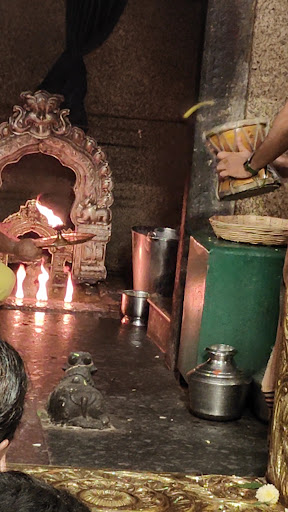
When the area around the sacred well was cleaned, they found a south-facing Nandi idol, a Shiva Lingam, a small pond, and a continuous flow of water emerging from Nandi’s mouth, falling onto the Shiva Lingam, and collecting in a pond. The water then drains into a well, flows through a canal, and eventually merges with the Arkavathi River, which further joins the Cauvery River.
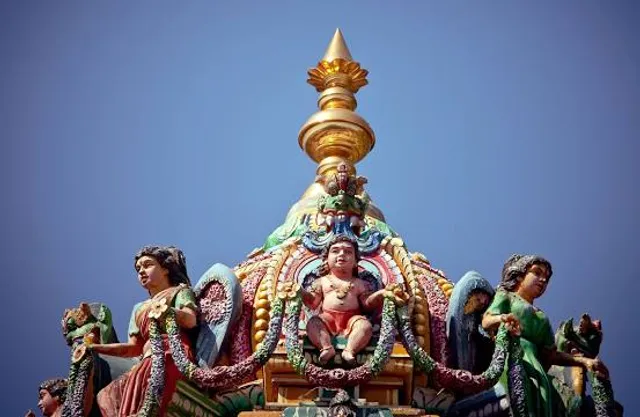
With growing awareness, local leaders, including B.K. Shivaram, along with Kadu Malleshwara Geleyara Balaga, led a legal and cultural fight to preserve the temple. They erected a grand Rajagopura (main temple tower) and restored the sacred forest around the temple. On October 25, 2009, the temple was formally consecrated. Furthermore, on February 10, 2014, chariots were constructed and dedicated to the temple.
Nestled amidst thick greenery, filled with various trees and flowering plants, the temple became popularly known as "Kadu Malleshwara," signifying a deity residing within a forested area, thus deriving its...
Read morePerched atop a small hillock in Malleshwaram, Shri Kadu Mallikarjuna Swamy Temple is a spiritually vibrant and historically significant Shiva temple in Bangalore. With about 50 steps leading to the sanctum, the gentle ascent adds to the sanctity and elevates the visitor into a calmer, more meditative space. The short climb offers a symbolic and physical elevation ushering devotees into a peaceful, sacred space that feels far removed from the chaos of city life.
The temple is dedicated to Lord Mallikarjuna, a form of Shiva, and is often revered for evoking the same divine energy as the famous Jyotirlinga at Srisailam. The main Shiva Linga here is swayambhu (self-manifested), which lends a unique spiritual potency to the sanctum.
The temple dates back several centuries and was originally located in a forested area—hence the name ‘Kadu’, meaning forest in Kannada. Despite the urban surroundings that have since grown around it, the temple retains a sense of untouched divinity and calm. The spiritual ambience is particularly powerful during the early morning hours, Mondays, and Pradosham, when the chanting and rituals envelop the temple in a deeply devotional atmosphere.
The Kadu Malleshwara Temple is not just a spiritual center but also a site of historical significance. According to an old inscription, Chhatrapati Shivaji’s brother, Ekoji (Venkoji Rao) visited this temple in 1669 A.D. He had come from Tanjore to bid farewell to his father Shahaji after his death and dedicated this village of Medaaka Ninganhalli (present-day Malleswaram) to the deity Mallikarjuna. This connection to the Maratha legacy adds a unique historical depth to the temple’s sanctity. A must-visit for heritage and history lovers.
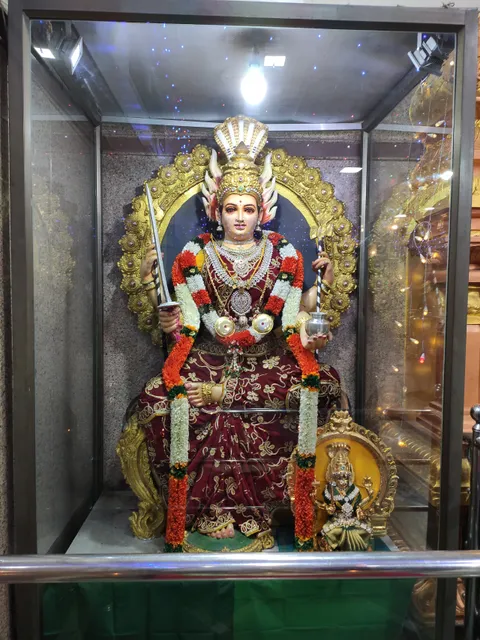
In addition to the main shrine, the temple complex houses several other deities, making it a rich spiritual ecosystem. These include Ganesha, Parvati, Dakshinamurthy, Kaal Bhairava, Durga, Chandikeshwara, Hanuman, the Navagrahas, and Subrahmanya. Each shrine is well-maintained and offers devotees a complete spiritual experience in one location. The temple is simple, clean, and remarkably free from commercialization, which makes the experience feel genuine and rooted.
For anyone seeking a spiritually elevating space in the heart of Bangalore, Shri Kadu Mallikarjuna Swamy Temple offers a rare blend of history, divinity, and peace. It’s a must-visit not just for devotees of Lord Shiva, but for anyone interested in the city’s sacred heritage and spiritual geography.
Adding to the temple’s sacred geography, it is flanked by several other ancient shrines in the vicinity—such as the Narasimha Temple, the Dakshinateertha Shiva Temple, and the Ganga Devi Temple making this a spiritually rich locale of Bangalore North.
That said, parking is a known challenge in this area. The narrow lanes and limited space make it advisable to either visit early in the day or opt for public transport or...
Read moreThe name of the area where this temple is located is named after this temple as Malleswaram. This temple built in Dravidian style is seen just diagonally opposite to Nandi Theertha temple tank. Actually Nandi Theertha is considered as a part of Kadu Malleswara Swamy temple. This temple built on a high hillock was set up by Venkoji, step brother of Shivaji in 17th century (1669)when he came here with his minister Baji Rao peshwa. The word “Kadu” in Kannada means “Jungle”. As the surroundings are full of wild trees and shrubs, this temple is called “Kadu Malleswara temple. Venkoji also built Narasimha Swamy temple seen at the foot of the hillock near Gangamma temple. In 1898 a devotee called Yale Mallappa Shetty renovated Kadu Malleswara temple. In 1981 the Goverenment renovated Narasimha Swamy temple also.
One has to climb nearly forty steps to reach the temple on the hillock. One finds many serpent stones and a huge serpent statue near the foot of the hillock. The surroundings look very attractive with green trees and plants. Near the entrance of the temple on the left side one can see a mandapa and the kitchen. The Vimana or gopuram of garbha gudi (inner sanctum) was built later in 1993.Recently a mukha mandapa (outer mandapa) was added. The idol of Kadu Malleswara is a tiny Shiva Linga with a pretty statue of Nandi in front outside the inner sanctum. On the back of the inner sanctum to the south,one can see deities of Dakshina Murty and Lord Subrahmanya and on the north, the statue of Chandikeswara. In the Mukha Mandapa the deities of Arthanareeswara, Kashi Viswanatha, Ganapati and Kalabhairava are seen. The navagraha platform is also seen on the other side. There is also Anjaneya temple with a bilwa tree seen behind it.
In this temple one week-long special utsavas are celebrated during Maha Shiva ratri and special poojas are done during kartika month. The temple timings are from 7.00 a.m. to 12.00 p.m. and from 6.00 a.m. to 9.00 p.m.
The nearby temples are Nandi Tirtha Kalyani temple, Narasimha Swamy temple, Gangamma Temple, Gayatri Temple, Vidya Ganapati Temple (W.Park Road), Eswar Temple (11th Cross, malleswaram), Sri Maha Ganapati Road (9th Cross, E-Park Road) and...
Read more