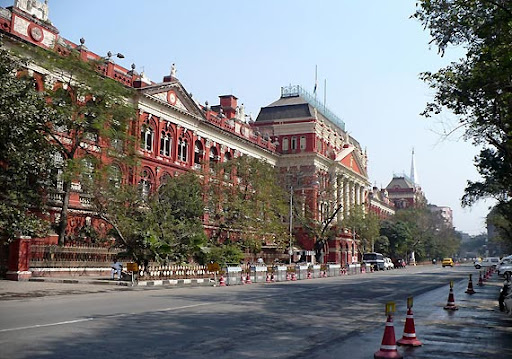
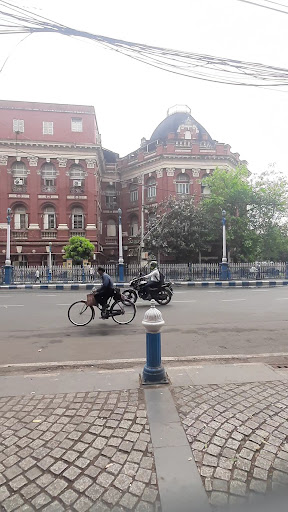
The Writers' Building is a historic government administrative building in Kolkata, West Bengal, India. Here are some key points about Writers' Building:
History: The construction of the Writers' Building began in 1777 during the tenure of Warren Hastings, the first Governor-General of Bengal. The building has undergone several expansions and renovations over the years.
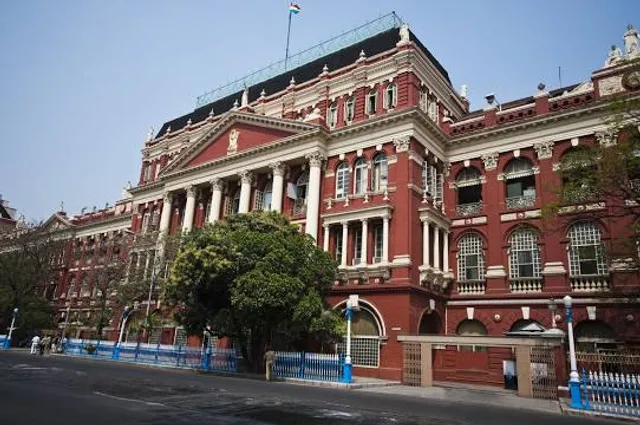
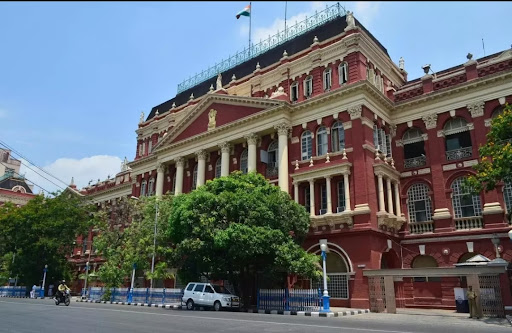
Architectural Style: The building is a fine example of British colonial architecture and features a blend of Indian and European architectural styles. It has a distinct red hue, which is characteristic of the colonial buildings in Kolkata.
Original Purpose: The original purpose of the Writers' Building was to house the clerks and junior officials of the East India Company, who were known as "writers." It served as the main administrative office for the British East India Company.
Government Offices: Over time, the Writers' Building became the seat of the government of Bengal and later West Bengal. It housed various government offices, including the Chief Minister's Office, until it was relocated in recent years.
Central Location: Writers' Building is centrally located in the B.B.D. Bagh (Dalhousie Square) area of Kolkata, is historically significant for its colonial-era structures and administrative offices.
Notable Features: The building features a clock tower and a statue of Minerva, the Roman goddess of wisdom, at its entrance. The clock tower has been a prominent landmark in the city.
Political Significance: Writers' Building has witnessed several important political events, including anti-colonial movements and protests during the independence struggle. It holds historical significance in the context of India's fight for freedom.
Restoration and Renovation: In recent years, Writers' Building has undergone restoration and renovation efforts to preserve its historical architecture. The restoration work aimed to maintain the building's heritage value.
Cultural Heritage: Writers' Building is considered an integral part of Kolkata's cultural and architectural heritage. It represents the city's colonial past and administrative history.
Access Restrictions: Access to certain parts of the Writers' Building may be restricted due to security concerns, especially given its historical importance and government functions.
Change in Function: In recent times, some government offices have been shifted to new locations, and the building's functions have evolved. It may house government departments or cultural organizations.
Writers' Building continues to stand as a symbol of Kolkata's colonial history and administrative legacy. Visitors interested in its history and architecture may explore its exteriors and surroundings, taking note of its role in India's political and...
Read moreThe Writers' Buildings, often shortened to just Writers', is the official secretariat building of the state government of West Bengal in Kolkata, India. The 150-meter long building covers the entire northern stretch of the iconic Lal Dighi or Red Lake at the centre of historic B.B.D. Bagh, long considered as the administrative and business hub of the city. It originally served as the principal administrative office for writers (junior clerks) of the British East India Company (EIC). Designed by Thomas Lyon in 1777, the Writers' Building has gone through a long series of extensions over the centuries. Since India's independence in 1947, it housed the office of the Chief Minister of West Bengal, cabinet ministers and other senior officials, until 4 October 2013, when a major restoration of the building was announced. The majority of government departments were subsequently moved out to a new repurposed building named Nabanna in Howrah on a temporary basis. Regarded as Kolkata’s first 3-story structure, the Writers’ Building in BBD Bagh (Dalhousie Square) is a renowned landmark. It is now the West Bengal Government Secretariat and is estimated to be valued at around Rs 653 crores.
The breathtaking architecture and interior design of the Writers’ Building in Kolkata bring in tens of thousands of visitors from all over the globe every year. It is an impressive 150 metres in length and many sculptures honouring Greek deities and the Roman goddess Minerva can be found within the structure.
The enormous complex comprises a total of 13 blocks, the last six of which were not built until after India attained its independence. Many sculptures depicting Greek deities and a sculptural representation of the Roman goddess Minerva may be seen throughout the structure.
Address: Binoy Badal Dinesh Bag N Rd, Lal Dighi, B.B.D. Bagh, Kolkata, West Bengal 700001
By air: The closest airport is Kolkata’s Netaji Subhas Chandra Bose International Airport, which provides service to all important cities in India. Once you have arrived, prepaid taxis or rental cabs can take you to the Writer’s Building.
By train: Trains to all of India’s main cities depart from and arrive at Howrah Junction Station, the closest station. Visitors can take a bus, prepaid taxi or book a cab via one of Kolkata’s many reliable vehicle rental agencies. It is also possible to take a bus to BBD Bagh.
Local transport:: Public transportation is plentiful and includes taxis, auto rickshaws, and the city’s historic trams, making it the only city in India with a functioning tram system. Writer’s Building’s tram stop is at B.B.D Bagh
Day Timings Monday – Saturday10:00 AM – 6:00 PMSundayClosed
Entry Fee: There is no entry fee to visit...
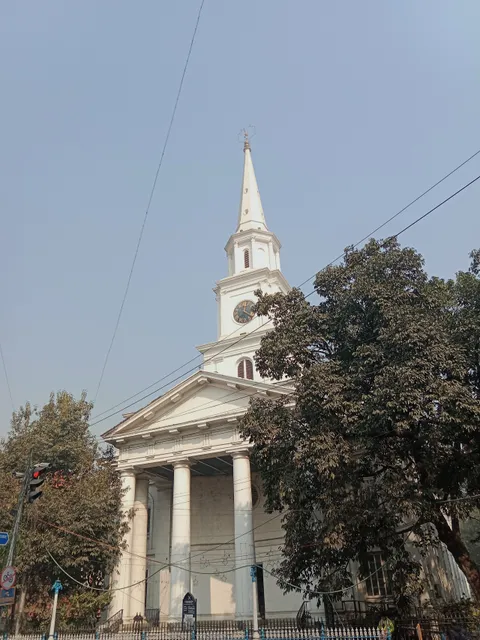
Read moreVery old and Prestigious building, Office for writers of the British East India Company adjacent to Lal Dighi.On 8th December 1930 freedom fighters Benoy Basu, Badal Gupta and Dinesh Gupta dressed in European outfits shot dead the notorious Inspector General of Police, Colonel N.S. Simpson, infamous for his brutal oppression of the prisoners in the jail, in this Writers' Building. Now Dalhousie Square is named after the trio and is called B.B.D. Bagh.It used to be the seat of power till the current Chief Minister shifted the main offices to the other side of thy. From the time of the British to that of the Left front, it was from this place that all major decisions took place. An immense structure. However, you will not be able to get a guided tour of this facility. Only if you are there for specific official work, you will be allowed inside. It is just like any other government office with stacks of files, documents and racks/almirahs. Again, if you are not in a government owned vehicle, you will not find carking in it's close proximity. But then, finding parking is a nightmare in that part of the city. But you can drive by slowly and see the grandeur of the building. This 18th century heritage building, built way back in 1777 for the lowly writers of the East India Company served as State Secretariat of West Bengal Government, housing officials including Chief Minister of the State. It is under renovation since 2013 when most of the offices moved out. On 8 December 1930 Benoy Basu, Badal Gupta and Dinesh Gupta shot dead the notorious Inspector General of Police, Colonel N.S. Simpson, infamous for his brutal oppression of the prisoners in the jail in this Writers Building and killed themselves when overwhelmed by the British forces. There are statues of these three revolutionaries in the vicinity and the area is named after them as BBD Bagh. I passed by the building recently which has the church nearby and took a few photographs. I have visited this building a few times including a call on on the then Chief Minister of West Bengal Jyoti Basu.Writers' Building was established in 1770 originally to serve as the office for writers of the British East India Company, hence this name. Writers' Building was designed by Thomas Lyon in 1777. The giant pediment at the centre is crowned with the statue of Minerva. The terrace also contains several unique statues of Zeus, Hermes, Athena and Demeter christened as Justice, Commerce, Science and Agriculture respectively. Outsiders are not allowed inside. You have to see the Building from outside...
Read more