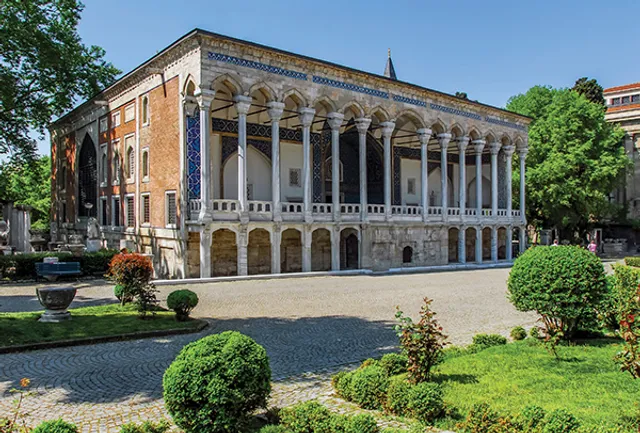
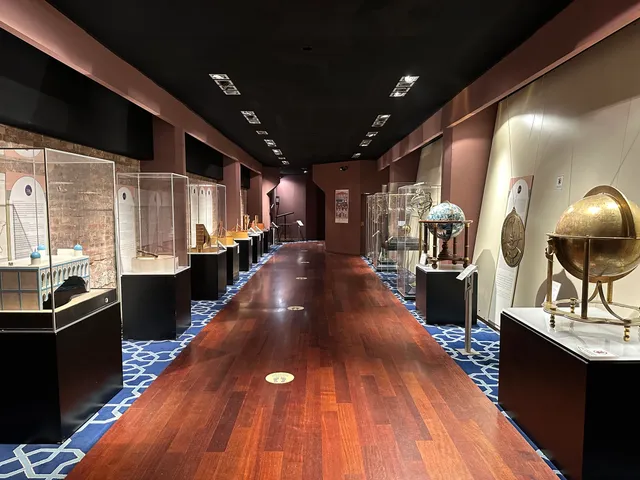
This is the "Tiled Pavilion" part of the Archeology museum. Beautiful tiles from different times and places (İznik - Nicea, Kütahya) can be seen. Osman Hamdi Bey, accepted as the first Turkish archeologist, managed and contributed a lot to this museum; one of his paintings is here. According to the notes on site: Çinili Köşk, now serving as a museum where outstanding samples of Turkish tiles and ceramics are exhibited, was built by Sultan Mehmed the Conqueror in 1472 and due to the tiles adorning its interior and exterior it is called Sırça Saray (Crystal Palace) or Kasr-1 Kaşi (Keshan Pavilion). It is known that sports competitions were held at Aga Çayırı (Master's Meadow), Kalfa Yeri (Head Clerk's Place) and Kum Meydanı (Sand Court) on the grounds surrounding the pavilion.
In spite of the changes it has undergone during its history, the building with its porticoed entrance, eyvans (liwan) and tiles is the only secular building belonging to the Ottoman civilian architecture in Istanbul in Seljukian style. The harmony of the turquoise, white, purple and dark blue tiles made in the mosaic technique are indicators of a well-developed sense of decoration. The inscription circumscribing the door below the eyvan decorated with mosaic tiles at the entrance gives the completion date of the construction and lauds its beauty as well. The present portico consisting of 14 marble columns was constructed during the reign of Abdülhamid I (1774-1789) after the (original) old wooden portico burned down in 1737.
After the fire Çinili Köşk was alloted to the Saray Agasi (Palace Master's) for a while.In 1875 when it was decided to be used as a museum some changes were made in the interior and it was opened in 1880 as Müze-i Hümayun (Imperial Museum). For a long time the building was used for the display of archaeological and Islamic artifacts. In 1939 Çinili Köşk was turned over to the Topkapi Palace Museum and its artifacts were dispersed to different museums, thus for a time Çinili Köşk lost its function as a museum.
It was thought appropriate to display arms, costumes, fermans (imperial edicts), paintings, books, etc. belonging to Mehmed the Conqueror on the 500th anniversary of his conquest of Istanbul (1953) and the building was restored and opened to the public under the name of Fatih Müzesi (Museum of the Conqueror). Later on the building was used as a section where Turkish-Islamic and Ottoman tiles and ceramics were displayed and in 1981 was annexed to the Istanbul Archaeological Museum Management because of the proximity of their locations.
Within the halls and rooms of the Çinili Köşk Museum are exhibited the matchless samples of Great Seljukian, Anatolian Seljukian and Ottoman tiles and ceramics dating between the end of the 12th century-to the beginning of the 20th century.
The main building may take about 2-3 hours, depending on how much interest you have in history, art and details, especially the sarcophagi and Troy parts of the museum.
Further reading about Osman Hamdi Bey and the architect Valéry may help you enjoy more. Nov.16,2023: The photos you'll see about this part of the museum are all any tourist can see : it's next to impossible to...
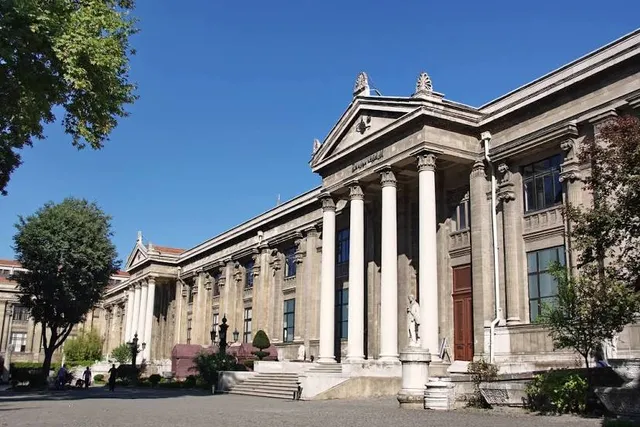
Read moreThe Istanbul Archaeological Museum is a mesmerizing time capsule that transports visitors through the depths of history. As an avid lover of archaeology, I can confidently say that this museum is an absolute treasure trove of ancient artifacts and a must-visit for anyone seeking to explore the rich cultural heritage of Istanbul. Upon entering the museum, one is immediately captivated by the grandeur of its architecture. The magnificent facade exudes an aura of antiquity, hinting at the priceless treasures that lie within. The museum is divided into three main sections: the Archaeological Museum, the Museum of the Ancient Orient, and the Tiled Kiosk Museum, each offering its own unique charm. The Archaeological Museum houses an awe-inspiring collection of artifacts spanning several millennia. From meticulously crafted statues of Greek gods and goddesses to intricate jewelry and sarcophagi, every item on display tells a compelling story of ancient civilizations. The attention to detail in preserving and showcasing these relics is commendable, as it allows visitors to truly appreciate the craftsmanship and historical significance of each piece. The Museum of the Ancient Orient presents an enchanting voyage into the cultures of Mesopotamia, Assyria, and Anatolia. The stunning array of cuneiform tablets, ancient seals, and mesmerizing Mesopotamian artwork offers a fascinating glimpse into the daily lives and beliefs of these ancient societies. The museum's well-curated displays and informative signage provide valuable context, making the experience both educational and immersive. One of the highlights of the Istanbul Archaeological Museum is the Tiled Kiosk Museum. Housed in a beautifully restored Ottoman building, this section showcases an exquisite collection of Iznik tiles and ceramics. The vibrant colors and intricate patterns of these tiles are simply breathtaking. Exploring the Tiled Kiosk Museum feels like stepping into a magical world of Ottoman artistry, where each tile tells its own tale of skilled craftsmanship and cultural heritage. Beyond its remarkable exhibits, the Istanbul Archaeological Museum also boasts a peaceful and serene atmosphere. The beautifully landscaped gardens surrounding the museum provide a tranquil oasis in the heart of bustling Istanbul. Taking a leisurely stroll through the gardens, adorned with ancient monuments and sculptures, enhances the overall experience and allows for reflection on the incredible journey through time. In conclusion, the Istanbul Archaeological Museum is a true gem that should not be missed by history enthusiasts, culture aficionados, or anyone with an appreciation for the wonders of the past. Its exceptional collection, captivating architecture, and knowledgeable staff combine to create an unforgettable experience. Prepare to be enchanted as you delve into the depths of antiquity and embark on a captivating adventure through the annals of history at this remarkable...
Read moreVisiting the Istanbul Archaeology Museum was an unforgettable journey into history, made even more special by sharing it with my childhood friends. The museum, nestled in the heart of Istanbul, is not just a building but a portal to the past. From the moment we stepped inside, we were captivated by the stunning collection of artifacts that spanned civilizations and epochs.
The exhibits are thoughtfully curated, each piece telling a story of ancient cultures and long-forgotten eras. The museum's vast collection, ranging from mesmerizing Mesopotamian relics to the intricate Alexander Sarcophagus, was both enlightening and awe-inspiring. It felt as though each artifact had a voice, whispering secrets of the past.
The layout of the museum facilitated a seamless journey through history, guiding us from one civilization to another. The attention to detail in the preservation and presentation of these historical treasures was evident and deeply appreciated. Each room brought new discoveries and a deeper understanding of the rich tapestry of human history.
What made the visit truly special was experiencing it with my childhood friends. Sharing the awe and wonder, reminiscing about our school days, and making new memories amidst these ancient relics added a layer of personal significance to the visit. The museum not only provided us with a glimpse into the past but also a space to reconnect with each other in the present.
The Istanbul Archaeology Museum is more than just a collection of artifacts; it's a celebration of human history, creativity, and resilience. It's a must-visit for anyone who finds themselves in Istanbul, whether a history buff or just looking for a profound experience. This visit will remain etched in my memory as a day when time stood still, and we were in the company of both history...
Read more