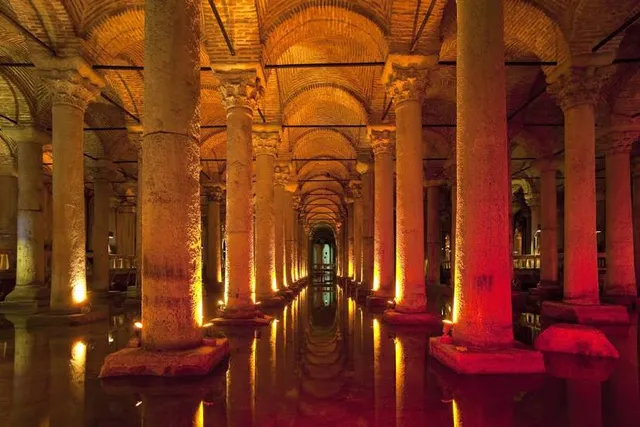
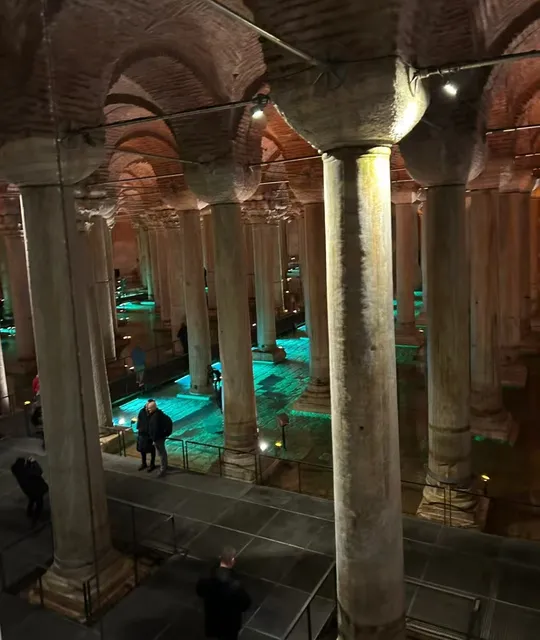
Dimensions 138 x 65. Approximately 1500 years old structure that can carry 80 thousand m3 of water. So the building you are looking at is from ancient times.
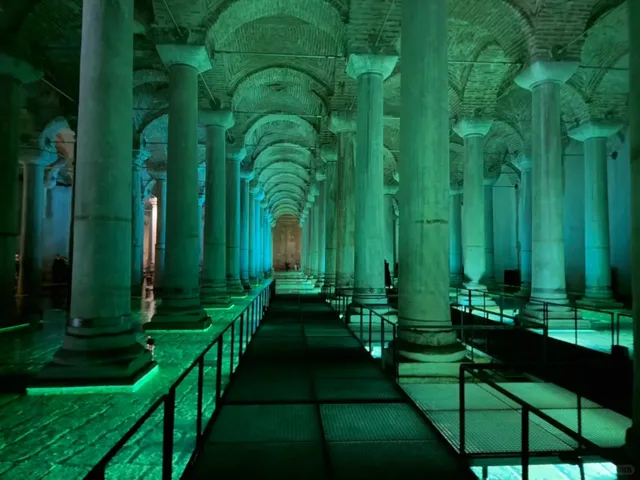
We are talking about 28 columns in 12 rows, there are 336 columns in total. Each column is 9 meters high. So no matter how you look at it, the gap is the size of the first two floors of an apartment building, including the shop.
So where does water come from here? teee is from belgard forest. So water comes from Sarıyer to Fatih.. So how does it come? It comes thanks to the arch, which we also know as the Bozdoğan arch (I guess everyone has seen it, even if they have not been to Istanbul in their lives, it is one of the thematic images used in the background on TV when the weather forecast is given). It also comes from the Mağlova belt in Eyüpsultan.
Many times this arch undergoes restoration. One of the interesting information is that while today we are walking on the platform, in the past it was used by boats.
There are Medusa statues in the far northwest.
These are the structures that are most familiar to tourists. One is looking to the side, the other is standing upside down. These are carved, not just fitted and sewn. So there is fine workmanship. It is unknown why they lie upside down or sideways. It is also thought that it was taken from a building during the Roman period. There is no information about why they exist. According to belief, there are gorgons in Greece and Medusa in Greek mythology, and there are also those who claim that she leans sideways or stands upside down to destroy or reduce the power of her gaze. Even though I told a few people, I did not get the necessary reaction. Another Medusa statue is displayed flat in the garden of the Istanbul Archaeological Museum, and there is even a broken one in front of it and another behind it.
We have no idea where they came from because there is no signboard or anything explaining it in the garden of the Istanbul Archaeological Museum. (Although, while I was writing, I noticed that there was a small sign at the bottom, so if it had something informative it would be memorable, right?) I wonder where it came from, where was it? who knows.
While visiting the cistern, some columns broke towards the middle, almost ready to break. They are columns that have undergone restoration.
If you look carefully at the tops of the initial columns near the stairs, you can see sculptures such as heads with engraved/carved facial features.
Some of the columns seem to have holes in them, who knows whether it was due to moisture or something else, or whether some work was going to be done there and it was abandoned at that time.
There are green stains on some of the columns. I wonder if a picture would be drawn or moss? Did it catch on and become fossilized or something? That's interesting too... who knows what? or it's on the walls.
The most interesting column has only one column. Do they call it the tear column or the crying column? Of course, they are not there on a sign or anything, we always see them by reading them on the search engine. This column stands out very much. Who knows why they did...
Read moreThe Basilica Cistern, also known as the Yerebatan Sarnıcı or Yerebatan Saray (which translates to “Subterranean Cistern” or “Subterranean Palace”), is a remarkable underground structure in Istanbul, Turkey. Let me share some fascinating details about it: History and Construction: The cistern was built during the 6th century under the reign of Byzantine emperor Justinian I. It lies 150 meters (490 feet) southwest of the Hagia Sophia on the historical peninsula of Sarayburnu. The name “Basilica” comes from its location beneath a large public square called the Stoa Basilica on the First Hill of Constantinople. Before its construction, a grand basilica stood on the same spot, serving as a commercial, legal, and artistic center during the Early Roman Age. Emperor Constantine initially built a structure there, which was later reconstructed and expanded by Emperor Justinian after the Nika riots of 532 that devastated the city. Historical texts mention that 7,000 slaves were involved in constructing the cistern. The enlarged cistern provided water for the Great Palace of Constantinople and other buildings on the First Hill. Even after the Ottoman conquest in 1453, it continued to supply water to the Topkapı Palace and beyond. Architectural Marvel: The Basilica Cistern is an underground chamber approximately 138 meters (453 feet) long and 65 meters (213 feet) wide. Its total area covers about 9,800 square meters (105,000 square feet). The cistern has the capacity to hold 80,000 cubic meters (2,800,000 cubic feet) of water. The ceiling is supported by a forest of 336 marble columns, each towering 9 meters (30 feet) high. These columns are arranged in 12 rows, with 28 columns in each row, spaced 5 meters (16 feet) apart. The capitals of the columns exhibit mainly Ionic and Corinthian styles, with a few Doric capitals as well. Rediscovery: Over time, the existence of the cistern was forgotten by most, except for the locals who continued to draw water from it. In 1565, the French traveler Petrus Gyllius left a record of the cistern, describing how he was rowed between the columns and saw fish swimming in the water beneath his boat. Visiting the Basilica Cistern: Today, the cistern is open for public access. Visitors can explore this subterranean wonder, marvel at the columns, and experience its mystical ambiance. It remains one of Istanbul’s hidden gems, blending history, engineering brilliance, and awe-inspiring...
Read moreA Magical and Mysterious Journey Underground – A Must-See in Istanbul!
The Basilica Cistern is truly one of Istanbul’s most enchanting and unforgettable experiences. Tucked quietly beneath the busy streets of the old city, this ancient underground wonder offers a peaceful yet awe-inspiring escape into the city’s rich Byzantine past.
From the moment you step inside, you’re transported into another world – one of flickering lights, tranquil water, and atmospheric classical music that echoes through the cavernous space. The soft lighting dramatically highlights the rows upon rows of marble columns (336 in total!), and the reflections on the shallow water create an almost dreamlike setting. It’s no wonder it has been featured in films like James Bond and Inferno.
The newly restored walkways and modern lighting enhancements have elevated the experience without taking away from its mystique. The recent addition of thought-provoking art installations adds another layer of beauty and meaning to the site. You can now wander past sculptures and interactive displays that are perfectly integrated with the ancient structure.
The Medusa heads at the far end are especially intriguing – shrouded in myth and mystery, they are a highlight for many visitors. Their eerie presence adds a touch of ancient legend that makes you pause and wonder about the stories of this place.
The cistern is surprisingly well-organized with clear signage in multiple languages, helpful staff, and a smooth entry process (especially if you buy tickets in advance). Despite being a popular attraction, it doesn’t feel overcrowded due to its vast space and controlled entry.
Tips: • Go early in the morning or near closing time to enjoy it in quieter moments. • Don’t rush – take time to admire the columns, listen to the music, and soak in the atmosphere. • Wear comfortable shoes as it can be slightly damp.
Final Verdict: Whether you’re into history, photography, architecture, or simply want to experience something utterly unique, the Basilica Cistern will leave a lasting impression. It’s a testament to the ingenuity of ancient engineering and a hauntingly beautiful corner of Istanbul that you should not miss. Absolutely magical.
⭐️⭐️⭐️⭐️⭐️ – A highlight of our trip and worth...
Read more