HTML SitemapExplore
logo
Find Things to DoFind The Best Restaurants

Seneca Village Site — Attraction in New York

Name
Seneca Village Site
Description
Nearby attractions
Central Park
New York, NY
Toll Family Playground
Central Prk W, New York, NY 10024
Summit Rock
Central Prk W, New York, NY 10024
Abraham and Joseph Spector Playground
Q2MJ+RH, New York, NY 10022
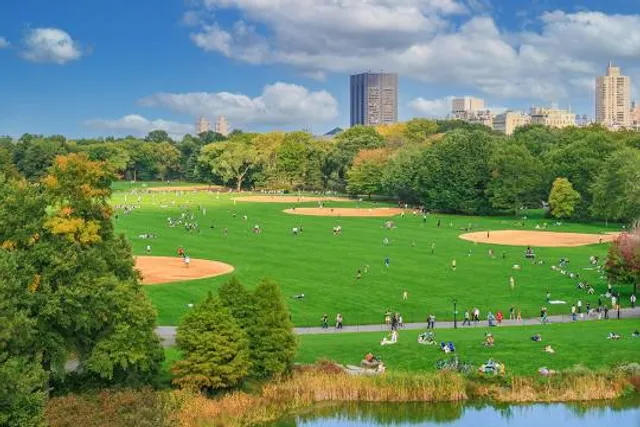
The Great Lawn
79th Street & 85th Street, New York, NY 10024
Diana Ross Playground
Central Park West &, W 81st St, New York, NY 10024
Arthur Ross Pinetum
86th St Transverse, New York, NY 10024
Theodore Roosevelt Park
200 Central Prk W, New York, NY 10024
American Museum of Natural History
200 Central Prk W, New York, NY 10024
Bard Graduate Center
18 W 86th St, New York, NY 10024
Nearby restaurants
Noi Due Cafe
491 Columbus Ave, New York, NY 10024
The Consulate UWS
519 Columbus Ave, New York, NY 10024, United States
Osteria Cotta
513 Columbus Ave, New York, NY 10024
Cilantro NY
485 Columbus Ave, New York, NY 10024
Good Enough To Eat
520 Columbus Ave, New York, NY 10024
The Viand
517 Columbus Ave, New York, NY 10024
Lokal Mediterranean Kitchen
473 Columbus Ave, New York, NY 10024
Tarallucci e Vino Upper West Side
475 Columbus Ave, New York, NY 10024
Prohibition
503 Columbus Ave, New York, NY 10024
Tasca NYC
505 Columbus Ave, New York, NY 10024
Related posts
Keywords
Seneca Village Site tourism.Seneca Village Site hotels.Seneca Village Site bed and breakfast. flights to Seneca Village Site.Seneca Village Site attractions.Seneca Village Site restaurants.Seneca Village Site travel.Seneca Village Site travel guide.Seneca Village Site travel blog.Seneca Village Site pictures.Seneca Village Site photos.Seneca Village Site travel tips.Seneca Village Site maps.Seneca Village Site things to do.
Seneca Village Site things to do, attractions, restaurants, events info and trip planning
Seneca Village Site
United StatesNew YorkNew YorkSeneca Village Site

Basic Info

Seneca Village Site

Central Park, Central Prk W, New York, NY 10024
4.7(42)
Open 24 hours
Save
spot

Ratings & Description

Info

Cultural
Outdoor
attractions: Central Park, Toll Family Playground, Summit Rock, Abraham and Joseph Spector Playground, The Great Lawn, Diana Ross Playground, Arthur Ross Pinetum, Theodore Roosevelt Park, American Museum of Natural History, Bard Graduate Center, restaurants: Noi Due Cafe, The Consulate UWS, Osteria Cotta, Cilantro NY, Good Enough To Eat, The Viand, Lokal Mediterranean Kitchen, Tarallucci e Vino Upper West Side, Prohibition, Tasca NYC
logoLearn more insights from Wanderboat AI.
Phone
(212) 310-6600
Website
centralparknyc.org

Plan your stay

hotel
Pet-friendly Hotels in New York
Find a cozy hotel nearby and make it a full experience.
hotel
Affordable Hotels in New York
Find a cozy hotel nearby and make it a full experience.
hotel
The Coolest Hotels You Haven't Heard Of (Yet)
Find a cozy hotel nearby and make it a full experience.
hotel
Trending Stays Worth the Hype in New York
Find a cozy hotel nearby and make it a full experience.

Reviews

Nearby attractions of Seneca Village Site

Central Park

Toll Family Playground

Summit Rock

Abraham and Joseph Spector Playground

The Great Lawn

Diana Ross Playground

Arthur Ross Pinetum

Theodore Roosevelt Park

American Museum of Natural History

Bard Graduate Center

Central Park

Central Park

4.8

(84.9K)

Open 24 hours
Click for details
Toll Family Playground

Toll Family Playground

4.5

(92)

Open 24 hours
Click for details
Summit Rock

Summit Rock

4.6

(123)

Open 24 hours
Click for details
Abraham and Joseph Spector Playground

Abraham and Joseph Spector Playground

4.0

(32)

Open 24 hours
Click for details

Things to do nearby

The Full-Day See It All NYC Tour
Fri, Dec 5 • 9:00 AM
New York, New York, 10019
View details
Spray paint In Bushwick with a local street artist
Sun, Dec 7 • 5:00 PM
Brooklyn, New York, 11206
View details
Private photohsoot in NYC by Lorena
Fri, Dec 5 • 11:00 AM
The Bronx, New York, 10462
View details

Nearby restaurants of Seneca Village Site

Noi Due Cafe

The Consulate UWS

Osteria Cotta

Cilantro NY

Good Enough To Eat

The Viand

Lokal Mediterranean Kitchen

Tarallucci e Vino Upper West Side

Prohibition

Tasca NYC

Noi Due Cafe

Noi Due Cafe

4.6

(935)

Click for details
The Consulate UWS

The Consulate UWS

4.7

(832)

Click for details
Osteria Cotta

Osteria Cotta

4.4

(597)

Click for details
Cilantro NY

Cilantro NY

4.3

(681)

Click for details
Get the Appoverlay
Get the AppOne tap to find yournext favorite spots!
Wanderboat LogoWanderboat

Your everyday Al companion for getaway ideas

CompanyAbout Us
InformationAI Trip PlannerSitemap
SocialXInstagramTiktokLinkedin
LegalTerms of ServicePrivacy Policy

Get the app

© 2025 Wanderboat. All rights reserved.
logo

Posts

Patricia PatrickPatricia Patrick
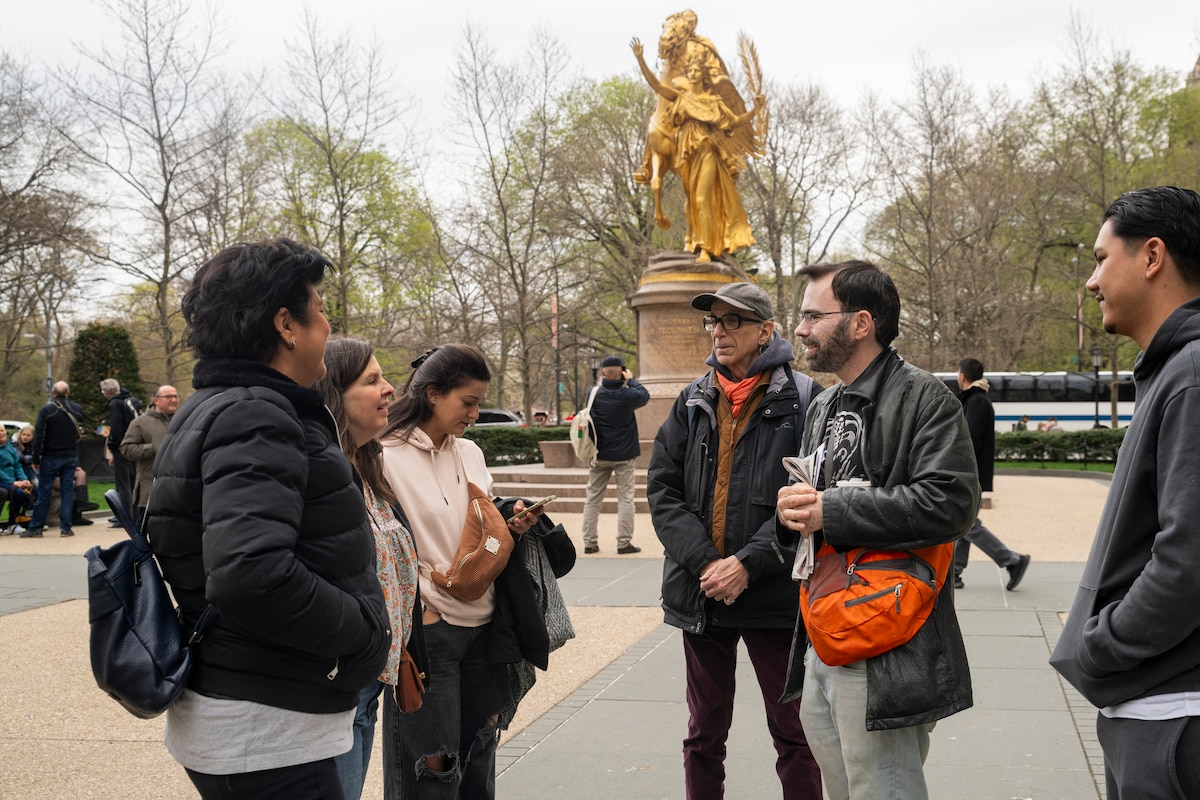
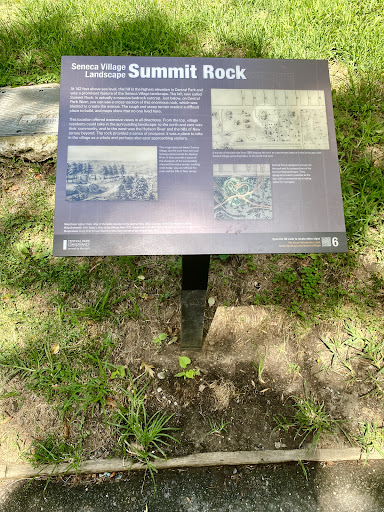
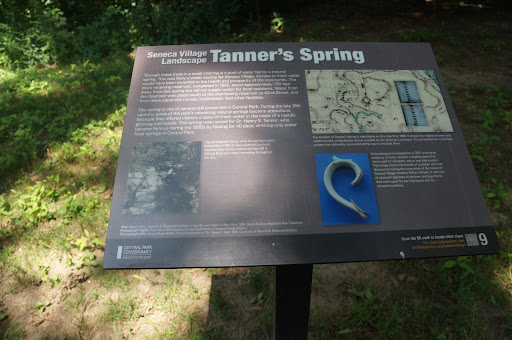
We partook in this black centric activity on Thursday, August 11, 2022. We purchased tickets prior to online for the 11 AM Seneca Village tour. Our tour guide was José who was nice, professional, and very informative. It is located on the Central Park West side. We began the tour with Jose discussing and showcasing a map of Seneca Village. This map dated back to the 1800s which pointed out three church landmarks on an iPad. The three churches which were discussed included: All Angels Church, African Union Church, and AME Zion Church. It’s unfortunate that the city of New York claimed eminent domain on Seneca Village. Jose informed us that the blacks escaped racism from downtown society by creating and building their life in Seneca village. It was wonderful and inspiring to hear the story of these middle class blacks when Seneca Village was in its prime during the 1830s to 1840s. The citizens had various jobs including: cart mans, pullman porters, cooks, caretakers, farmers, and inn keepers. Unfortunately we were informed in 1857, the whole community was dissolved for Central Park to be built. As we already knew there was little to no financial compensation for having forced these people out of their homes. We learned about Andrew Williams who was one of the first residents of Seneca Village. Jose did state that there have been interviews of Andrew Williams’s descendants. William G. Wilson was another resident of Seneca Village. When an excavation on Seneca Village was performed, artifacts were found. This includes: a bone toothbrush, broken jars, glass, a fishing weight, and a curry comb. Jose informed us that Seneca Village residents did have stables for horses which they used to pull horse carriages. In addition to these residents being stable, they were also successful with disposable income to purchase luxury goods. Unfortunately we learned that by the 1840s, New York City was practicing predatory acts on Seneca Village. This includes building a huge land reservoir east of Seneca Village. In addition, the Irish community was also moving in. A key fact we learned was Epiphany Davis and Andrew Williams founded Seneca Village. We did also learn that the reservoir took four years to build, generated 180,000,000 gallons of freshwater, and all of this water was brought into New York City. What is now known as the Great Lawn was where the reservoir was held. A wonderful fact we also learned was Seneca village had women land owners including: Elizabeth Harding, Diana Harding, and Nancy Moore. Nancy Moore reportedly had one of the largest homes in Seneca village with three stories. Other facts we learned were that a lot of the homes had solid foundations built with rock and Manhattan schists. The residents used natural spring water from Tanner spring, since they couldn’t use water from the reservoir that was built. We ended the tour at Summit rock which is the highest point in Central Park. This location was a place of meditation for Seneca Village residents. Much is not known unfortunately about where the residents went once Seneca Village was destroyed. Jose did offer to give tour participants links of the Williams family interviews and photos that were shown on the tour. We greatly enjoyed this tour and our tour guide Jose went into great detail about the significance of Seneca village. The plaques were also very helpful and would be great to utilize for a self guided tour. Unfortunately we had to immerse ourselves mentally, since there is no real tangibles we could utilize to experience what Seneca Village was like. There’s very little research and resources that have been invested in Seneca Village. We hope in the future the city of New York will understand the importance of this village. It contributed to New York’s history and growth as a city for Black people. I would highly recommend the Seneca Village tour to everyone in New York City. This especially goes for Foundational Black Americans who want to understand how our history may be lost, but it cannot be erased.
Amy MiddletonAmy Middleton
Unearthing the Secret History of Seneca Village: A Reflection on Central Park As we wander through the majestic expanse of Central Park, it is crucial to acknowledge the hidden stories woven into the fabric of its existence. One such story lies within the forgotten Seneca Village, a community that once thrived in the very location now beloved by park-goers. Exploring the history of Seneca Village serves as a poignant reminder of the sacrifices made, and the injustices faced, to create the peaceful oasis we enjoy today. The memory of Seneca Village holds profound importance, for it sheds light on the brutalities endured by its African American and Irish immigrant residents. Established in the early 19th century, this vibrant settlement served as a haven of autonomy and opportunity amidst a time of widespread discrimination and systemic racism. The village's residents thrived, building homes, churches, and schools, and cultivating a sense of community that defied the societal norms of the era. However, the fate of Seneca Village was sealed when city officials decided to claim the land for the creation of Central Park, displacing its inhabitants and erasing their history. The secrecy surrounding Seneca Village's history makes it all the more captivating and urgent to explore. It is disheartening to think that a place brimming with life and resilience could be swept away, leaving behind few reminders of its existence. The absence of explicit information about Seneca Village in popular narratives only underscores the need to delve deeper, to celebrate the stories of those who once called this place home. Walking through Central Park, surrounded by its sprawling beauty, it becomes easy to forget the hardships endured by the marginalized communities whose lives were disrupted to build this haven. Remembering the brutalities that occurred in Seneca Village fosters a sense of empathy and respect for those who have faced adversity. It is an opportunity not to dwell on the darkness of the past, but rather to honor the resilience and spirit of a community that fought against injustice. While it is crucial to acknowledge the history of Seneca Village, it is equally important to find joy in our present surroundings. Central Park offers solace, relaxation, and serenity to countless visitors every day. From picnics on the Great Lawn to leisurely strolls along the Bethesda Terrace, the park holds a special place in the hearts of New Yorkers and visitors alike. By cherishing the park's current offerings, we honor both the sacrifices made and the glimmers of hope that emerged from Seneca Village. Exploring the hidden history of Seneca Village enables us to reflect upon the injustices faced by marginalized communities while enjoying the beauty of Central Park. As we walk through the park's lush landscapes, let us remember and cherish the stories of those who came before us, acknowledging their struggles and celebrating their resilience. By doing so, we ensure that the memory of Seneca Village lives on, reminding us to create a more inclusive and compassionate future.
dottie sdottie s
Near the 85th Street entrance of Central Park, Seneca Village holds great historical significance. This area was home to a predominantly Black community before the city forced them out to create Central Park. Founded in 1825, it was one of the first free Black communities in New York City and served as a place of opportunity and refuge from racial discrimination.
See more posts
See more posts
hotel
Find your stay

Pet-friendly Hotels in New York

Find a cozy hotel nearby and make it a full experience.

We partook in this black centric activity on Thursday, August 11, 2022. We purchased tickets prior to online for the 11 AM Seneca Village tour. Our tour guide was José who was nice, professional, and very informative. It is located on the Central Park West side. We began the tour with Jose discussing and showcasing a map of Seneca Village. This map dated back to the 1800s which pointed out three church landmarks on an iPad. The three churches which were discussed included: All Angels Church, African Union Church, and AME Zion Church. It’s unfortunate that the city of New York claimed eminent domain on Seneca Village. Jose informed us that the blacks escaped racism from downtown society by creating and building their life in Seneca village. It was wonderful and inspiring to hear the story of these middle class blacks when Seneca Village was in its prime during the 1830s to 1840s. The citizens had various jobs including: cart mans, pullman porters, cooks, caretakers, farmers, and inn keepers. Unfortunately we were informed in 1857, the whole community was dissolved for Central Park to be built. As we already knew there was little to no financial compensation for having forced these people out of their homes. We learned about Andrew Williams who was one of the first residents of Seneca Village. Jose did state that there have been interviews of Andrew Williams’s descendants. William G. Wilson was another resident of Seneca Village. When an excavation on Seneca Village was performed, artifacts were found. This includes: a bone toothbrush, broken jars, glass, a fishing weight, and a curry comb. Jose informed us that Seneca Village residents did have stables for horses which they used to pull horse carriages. In addition to these residents being stable, they were also successful with disposable income to purchase luxury goods. Unfortunately we learned that by the 1840s, New York City was practicing predatory acts on Seneca Village. This includes building a huge land reservoir east of Seneca Village. In addition, the Irish community was also moving in. A key fact we learned was Epiphany Davis and Andrew Williams founded Seneca Village. We did also learn that the reservoir took four years to build, generated 180,000,000 gallons of freshwater, and all of this water was brought into New York City. What is now known as the Great Lawn was where the reservoir was held. A wonderful fact we also learned was Seneca village had women land owners including: Elizabeth Harding, Diana Harding, and Nancy Moore. Nancy Moore reportedly had one of the largest homes in Seneca village with three stories. Other facts we learned were that a lot of the homes had solid foundations built with rock and Manhattan schists. The residents used natural spring water from Tanner spring, since they couldn’t use water from the reservoir that was built. We ended the tour at Summit rock which is the highest point in Central Park. This location was a place of meditation for Seneca Village residents. Much is not known unfortunately about where the residents went once Seneca Village was destroyed. Jose did offer to give tour participants links of the Williams family interviews and photos that were shown on the tour. We greatly enjoyed this tour and our tour guide Jose went into great detail about the significance of Seneca village. The plaques were also very helpful and would be great to utilize for a self guided tour. Unfortunately we had to immerse ourselves mentally, since there is no real tangibles we could utilize to experience what Seneca Village was like. There’s very little research and resources that have been invested in Seneca Village. We hope in the future the city of New York will understand the importance of this village. It contributed to New York’s history and growth as a city for Black people. I would highly recommend the Seneca Village tour to everyone in New York City. This especially goes for Foundational Black Americans who want to understand how our history may be lost, but it cannot be erased.
Patricia Patrick

Patricia Patrick

hotel
Find your stay

Affordable Hotels in New York

Find a cozy hotel nearby and make it a full experience.

Get the Appoverlay
Get the AppOne tap to find yournext favorite spots!
Unearthing the Secret History of Seneca Village: A Reflection on Central Park As we wander through the majestic expanse of Central Park, it is crucial to acknowledge the hidden stories woven into the fabric of its existence. One such story lies within the forgotten Seneca Village, a community that once thrived in the very location now beloved by park-goers. Exploring the history of Seneca Village serves as a poignant reminder of the sacrifices made, and the injustices faced, to create the peaceful oasis we enjoy today. The memory of Seneca Village holds profound importance, for it sheds light on the brutalities endured by its African American and Irish immigrant residents. Established in the early 19th century, this vibrant settlement served as a haven of autonomy and opportunity amidst a time of widespread discrimination and systemic racism. The village's residents thrived, building homes, churches, and schools, and cultivating a sense of community that defied the societal norms of the era. However, the fate of Seneca Village was sealed when city officials decided to claim the land for the creation of Central Park, displacing its inhabitants and erasing their history. The secrecy surrounding Seneca Village's history makes it all the more captivating and urgent to explore. It is disheartening to think that a place brimming with life and resilience could be swept away, leaving behind few reminders of its existence. The absence of explicit information about Seneca Village in popular narratives only underscores the need to delve deeper, to celebrate the stories of those who once called this place home. Walking through Central Park, surrounded by its sprawling beauty, it becomes easy to forget the hardships endured by the marginalized communities whose lives were disrupted to build this haven. Remembering the brutalities that occurred in Seneca Village fosters a sense of empathy and respect for those who have faced adversity. It is an opportunity not to dwell on the darkness of the past, but rather to honor the resilience and spirit of a community that fought against injustice. While it is crucial to acknowledge the history of Seneca Village, it is equally important to find joy in our present surroundings. Central Park offers solace, relaxation, and serenity to countless visitors every day. From picnics on the Great Lawn to leisurely strolls along the Bethesda Terrace, the park holds a special place in the hearts of New Yorkers and visitors alike. By cherishing the park's current offerings, we honor both the sacrifices made and the glimmers of hope that emerged from Seneca Village. Exploring the hidden history of Seneca Village enables us to reflect upon the injustices faced by marginalized communities while enjoying the beauty of Central Park. As we walk through the park's lush landscapes, let us remember and cherish the stories of those who came before us, acknowledging their struggles and celebrating their resilience. By doing so, we ensure that the memory of Seneca Village lives on, reminding us to create a more inclusive and compassionate future.
Amy Middleton

Amy Middleton

hotel
Find your stay

The Coolest Hotels You Haven't Heard Of (Yet)

Find a cozy hotel nearby and make it a full experience.

hotel
Find your stay

Trending Stays Worth the Hype in New York

Find a cozy hotel nearby and make it a full experience.

Near the 85th Street entrance of Central Park, Seneca Village holds great historical significance. This area was home to a predominantly Black community before the city forced them out to create Central Park. Founded in 1825, it was one of the first free Black communities in New York City and served as a place of opportunity and refuge from racial discrimination.
dottie s

dottie s

See more posts
See more posts

Reviews of Seneca Village Site

4.7
(42)
avatar
5.0
3y

We partook in this black centric activity on Thursday, August 11, 2022. We purchased tickets prior to online for the 11 AM Seneca Village tour. Our tour guide was José who was nice, professional, and very informative. It is located on the Central Park West side. We began the tour with Jose discussing and showcasing a map of Seneca Village. This map dated back to the 1800s which pointed out three church landmarks on an iPad. The three churches which were discussed included: All Angels Church, African Union Church, and AME Zion Church. It’s unfortunate that the city of New York claimed eminent domain on Seneca Village. Jose informed us that the blacks escaped racism from downtown society by creating and building their life in Seneca village. It was wonderful and inspiring to hear the story of these middle class blacks when Seneca Village was in its prime during the 1830s to 1840s. The citizens had various jobs including: cart mans, pullman porters, cooks, caretakers, farmers, and inn keepers. Unfortunately we were informed in 1857, the whole community was dissolved for Central Park to be built. As we already knew there was little to no financial compensation for having forced these people out of their homes. We learned about Andrew Williams who was one of the first residents of Seneca Village. Jose did state that there have been interviews of Andrew Williams’s descendants. William G. Wilson was another resident of Seneca Village. When an excavation on Seneca Village was performed, artifacts were found. This includes: a bone toothbrush, broken jars, glass, a fishing weight, and a curry comb. Jose informed us that Seneca Village residents did have stables for horses which they used to pull horse carriages. In addition to these residents being stable, they were also successful with disposable income to purchase luxury goods. Unfortunately we learned that by the 1840s, New York City was practicing predatory acts on Seneca Village. This includes building a huge land reservoir east of Seneca Village. In addition, the Irish community was also moving in. A key fact we learned was Epiphany Davis and Andrew Williams founded Seneca Village. We did also learn that the reservoir took four years to build, generated 180,000,000 gallons of freshwater, and all of this water was brought into New York City. What is now known as the Great Lawn was where the reservoir was held. A wonderful fact we also learned was Seneca village had women land owners including: Elizabeth Harding, Diana Harding, and Nancy Moore. Nancy Moore reportedly had one of the largest homes in Seneca village with three stories. Other facts we learned were that a lot of the homes had solid foundations built with rock and Manhattan schists. The residents used natural spring water from Tanner spring, since they couldn’t use water from the reservoir that was built. We ended the tour at Summit rock which is the highest point in Central Park. This location was a place of meditation for Seneca Village residents. Much is not known unfortunately about where the residents went once Seneca Village was destroyed. Jose did offer to give tour participants links of the Williams family interviews and photos that were shown on the tour. We greatly enjoyed this tour and our tour guide Jose went into great detail about the significance of Seneca village. The plaques were also very helpful and would be great to utilize for a self guided tour. Unfortunately we had to immerse ourselves mentally, since there is no real tangibles we could utilize to experience what Seneca Village was like. There’s very little research and resources that have been invested in Seneca Village. We hope in the future the city of New York will understand the importance of this village. It contributed to New York’s history and growth as a city for Black people. I would highly recommend the Seneca Village tour to everyone in New York City. This especially goes for Foundational Black Americans who want to understand how our history may be lost, but it...

   Read more
avatar
5.0
2y

Unearthing the Secret History of Seneca Village: A Reflection on Central Park

As we wander through the majestic expanse of Central Park, it is crucial to acknowledge the hidden stories woven into the fabric of its existence. One such story lies within the forgotten Seneca Village, a community that once thrived in the very location now beloved by park-goers. Exploring the history of Seneca Village serves as a poignant reminder of the sacrifices made, and the injustices faced, to create the peaceful oasis we enjoy today.

The memory of Seneca Village holds profound importance, for it sheds light on the brutalities endured by its African American and Irish immigrant residents. Established in the early 19th century, this vibrant settlement served as a haven of autonomy and opportunity amidst a time of widespread discrimination and systemic racism. The village's residents thrived, building homes, churches, and schools, and cultivating a sense of community that defied the societal norms of the era. However, the fate of Seneca Village was sealed when city officials decided to claim the land for the creation of Central Park, displacing its inhabitants and erasing their history.

The secrecy surrounding Seneca Village's history makes it all the more captivating and urgent to explore. It is disheartening to think that a place brimming with life and resilience could be swept away, leaving behind few reminders of its existence. The absence of explicit information about Seneca Village in popular narratives only underscores the need to delve deeper, to celebrate the stories of those who once called this place home.

Walking through Central Park, surrounded by its sprawling beauty, it becomes easy to forget the hardships endured by the marginalized communities whose lives were disrupted to build this haven. Remembering the brutalities that occurred in Seneca Village fosters a sense of empathy and respect for those who have faced adversity. It is an opportunity not to dwell on the darkness of the past, but rather to honor the resilience and spirit of a community that fought against injustice.

While it is crucial to acknowledge the history of Seneca Village, it is equally important to find joy in our present surroundings. Central Park offers solace, relaxation, and serenity to countless visitors every day. From picnics on the Great Lawn to leisurely strolls along the Bethesda Terrace, the park holds a special place in the hearts of New Yorkers and visitors alike. By cherishing the park's current offerings, we honor both the sacrifices made and the glimmers of hope that emerged from Seneca Village.

Exploring the hidden history of Seneca Village enables us to reflect upon the injustices faced by marginalized communities while enjoying the beauty of Central Park. As we walk through the park's lush landscapes, let us remember and cherish the stories of those who came before us, acknowledging their struggles and celebrating their resilience. By doing so, we ensure that the memory of Seneca Village lives on, reminding us to create a more inclusive and...

   Read more
avatar
5.0
2y

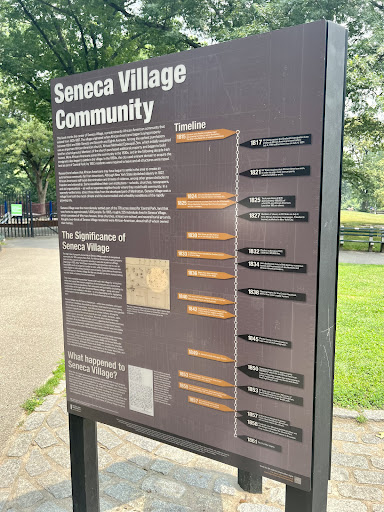
Very informative. Love the timeline and other information highlighting the racial climate and how it influenced both the beginnings and endings of the community. Loved the signs in the areas where these buildings stood; it in a way felt like taking a walk through the village. Highly recommend. Next time, I’d be interested in taking a guided tour, but there is an audio...

   Read more
Page 1 of 7
Previous
Next