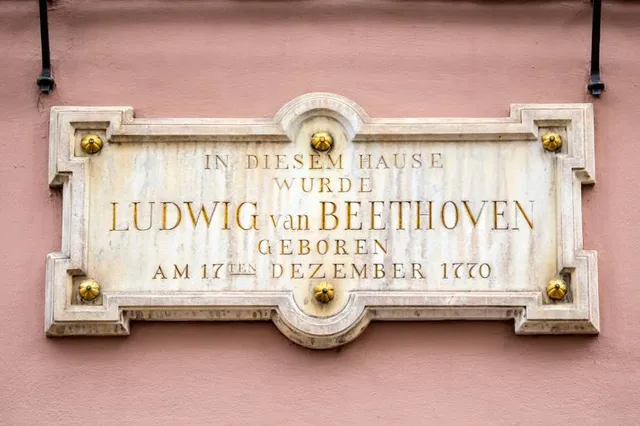
The museum was opened on 10 May 1893 during the second chamber music festival. It was extended several times. Today, it houses the largest Beethoven collection in the world. The museum includes two formerly separate buildings: the front building and the annex toward the garden where the composer spent the first years of his life. When setting up the buildings as a museum, they were connected. The rambling rooms with their low ceilings, the creaking stairs in the back building and the wooden floors in the listed building of the 18th century convey an impression of the living conditions of that time. In the 20th century, the permanent exhibition was renewed several times. The original concept focused on a reconstruction of the house and on the display of a lot of items. When the rooms and the exhibition were refurbished and updated the last time in 1995/96, the idea was to give visitors the opportunity to experience a step back in time when viewing the 150 exhibits from the proprietary collection of the Beethoven Haus. Portraits, manuscripts, sheet music printouts, instruments and items of everyday life give an insight into Beethoven's life and work.To Beethovens 250th Birthday in 2020 the exhibition has been extendit and renovated. Opening at 17 December 2019 visitors find a complete new updated form of the permanent exhibition designed by Holzer Kobler architect firm and Studio TheGreenEyl and Lichtvision Design. They restructured the new exhibition and replaced the chronological structure with a thematic one. Media means complement the displayed objects and the house itself becomes an exhibition piece through the choice of color and the exhibition pieces themselves that were chosen wisely for every room. On display are, for example the baptism entry in the register of St. Remigius, the poster announcing Beethoven's first public performance in Cologne in 1778, the first printed composition from 1783 and a portrait of Beethoven's grandfather. Paintings of Beethoven's employers... The room connecting the buildings shows the historic console of the organ that once stood in St Remigius' Church (former Minoriten church) and that Beethoven regularly played since he was ten years old. The console was given to the Beethoven-Haus when the church was reconstructed in 1904. Distinct from the organ it pertained to, the console survived the Second World War. Silhouettes and portraits of the von Breuning family, greeting cards to Beethoven from Eleonore von Breuning, pictures of Franz Gerhard Wegeler and Christian Gottlob Neefe depict some of the people most influential for Beethoven's personal development and musical education. The relocation to Vienna is represented by the famous entry of Count Ferdinand Ernst von Waldstein in Beethoven's register, wishing Beethoven "Mozart's spirit from Haydn's hands" when taking lessons with Haydn in Vienna. (The original register is in Vienna). Twelve exhibition rooms illustrate Beethoven's early years as piano player and composer as well as his master compositions. On display are portraits of Beethoven's teachers Joseph Haydn, Johann Georg Albrechtsberger and Antonio Salieri, the string quartet instruments provided by Prince Karl von Lichnowsky, a patron of Beethoven during the first years in Vienna (on permanent loan from the State Institute for Music Research, Prussian Cultural Heritage, Berlin), Beethoven's last instrument, the pianoforte from Conrad Graf and selected composition editions. Portraits of the composer in various stages of his life and the famous bust from Vienna sculptor Franz Klein (1779–1840) among...
Read moreVisiting the house of the most famous Bonn citizen was great but left me with mixed feelings.
Getting to the house was quite easy, Bonn city has done a very good job on this, as signs can be followed from all around the city. You have to buy tickets in the museum shop located on the opposite side of the street, however this is apparently not a well known fact as many visitors go straight to the house entrance. Backpacks are not allowed inside (you can lock in in the basement of the museum shop free of charge, only deposit needed) and photography is forbidden inside the house, however no reason was provided when asked why. Audio guide in 6 different languages was available in the store or via a downloadable audio app on the phone (don't forget headphones).
The house itself was relatively small, compact, easy to navigate through and beautifully maintained. All important items (paintings, notes, musical instruments, letters) and memorabilia were displayed (however not all of them were original and did not add much to the authenticity of the experience) and through them you get to learn a lot about the composer's life. I feel it could be better organized as I didn't quite catch some of the milestones in Beethoven's life.
I was a bit disappointed with the audio guide - the explanations were rather long (most of them were 2 to 4 minutes long) and maybe too detailed to the point it stopped being interesting to me (for example looking at one small medallion and listening to nearly 3 minute explanations seemed a bit much). On a positive note - some of the explanations were accompanied by Beethoven music. Honestly I was personally happier with the written notes located in each room. There is a possibility to visit a very tiny garden and take a picture of the house from there.
The museum store offers many interesting items to buy - from books and CD's to cups, postcards and music boxes - and the staff was very nice and friendly. Toilets were located in the basement next to the locker room. The 10 EUR price tag as entry fee is on the higher spectrum of the museum's entrance fees but I guess it's adequate to the experience.
My experience was generally good, but details matter and there are a couple of them to be improved in my opinion. Visited...
Read moreThe museum was a highlight of our visit to Bonn. It is a true gem of Bonn! Highly recommend. A big thanks to Astrid and 2 other docents in the museum. They were kind, welcoming and informative and made the visit extra special. However, we had a very unfriendly interaction with the 2 women who sold tickets, and we almost walked out. For some reason the audio guides on our phones didn’t work. We were told that this situation has never happened to any else. Then some headphones and audio guides from the museum were produced but we felt bullied into leaving our passports in order to use those guides. Again, we were told that no one else has ever refused leaving their passports or some form of ID. We refused to leave our passports, we didn’t have our driving licenses from the U.S. with us, and we didn’t have any other form of ID. We offered to leave a few euros as a deposit, but that offer was refused and the guides were reluctantly handed to us, with a threatening tone that we must return them at the end of our visit. In addition, there was a strong smell of cigarette smoke in the ticket office. I thought someone was actually smoking in the area. I was attempting to fan the smoke away, and one of the women selling tickets told me that I was being rude by trying to fan the smoke. She informed me that her colleague had gone outside to smoke and that it was legal to smoke outside in Germany. She also told me that I should have just backed up to avoid the smoke. I informed her that I have asthma and my health is important. At that point we were ready to ask for a refund and leave. I’m glad we stayed and saw the museum- and again it was only because of the warmth of the staff inside the museum- but I hope that your organization would look into the unwelcoming behaviors of the employees selling...
Read more