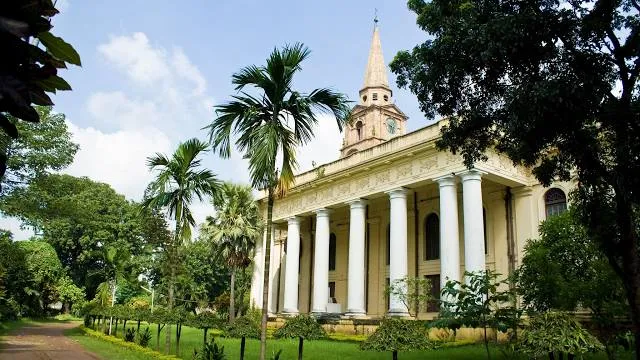
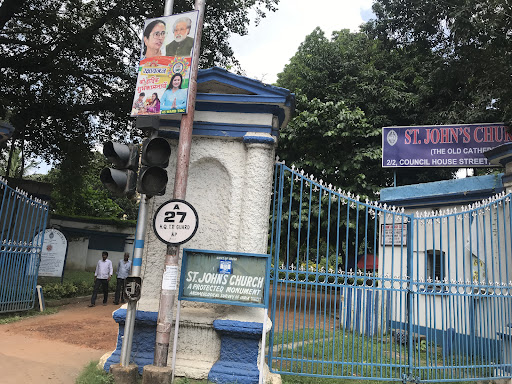
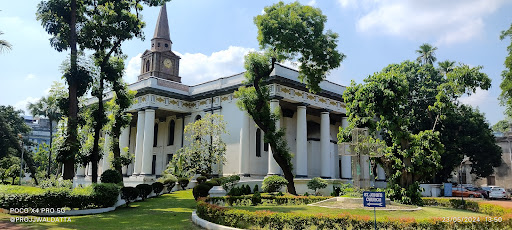
St. John's Church, originally a cathedral, was among the first public buildings erected by the East India Company after Kolkata (Calcutta) became the effective capital of British India. It is located at the North-Western corner of Raj Bhavan, and served as the Anglican Cathedral of Calcutta till 1847, when the see was transferred to St. Paul's Cathedral. Construction of the building, modelled on St Martin-in-the-Fields of London, started in 1784, with Rs 30,000 raised through a public lottery, and was completed in 1787. It is the third oldest church in the city, next to the Armenian and the Old Mission Church.
The church is a large square structure in the Neoclassical architectural style. A stone spire 174 ft tall is its most distinctive feature. The spire holds a giant clock, which is wound every day
One of the driving forces behind the construction of the cathedral was Chaplain William Johnson, the husband of Begum Johnson.
Tall columns frame the church building on all sides and the entrance is through a stately portico. The floor is a rare hue of blue-grey marble, brought from Gaur. Large windows allow the sunlight to filter through the coloured glass.
The main altar is of a simple design. Behind the altar is a semi-circular dome and the floor is of dark blue, almost black, stone. To the left of the altar hangs a painting of The Last Supper by the British artist of German origin, Johann Zoffany. On the right is a beautiful stained glass window.
The walls of the church contain memorial tablets, statues and plaques, mostly of British army officers and civil servants.
James Achilles Kirkpatrick, popularly known as the White Mughal was the central character of William Dalrymple best selling work of history White Mughals died in Calcutta on 15 October 1805 at the age of 41. He was buried at the North Park Street Cemetery, but neither his grave nor the cemetery exists today.
James Achilles Kirkpatrick's father James Kirkpatrick, popularly known as the Handsome Colonel, along with his brothers erected a memorial in memory of James Achilles Kirkpatrick on the southern wall of the St. John's Church. The overblown and oddly inappropriate epitaph, erected still stands to this day
On the walls of the St. John's Church hangs a painting modeled after Leonardo da Vinci's painting The Last Supper. Painted by Johann Zoffany, the painting is not, however, an exact replica of Leonardo's masterpiece.
The top left-hand corner of the painting shows a sword, which represents a common peon's tulwar. A water ewer standing near the table is a copy of Hindustani spittoon and next to it lies a water-filled beesty bag (a goatskin bag used for storing water).
The most unusual feature of Zoffany's Last Supper lies in the selection of models used to represent Jesus and his twelve disciples. Jesus was portrayed as the Greek priest Father Constantinos Parthenios.[6] while John is represented by W.C. Blacquiere, the police magistrate of Calcutta during the 1780s. Judas was portrayed as the auctioneer William Tulloh[7] In short, these are all people of power at the time, including people from the East India Trading Company.
Zoffany's Last Supper has been restored as the result of a co-operation between the INTACH Art Conservation Centre and the Goethe Institut, both of Calcutta. They sponsored the German painting conservator Renate Kant (based in Singapore) to supervise the restoration and train the restorers of the INTACH Centre. The restoration of Zoffany's Last Supper was completed...
Read moreExploring the Historical Marvel: St. John's Church, Kolkata
St. John's Church in Kolkata stands as a testament to the city's rich historical and architectural heritage. Situated in the heart of the bustling metropolis, this iconic church holds immense significance both as a religious site and as a symbol of colonial-era architecture. Stepping into its hallowed halls is akin to stepping back in time, immersing oneself in the stories and legacies of a bygone era.
A Glimpse into History: Built in 1787, St. John's Church is one of the oldest churches in Kolkata. It was constructed during the British Raj, a time when Kolkata, then known as Calcutta, served as the capital of British India. The church was designed by Lieutenant James Agg, incorporating elements of neoclassical architecture, which was popular during that period.
Architectural Marvel: The exterior of St. John's Church is a sight to behold, with its imposing façade adorned with towering columns and intricate detailing. The grandeur of its architecture reflects the power and influence of the British Empire during the colonial era. As visitors approach the entrance, they are greeted by a majestic portico and a soaring steeple, adding to the church's aura of magnificence.
Interior Splendor: Upon entering St. John's Church, visitors are enveloped in an atmosphere of serenity and reverence. The interior is adorned with elegant furnishings, including finely crafted pews, ornate stained glass windows, and a magnificent altar. The church's impressive dome, adorned with intricate frescoes, is a sight to behold, evoking a sense of awe and wonder.
Historical Significance: St. John's Church is not only a place of worship but also a repository of history. It houses several memorials and plaques dedicated to prominent figures from Kolkata's colonial past. One notable memorial is dedicated to Job Charnock, the founder of Kolkata, whose grave lies within the church premises. Additionally, the church contains memorials commemorating soldiers who lost their lives during various conflicts, including the Siege of Calcutta in 1756.
Visiting St. John's Church: For those interested in experiencing Kolkata's rich history and architectural heritage, a visit to St. John's Church is a must. The church is open to visitors throughout the week, with guided tours available for those seeking a deeper understanding of its significance. Whether one is drawn to its historical significance, architectural beauty, or spiritual tranquility, St. John's Church offers a truly immersive experience that captivates the senses and leaves a lasting impression.
Conclusion: St. John's Church stands as a testament to Kolkata's storied past and enduring legacy. Its magnificent architecture, rich history, and spiritual significance make it a must-visit destination for tourists and locals alike. As one wanders through its hallowed halls, one cannot help but be transported back in time, marveling at the grandeur and majesty of a bygone era. In preserving and celebrating places like St. John's Church, we honor the legacy of those who came before us and ensure that their stories continue to inspire future...
Read moreThe construction of St John's Church began in 1784 on a piece of land donated by Maharaja Nabo Kishen Bahadur who was also the founder of Shovabazar Raj Family. A public lottery system helped raise money to build the church. The contributions came in large numbers and helped collect a sum of INR 30,000 at that time. The architect behind this historic monument is James Agg who designed the church as per the neoclassical style. The stones used in the structure belonged to the ruins of Gour and were shipped down River Hooghly to build the church. The foundation stone of the Church was laid by the then Governor General of India, Warren Hastings.
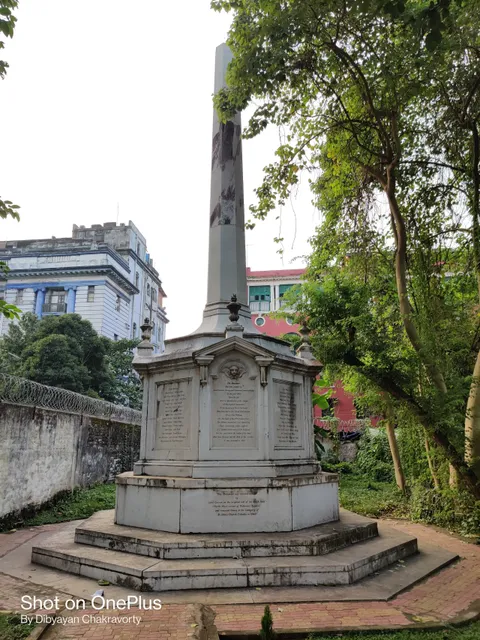
St. John’s Church has a rich collection of artefacts about Kolkata and the Church that are considered to have significant historical value. The land donated for the Church was an old burial ground that was unused since 1767. The founder of Kolkata, Job Charnock, was buried here with his family. When the church was built, it was built on top of the old mausoleums, but the remains of the deceased were taken away. The graves of Job Charnock and his family were left as it is and can still be seen inside the premises. The compound was also chosen as the burial ground for Lady Canning, wife of the Governor-General and Viceroy of India, Charles Canning, after her death in 1861. The Black Hole Monument which was moved into the Church premise in the 1940s. St John's Church is one of the oldest churches in Kolkata that was built during the reign of the British Kingdom when the city was the capital of British India. The church served as Anglican Cathedral till St. Paul's Cathedral was made the Anglican cathedral in 1847. It is a splendidly well-maintained structure that draws history and architecture buffs for its uniqueness and ancient features. One may notice the unique tall features of St John's Church which is a characteristic part of the neoclassical architecture. The colour scheme and the stained glass windows add to the character of the structure. The church maintains utmost silence to allow the visitors to sit in peace for at least a moment.
The regal edifice was built on land which once was used as a graveyard so that visitors will find a lot of memorials and tombs in the compound. Each of these memorials or tombs is a piece of art and history that make some mourn while they inspire some. These stories not just offer a glimpse into the melancholic stage of human beings, but also force us to appreciate the present and inspire us to make our lives even better. St John's Church is a perfect attraction for those who wish to immerse themselves in the divine powers of the God or those who are always searching for a spiritual escape in the city. Visiting the church is a blissful experience in itself. Entry timings : 8:00 AM - 5:00 PM, Prayers: 8:00 AM - 9:00 AM Entry Fee : ₹10 (any amount of donations are accepted) I want to invite you all ,please visit here and experience extraordinary things🙏❤🩹 ....i loved it's environment ❣️first time i came here so I was feeling glad to visit. For more interesting and informative reviews about West Bengal even kolkata then you should follow me here and on also Facebook...
Read more