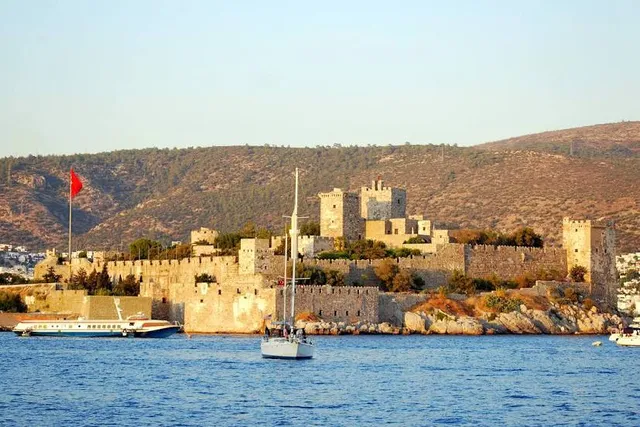
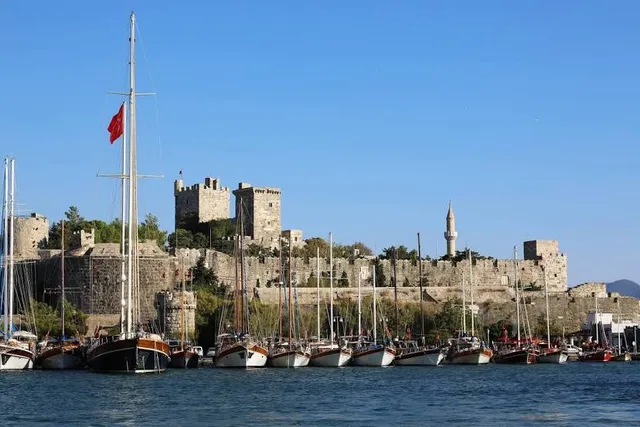
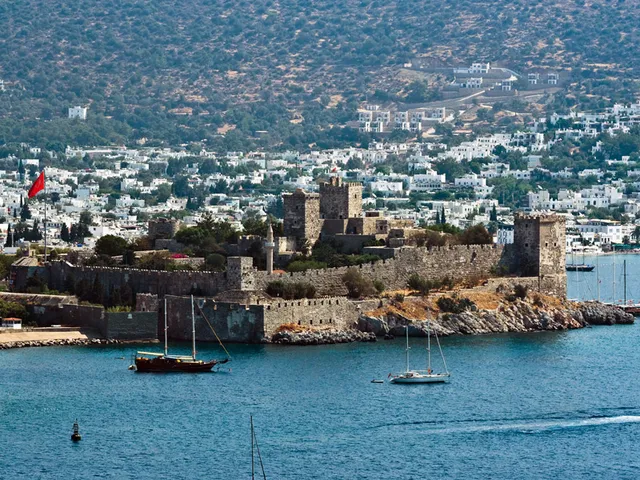
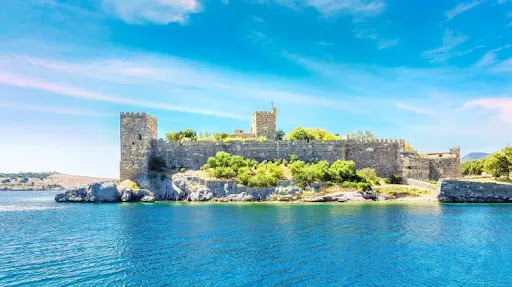
This imposing structure, built by the Knights of St. John in the early 15th century, is the most prominent feature of Bodrum.
The Bodrum Castle (Castle of St. Peter) is located on a small rocky peninsula set between two sheltered bays in Bodrum, on the south-west coast of Anatolia. This peninsula was inhabited and known in the ancient world as Zephyrion and was probably used as a rear base by the Byzantines in the early Middle Ages and then by the Turks. The Castle was built by the Order of St. John of Jerusalem (also called Knights of St.John, Knights Hospitallers, Knights of Rhodes) under the mastership of The Grand Master Philibert de Naillac, at the beginning of 15th century A.D., and ruled by them almost 120 years until the conquest of Rhodes by Suleiman I (Suleiman The Magnificent) in 1522. In Ottoman Period, the Bodrum Castle is used as a small garrison base and in 1895 it was transformed into a prison. During the 1st World War, the castle was bombed on the 26th of May 1915 by a French battleship. This caused great damage to the castle, the prisoners were moved inland and the castle was evacuated. Then the Italians invaded Bodrum and they posted their soldiers at the castle and used it as their headquarters. Following the success of the Turkish War of Independence under the leadership of Mustafa Kemal on the 5th of July 1921, the Italian military forces were dispersed. Between the years 1939-1945 during the 2nd World War, the Castle was yet again used as a military base but was evacuated at the end of the war. Today, the Bodrum Castle is home to the Museum of Underwater Archaeology, which is unique in Turkey, and one of the most significant Underwater Archaeology Museums in the world.
The Bodrum Castle preserves its original plan and character of Knights’ period and represents Gothic architecture. Since The Order of the Knights of St. John was a multinational organization with members from several countries of Europe, each Order had its own tower, each in its own style.
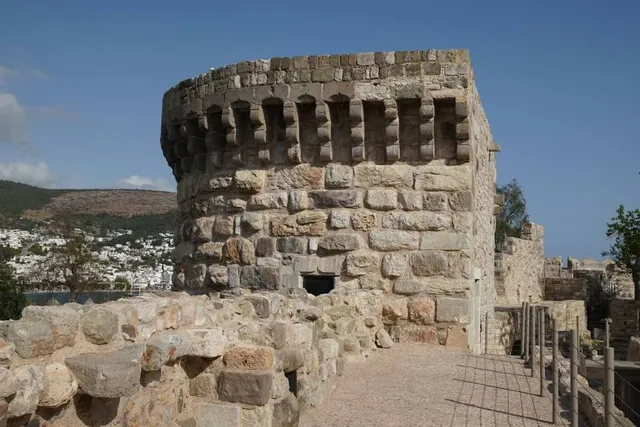
The Castle consists of the French, Spanish (Snake), German, Italian and English Towers. The knights had placed hundreds of painted coats of arms and carved reliefs on the walls above the gates. Two hundred and forty-nine separate designs still remain, including those of grandmasters, castle commandants, countries, and personal coat of arms of knights and religious figures. Among those, the most noticeable one is the coat of arms of King Henry IV of England on the English Tower.
The defences originally consisted of a single curtain wall, but an outer wall reinforced with towers (Carretto and Gatineau Bastions) was added and embrasures were inserted at certain points for cannons at about the middle of the 15th century A.D. The other structures of the Castle are the north moat, large ravelin, harbour battery, harbour tower, forecourt, inner gatehouse, chapel and inner bailey. In the inner castle, wide areas were excavated in the natural rock to form cisterns for collecting rainwater.
In addition to this main character of the Castle, traces of the ancient world can also be seen on the walls because some pieces of the Maussolleion ruins, which were one of the seven wonders of the ancient world, were used as construction materials. There are Ottoman additions like a minaret on the chapel and a Turkish bath (Hamam). With these features, Bodrum Castle presents a multilayered historical and...
Read moreBodrum Castle, also known as the Castle of St. Peter, is a magnificent historical landmark located in Bodrum, Turkey. This impressive fortress holds a significant place in history and stands as a testament to the region's rich heritage.
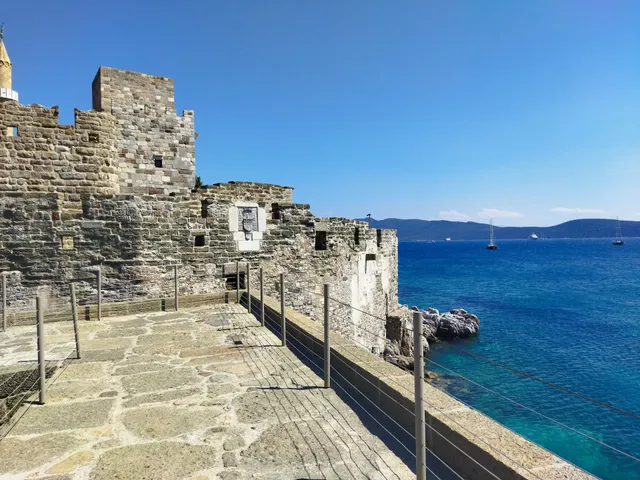
Built in the 15th century by the Knights of St. John, Bodrum Castle showcases stunning medieval architecture and offers a glimpse into the past. Its sturdy stone walls, towering towers, and imposing battlements create a formidable sight against the backdrop of the Aegean Sea.
Exploring the castle is like stepping into a time machine. The inner courtyards, dungeons, and chambers are filled with artifacts, exhibits, and displays that narrate the castle's intriguing history. From ancient shipwrecks to archaeological findings, each corner holds a treasure trove of knowledge.
One of the most remarkable features of Bodrum Castle is the Museum of Underwater Archaeology housed within its walls. This museum is renowned for its extensive collection of artifacts retrieved from shipwrecks in the Aegean Sea, offering visitors a captivating journey through maritime history.
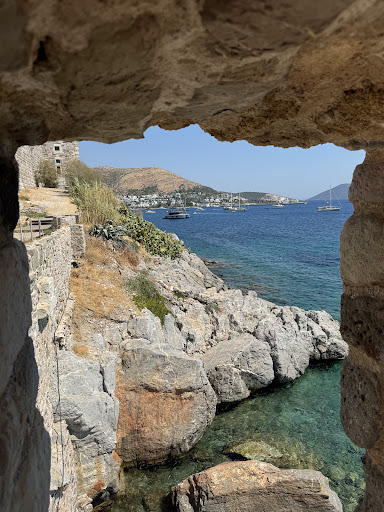
Moreover, the castle offers breathtaking panoramic views of Bodrum and its surroundings. The stunning vistas of the sea, marina, and cityscape from the castle's ramparts are simply awe-inspiring, making it a favorite spot for photography enthusiasts and visitors seeking memorable experiences.
Bodrum Castle stands not only as a remarkable architectural marvel but also as a cultural hub, hosting various events, exhibitions, and festivals throughout the year. It serves as a symbol of Bodrum's identity and heritage, attracting visitors from all around the world.
Visiting Bodrum Castle is a captivating and educational experience that allows travelers to delve into the region's past, appreciate its architectural splendor, and immerse themselves in its rich cultural heritage. It truly is a must-visit destination for history enthusiasts and those seeking a glimpse into the fascinating...
Read moreExpensive for what it is, only worth a visit if you really care about the history.
Me and my girlfriend visited, after having looked online and the website for the place stated the tickets were very cheap. Turns out, there’s a cheap price for the locals and for tourists, the cheapest of the tickets is €21. This gets you in the castle, but not entry to the aquatics museum that is inside the castle - that’s another €5 again.
If we’d known this price, we likely wouldn’t have ended up going, but as we’d made the effort, we brought tickets and went inside.
The castle is a cool bit of Bodrum history, it’s interesting to walk around and learn a bit about Bodrum’s past in the (thankfully air conditioned) rooms scattered around the castle interior. We probably spent a couple hours there in total, but a good chunk of that was just wandering around, looking at more castle before finding another small room to learn more of the castles history.
For someone who is interested in history, or genuinely has an interest in learning about the castle or Bodrum history itself, I’d recommend this as a good day out. However, for couples with less interest, or a family with kids who wouldn’t have much interest either, I wouldn’t recommend it for the price.
The women staffing the ticket booth weren’t very pleasant and the fridge was broken at the first of a few refreshment stands, so we ended up drinking warm water as we walked around.
You do get good views of Bodrum around the edges of the castle, which are pleasant to look at but that can be achieved by a decent walk out of Bodrum town towards the higher...
Read more