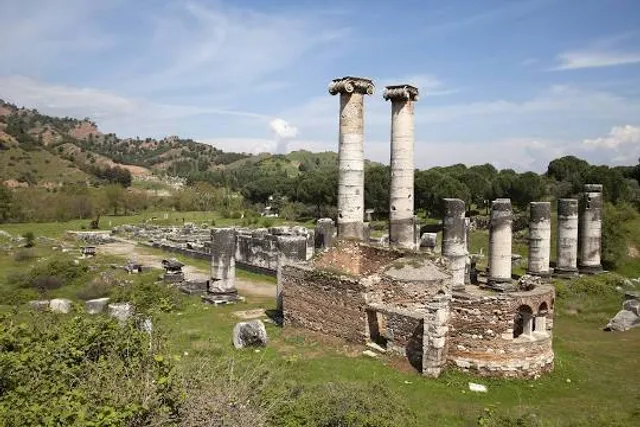
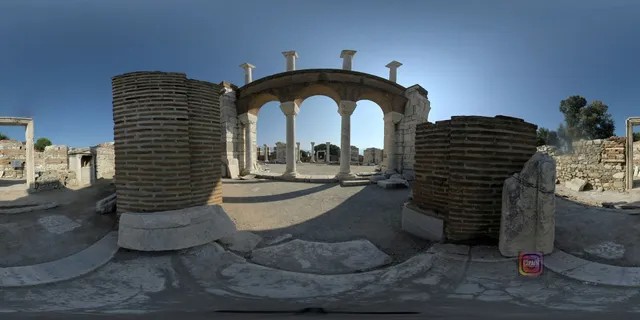
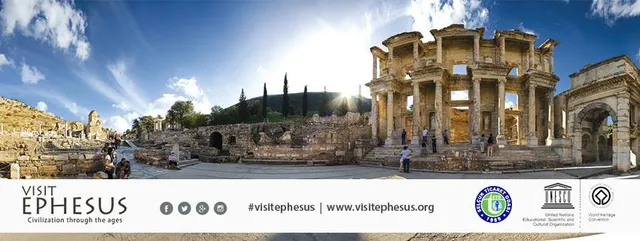
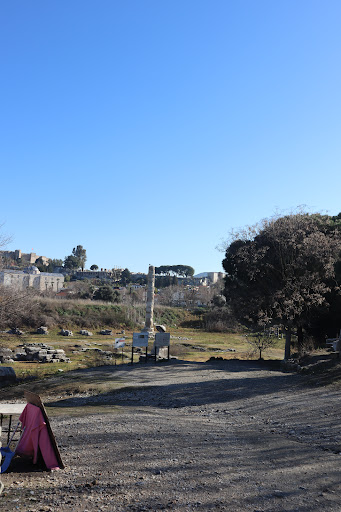
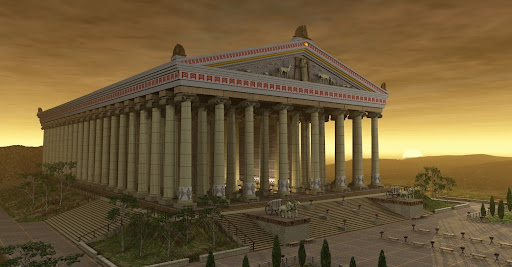
The Temple of Artemis is known as one of the Seven Wonders of the ancient world. It has been built in the areas of Ephesus on a flat area which has over the centuries turned into a swamp. If you visit Ephesus today, you can only see the ruins of the foundations of this marvelous construction of the Hellenistic Age, entirely made of marble and full of sculptured columns' capitals and shafts. The most beautiful remaining of this temple are today exhibited in the London British Museum.
The oldest remaining found date back till the 6th century BC. It was surrounded by 36 huge columns, later enlarged upon the orders of the Lydia King, Kreisos, during the 6th century BC. Most of the exhibits in the London British Museum belong to this period.
The new Artemis has been rebuilt in the 2nd century BC. Located on top of the previous one, it had tremendous dimensions: 127 columns of each 17,5 meters high. Unfortunately this one has also been destroyed by fire, reconstructed and again demolished by earthquakes, rebuilt and at last looted by Goths one year later. The statue of many-breasted Artemis was the symbol of the temple but also of abundance, hunting and wild life. The genuine statue of Artemis, removed during the fire, is today exhibited in the Ephesus Museum. Many copies of this statue found during the latest excavations date back from the Roman period.
Mythological Info
Artemis was also called Cynthia, from her birth place, Mount Cynthus in Delos. She was Apollo's twin sister, daughter of Zeus and Leto. She was one of the three maiden goddesses of Olympus: the pure maiden Vesta, gray-eyed Athena who cares but for war and the arts of the craftsmen, and Artemis, lover of woods and the wild chase over the mountain.
She was the Lady of Wild Things, Huntsman-in-chief to the gods, an odd office for a woman. As a huntress her favorite animal was the stag, because its swiftness gave the best opportunity for her method of capture, which was by her silver bow and arrows and speed of foot.
As Phoebus was the Sun, she was the Moon called Phoebe and Selene (Luna) representing the evening and night, carrying a torch, and clad in long heavy robes, with a veil covering the back of her head. Neither name originally belonged to her.
Phoebe was a Titan, one of the older gods. So too was Selene, a moon-goddess, indeed, but not connected with Apollo. She was the sister of Helios, the sun-god with whom Apollo was confused.
She was worshiped in Athens, Corinth, and Thebes as goddess of strict upbringing, of good fame, of upright mind, and of sensibility in the affairs of ordinary life. She chased and fired her arrows at all wild and unchecked creatures and actions.
In the later poets, Artemis is identified with Hecate. She is "the goddess with three forms", Selene in the sky, Artemis on earth, Hecate in the lower world and in the world above when it is wrapped in darkness. Hecate was the Goddess of the dark of the Moon, the black nights when the moon is hidden. She was associated with deeds of darkness, the Goddess of the Crossways, which were held to be ghostly places of evil magic.
The temple of Artemis was in Ephesus of today's Turkey. It is noteworthy that it took 120 years to complete, initially started by King of Lydia, Croesus. The temple was built of marble and limestone, materials transported from nearby hills. Some 120 marble columns supported the main section of the temple. Each column was 20 meters high. The enormous boulders were moved there by pulleys and connected with metal pins. After the completion of the roof, artists decorated the building with wonderful sculptural performances. In the middle of the temple was the marble statue of Artemis. The temple was one of the largest in the classical world, much larger than the Parthenon that was later built in Athens. The base of its foundations was 131 meters long and 79 meters wide. In 356 BC. the temple was destroyed by fire. The fire was made by Herostratos, who wanted to become famous. By coincidence, Alexander the Great was born on the day of the temple's destruction. Later, Alexander visited Ephesus and ordered that the temple be rebuilt in the same place. The temple of Alexander survived until the 3rd century AD. century. With the passage of time the mud flooded the port of Ephesus and the city collapsed insignificant! The Goths then plundered the temple and the floods ended the disaster. The spectacle of the miracle was so impressive that Antipatros says: "I have seen the impressive Babylon with its hanging gardens, the statue of Zeus, the Colossus of Rhodes, the Great Pyramid and the Mausoleum of Halicarnassus, but when I saw her house Artemis arrived as the clouds, the other masterpieces lost their shine and then I exclaimed: In addition to Mount Olympus, the Sun never looked at something so huge. Today, there are few boulders of the foundations and a single restored column left by the temple in Ephesus. My rating would be excellent if the Turkish authorities were to better preserve the archaeological site with restorations, and by stripping off the waters that sweep in the area of the Ancient Temple!
The Temple of Artemis was one of the Seven Wonders of the Ancient World, located at Ephesus (modern-day Turkey), a major religious and economic center dedicated to the Greek goddess of the hunt, Artemis. Famous for its immense size, marble construction, and incredible artwork, it was destroyed and rebuilt multiple times, notably by arson (Herostratus in 356 BC) and invasions (Goths in 262 AD), with little remaining today but its foundations and scattered artifacts, as the site was eventually used as a quarry. Key Aspects of the Temple: Location: Ephesus, near the coast of Asia Minor (modern Turkey), built on marshy ground to protect against earthquakes. Scale: An enormous Ionic temple, larger than the Parthenon, featuring double rows of tall, carved columns. Significance: A vital cult center for Artemis, attracting pilgrims and boasting immense wealth and political power. Destruction & Rebuilding: Early versions destroyed by floods and earthquakes. Burned by Herostratus in 356 BC, seeking fame. Rebuilt with greater splendor. Destroyed by Goths in 262 AD. Finally abandoned, used as a quarry for other buildings. Legacy: Although only ruins remain at the site, fragments of its art are in the British Museum. Why "Abscess"? The term "abscess" in your query is likely a misunderstanding or a typo for Ephesus, the ancient city where the temple stood, as "abscess" refers to a collection of pus in body tissue and has no connection to the temple. In short, the Temple of Artemis was a spectacular, iconic ancient wonder in Ephesus, Turkey, known for its grandeur and tragic cycle of destruction.