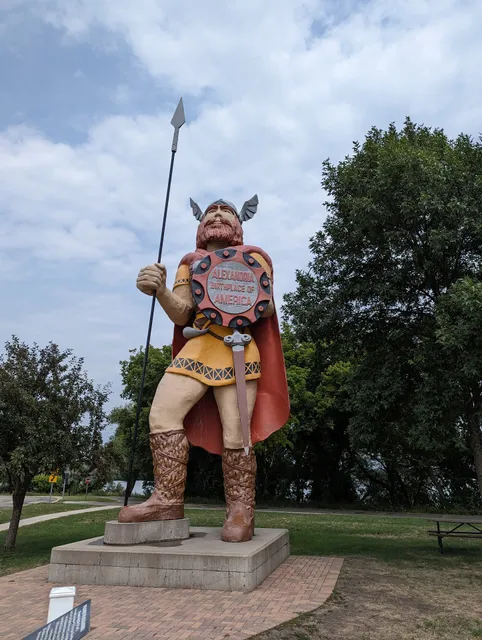
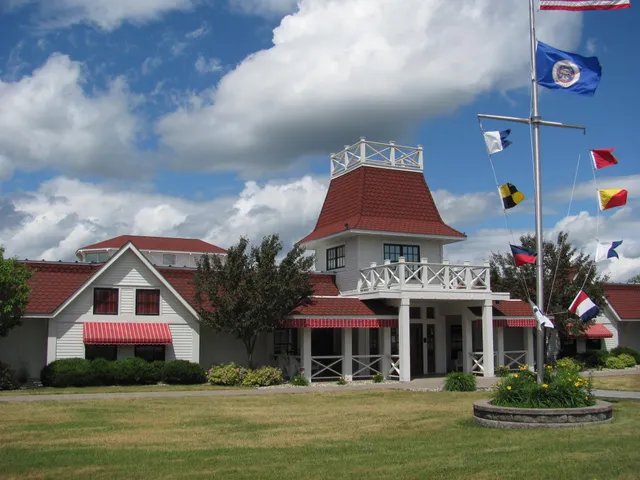
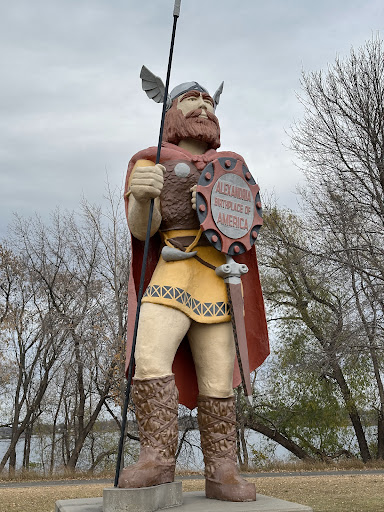
Well, if you visit Alexandria Minnesota, and you have any interest in history especially alternative history, then you most definitely have to come here. So I am a historian, the kind of historian, who doesn't like nice Pat answers, like how this is a hoax. The Kensington stone is real. Anybody who thinks that some Swedish immigrant farmer busting his tail trying to keep from freezing to death or Starving in 1890 homesteading this deep in Minnesota territory, had the time inclination, knowledge, or ability to create this "Hoax," Well, that person is an idiot. and that person may very well be the historical curator at the Smithsonian for all that it matters, if that person thinks this is a sham, that person is an idiot. What are the odds that this immigrant farmer would have been part of one tenth of 1% of the entire historian population that was even remotely familiar with runes in 1890. Go further, the contemporaries at the time considered Vikings to be illiterate, barbarians. It wasn't until well after World War II that contemporary historians accepted that Vikings were educated literate and worldly traveled. It wasn't until the late 1950s before, Swedish Scholars studying many newly discovered rune totems in remote areas of interior Sweden and Norway, discovered that Vikings, not only literate in runic, we're also well-versed in celt, Gaelic, Germanic, and most decidedly important because there is evidence of it here, Latin. but how could they have gotten here? People ask, nobody questions the seaworthiness of a longship since a Minnesotan sailed a replica in the early 70s from Duluth Harbor back home, to Norway. So the only other question is how did they provision the trip. The Norwegian still celebrate the food that they used. That food, is lutefisk. This lye-cured dried fish, requires a minimum of 36 hours immersion in a brine in order to reconstitute to either be eaten or for that matter, rot. A longship can be packed with eight weeks of this food. It's miserable stuff, you should try some, but it is also a critical technological factor, that made Viking expeditions possible. I'll bet somewhere in Denmark is a parchment that covers the funding of this Expedition. But the Smoking Gun on the Kensington stone is the simple addition of an AVM, a prayer to the Blessed Mother Mary in Latin. How this crafty brilliant unsung Vanguard of historical Revolution new 60 years before anybody else, the Vikings were literate and not only literate but literate and Latin is beyond me. I propose that these archaeologists and anthropologists that challenge the veracity of this Stone, go look up another little scientific principle known as Occam's razor. I would with absolute confidence lay my entire lifes assets on the bet, that it is considerably more likely that the stone is real Vikings spoke Latin and they had the ability means an interest in traveling as far as Minnesota and deep interior Minnesota at that, then this immigrant Swedish farmer was a freaking mutant historical genius with knowledge undiscovered by anyone else. Without that knowledge, he could have never fabricated this so-called hoax. So, Boston can kiss my dot-dot-dot. Alexandria Minnesota, holds the title as the earliest yet verifiably known place that a European set foot in North America, other than Greenland of course which had Viking settlements from the 12th century on. Let's return to Occam's razor for a second. I think the stone itself has absolute veracity, but for the idiots and doubters out there, the considerable additional material found throughout the region, by plowing fields, such as 12th and 14th century era metallurgically verifiable, Viking style Axe Heads and other artifacts that can also be found at this Museum, should put the final Nails in the coffin, and lay to rest once and for all, any reasonable doubt. You should come to this Museum it cost $8 it's worth it, you're looking at a piece of history that isn't in any history book yet because Europeans love their Christopher Columbus story and they sure as hell don't...
Read moreNestled within the quaint town of Alexandria, Minnesota, lies an enigmatic artifact that has captivated the imagination of scholars and enthusiasts for over a century—the Kensington Runestone. Discovered in 1898 by Swedish immigrant Olof Ohman, the runestone has sparked intense debate over its authenticity and origin, shedding light on its profound significance in shaping the narrative of Minnesota's history.
In the late 19th century, while clearing land on his farm near Kensington, Olof Ohman, a Swedish immigrant, unearthed a peculiar 202-lb slab of graywacke stone. According to his account, the stone was buried under the roots of a large tree. When unearthed, it was found to bear inscriptions mysterious markings resembling medieval Norse runes. Ohman's son also reported seeing the stone before it was fully unearthed.
Initially dismissed as a mere curiosity, the significance of the discovery soon became apparent as experts examined the inscription. The runic script purportedly narrates the tale of a Viking expedition to the region in the year 1362, predating the arrival of Christopher Columbus to North America by over a century. This revelation ignited a firestorm of speculation and intrigue, thrusting the small town of Kensington into the spotlight of international attention.
Runestones are ancient stone monuments bearing runic inscriptions, typically dating back to the Viking Age in Scandinavia, roughly from the late 8th to the early 12th century. They were erected as memorials, grave markers, or to commemorate significant events. These inscriptions often include names of individuals, messages, or stories from Norse mythology. The Kensington Runestone, is one of the few runestones found outside of Scandinavia.
Beyond its archaeological significance, the Kensington Runestone holds profound cultural and historical importance. If authentic, the inscription challenges conventional narratives of European exploration in North America, suggesting that Vikings may have ventured far beyond the confines of their Norse homelands.
The stone was then sent to Northwestern University in Evanston, Illinois. It achieved brief success in 1949, when the stone was put on display at the Smithsonian Institution though the scholarly consensus dismissed it as a hoax.
Regardless of its authenticity, the Kensington Runestone continues to exert a profound influence on Minnesota's cultural landscape. The name for the National Football League’s Minnesota Vikings is a direct outcome of the fame of the Kensington Runestone and the annual Kensington Runestone Festival celebrates the region's Scandinavian heritage.
While the initial draw of the the Runestone Museum is the Runestone itself, the museum also focuses on Fort Alexandria, a remarkable example of early Nordic-American folk culture. In the tumultuous aftermath of the Dakota Conflict of 1862, the landscape of Alexandria underwent a profound transformation. Fleeing settlers left behind ghostly remnants of their once-thriving communities. In response to the upheaval, the Eighth Regular Infantry, under the directive of the Governor of Minnesota, erected Fort Alexandria in the spring of 1863. This military stockade, a symbol of resilience amidst adversity, served as the nucleus of social and commercial activity in the region.
Stepping through the gates of Fort Alexandria, visitors are transported to an era of frontier living, where log residences, a church, a school, and a blacksmith shop dot the landscape. The meticulous reconstruction of these structures offers a vivid portrayal of pioneer life in Central Minnesota during the 19th century.
The museum's extensive collection offers a kaleidoscopic view of history, from the storied adventures of the Vikings to the enduring legacy of Native American tribes. Among the highlights are the 45-foot Viking ship Snorri and the Native...
Read moreWhile it was fun to see a famous curiosity, my family and I were disappointed that the short film, exhibit and museum guides really leaned into the authenticity narrative. We found that the evidence presented was pretty weak - for example, the short film you watch at the beginning concludes with (and I'm paraphrasing here because I don't remember the exact words) "look around you, feel the presence of the vikings in the weather and landscape and decide for yourself." Some of the statements presented as truth, such as that the discoverer of the stone never said it was a hoax and affirmed it was authentic until he died, were directly refuted at another museum we visited on our trip. I think the Runestone Museum would be more interesting if they told both sides: the original story and the reasons people believe it is a hoax. One other thing they could improve upon is how all of the other artifacts are displayed in the exhibits. They seemed mostly jumbled together, lacked clear displays and the interpretive signs and written information was not adequate to explain the significance of most of the pieces. That said, the people working there are welcoming and the viking ship and little village were worth looking at. Overall it was a little expensive for what it was and I would skip it unless you are really into oddities, such as...
Read more