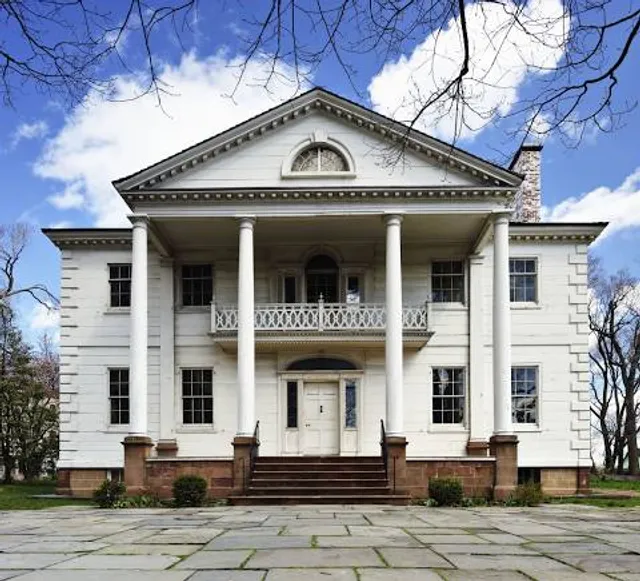
The Morris-Jumel Mansion is recognized as the oldest house of Manhattan, New York and one of our country’s first and most prominent historic house museum. It is owned and operated by the New York City government.
Built in 1765, the mansion features elements of Palladian, Federal and Georgian style architecture, and it served as the residence for many prominent figures in America’s history.
In June of 2025, I brought and treated my wife and myself for a self guided tour of the Morris-Jumel Mansion to celebrate our Happy Juneteenth holiday, and we thoroughly enjoyed our visit of this historic destination. During our time at the mansion, we learned much about the occupants that resided at the mansion.
The mansion was built initially for Colonel Roger Morris, an officer in the British Army, and his spouse, Mary Philipse, a potential love interest of George Washington and a member of the Philipse Family, a prominent Dutch family of 18th Century New York.
In the early years of the American revolution, the Morris family fled the mansion likely stemming from fears that their home would subject to arson attacks carried out by the Patriots, colonists that opposed Great Britain’s governance during the colonial era.
In 1776, George Washington occupied and used the mansion as a military headquarters following his army’s retreat of Manhattan during the Revolutionary war. The exhibit that detailed George Washington’s time at the mansion indicates he may have chosen the site due to its elevated topography, which gave him the advantage to see approaching British troops.
Washington would flee from the mansion in October of 1776 due to advancing British troops. The British would occupy the house from 1776 until their last evacuation in 1783. During much the British occupation, the mansion would serve as the headquarters of British lieutenant general, Henry Clinton and Hessian commander, Wilhelm von Knyphausen
After becoming President in 1789, George Washington returned to the mansion and celebrated a party with several other Founding Fathers.
Throughout much of the 19th century, the mansion was primarily owned by the Jumel family which included French merchant, Stephen Jumel & his wife, Eliza Bowen Jumel, who would go down as one of the wealthiest female figures of New York history.
When the Jumels occupied the mansion, the house was regarded as the “social center of colonial New York.” The Jumels used their home to host numerous lavish celebrations and it was visited by many prominent European & American figures.
During our visit of the mansion, both my wife and I were fascinated to learn about the Eliza Jumel & the mansion’s connection with the Solomon Northrop family. Solomon Northrop was the son of a freed slave and a free woman of color, an American abolitionist, and the author of the memoir of the “Twelve Years A Slave.” We learned that Solomon’s wife, Ann was hired by Eliza Jumel to work as a cook at the mansion. Ann, her children and her husband, Solomon would live and work at the mansion for a number of years.
Other important highlights that are featured at the mansion are an 18th century kitchen which contained many replicas pots and tools that were used by slaves to cook and prepare meals. Other rooms include Eliza Jumel’s bedchamber, a French parlor, the Aaron Burr room, as well as items that were used by the British and Hessians when they occupied the mansion.
Due to its unique architecture design and rich heritage, the Morris Jumel Mansion is listed on the US National Register Of Historic Places and is recognized as a National Historic Landmark.
If you are passionate enthusiast on US history, particularly colonial America & 18th & 19 Century New York, you’ll definitely have fun visiting and exploring the Morris Jumel mansion, an amazing cultural gem and delightful New...
Read moreAs my chum and I made our way up Manhattan last Saturday, one of my other friends messaged me (upon figuring out what we were doing) and asked if we were stopping at the Morris-Jumel Mansion. The name wasn't familiar, but a quick check confirmed it wasn't too far off our official itinerary. And how can you not stop by the oldest house in NYC (especially when it's not clear you're ever going to be in this neighborhood again)? So off we went.
You'd never know this place was here, even from two blocks away. It's very much tucked away on a hidden block on the eastern side of the island (up where everything is super narrow and you can probably walk across Manhattan in five minutes) and has somehow managed to hold its own over the past few centuries. To get to it from Broadway you have to go past a few run-down streets - at no point did we feel like we were in danger or anything like that; it's just a little skuzzy up in these parts.
After moseying around the property for a minute or two, we walked up to the door and I impulsively rang the bell. One of the employees opened the door for us and led us in. I will say that I've spent an above average amount of time in ye olde museums/houses like this; my mother's idea of a great childhood vacation was visiting presidential homesteads. If you go into one of these in July, expect to be pretty hot. They're not installing air conditioning in these places, and you're lucky to get a fan plugged in. This was not a respite from the heat by any means.
We were the only visitors on the premises at that time, and I didn't get the impression this place had been hopping at any other point in the day. There were about three employees on the first floor, all of whom were very pleasant and accommodating. We were given the option of paying $10 for a self-guided tour, and I believe $20 or so for a guided tour. We went with the $10 option, which I thought was a pretty decent deal and still included a few minutes' worth of info from one of the guides about the house's history before we were largely left to our own devices. Very cool. Neither of us are the type to dawdle so it was a pretty quick tour and we were in and out in about 10 or 15 minutes.
I don't know that this is a repeat destination, but as a one-off trip it was definitely an...
Read moreThings are always a bit open to interpretation and clarification. Morris-Jumel Mansion is an amazing home, and it is a miracle it has been preserved, one of the few pre-, and Revolutionary War era structures saved from New York's never-ending sprint to level and rebuild itself. Yes, it was built in 1765 and is the city's oldest surviving home. However, the argument can be made that the oldest surviving home structure not preserved is on Staten Island, the Manee-Seguine Homestead (not the nearby Seguine Mansion mind you), the oldest portion of which may date to the 1670s. That building is an utter wreck, with many attempts by various organizations to save it and even a court order issued against the current owner to prevent its further deterioration (yet it appears all for naught). With its historic ties as one of George Washington's headquarters during the Revolutionary War the Morris-Jumel home holds a special place in New York and national history as a tangible piece of American history. Hopefully, after the pandemic, it will be fully open again as a museum. My accompanying photos are from a visit in Sept. 2009 (Google slaps the upload date...
Read more