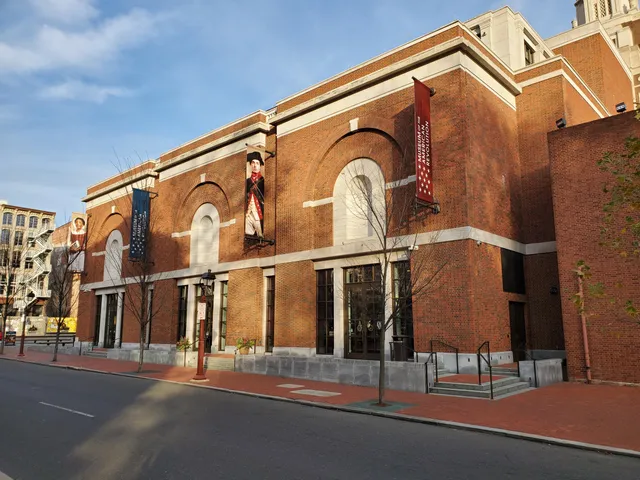
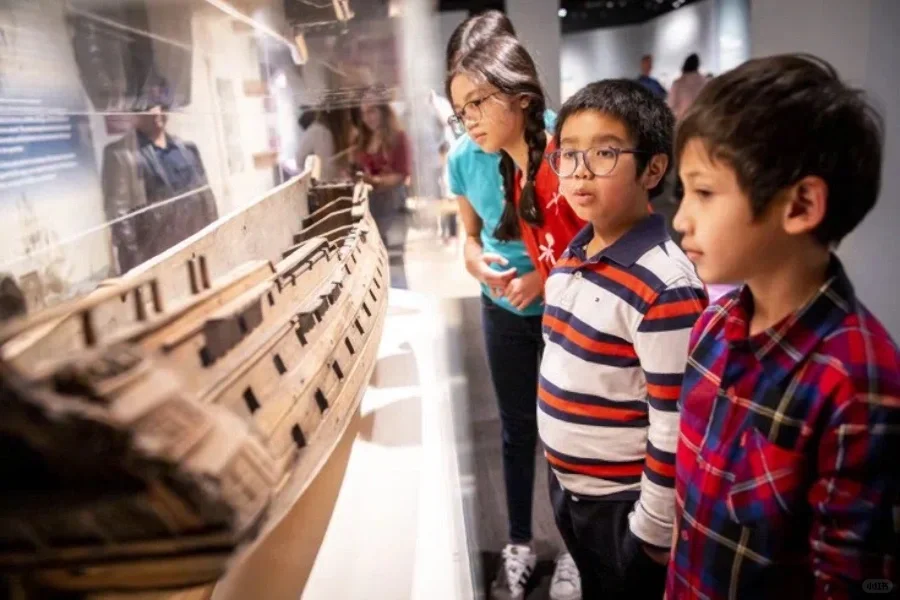
I visited The Museum of the American Revolution as part of an elementary school field trip. When I arrived to check in, another large group was already waiting at the doors to enter the museum with an entry time 5 minutes after ours. It was raining, so they took in the other group first, but I do not know why the museum would schedule such large groups of students only 5 minutes apart. When it was our turn to enter the museum, I was informed at that time that there were only 3 tour guides available to us when I was told that there would be 5. The excuse I was given was that staff members called out sick. This threw a wrench into our pre-planned student groupings and we had to quickly make adjustments outside in the rain. This left us with three groups with over 20 students in each group, which exceeded the museum’s limit of 15 students per group. Upon entering, my group was taken to the top of the staircase and shown a large painting. No one offered to take our coats per the pre-visit educator notes on their website, nor was a restroom pointed out. The area at the top of the staircase was extremely loud and it was difficult to hear our guide as sound resonated from all of the groups on the first and second floors. My students were given character cards of a historical person. They were asked for a few facts from the card and we then moved on. The museum is packed with many different artifacts and interactive exhibits. Unfortunately, we did not get to enjoy most of them. Our guided tour was extremely rushed. We would stop at a particular location, the guide would lecture and ask questions, and then we would move on, passing 2-3 areas without stopping. This extremely detracted from our experience. The majority of my student population is African American and we blew right past the exhibit on African Americans and their role in the Revolution. We moved onto the half life-sized privateer ship. All students from my school were gathered and the speaker was very well-spoken and easy to hear. He chose one student to be a “member of the crew” and put a hat on him, provided an example of how a crew member would address his current captain on the street, showed us a cannonball, and the presentation was concluded. Again, it was very quick like the tour, and left me wanting more. We’ve visited another local venue to reflect on our unit on the American Revolution, so I can’t help but compare. The other venue dressed up three students in full gear when conducting a demonstration like that. We had one student wear a hat here. That’s it. The other venue has several artifacts or replica artifacts that students can pass around and hold. Not one artifact was made available to my students. Kids like to touch things. There were a few exhibits that allowed you to touch and interact, but most artifacts were under glass. Additionally, while at the museum, I did not witness one person dressed in period-correct attire! Khaki pants/skirt and a blue polo shirt were what the guides wore. Again, when visiting another local venue, all of our guides were dressed in period-correct attire. After exiting the room that housed the privateer ship, we were rushed past photos of the people featured on our character cards. The guide pointed out a few and he kept moving. Our tour concluded with a short film (approximately 10 minutes) about George Washington and the unveiling of Washington’s Tent. The movie screen lifts up and behind glass you see Washington’s Tent. It shows through the screen and the effects are very good. Before leaving, we visited the gift shop. I’ve been to many gift shops and this by-far was one of the most overpriced shop that I’ve ever been in. Like more than Disney overpriced. $30-$40 for a t-shirt. $20 for a small stuffed animal. $7 for an iced butter cookie. Some of my students walked out disappointed because the $5 they brought with them could not afford anything but a pencil or some candy. If you're an educator, I suggest making a personal visit, but look elsewhere when...
Read moreOn April 19th, 2017, the 242nd Anniversary of the "Shot Heard Around the World" in the Battles of Lexington and Concord that started the American Revolutionary War, a conflict that lasted eight years, with six years of battles ending in October 1781 with the formal surrender at Yorktown, Virginia by Lord Charles Cornwallis of the British Army and the war ending with America's Official Independence on September 3rd, 1783 with the signing of the Treaty of Paris by Benjamin Franklin, John Adams, and John Jay, and British Clergyman, Richard Oswald. The Museum of the American Revolution opened to the general public, with four major exhibits for each period in the war. From the Stamp Act and the end of the French and Indian War, up to the signing of the United States Constitution and early independence challenges in the 1780s.
During my experience at the Museum of the American Revolution, I was easily surprised at just how vast and significant this museum is, it tells the happenings of the American Revolutionary War in a hands on and historically relevant manner. The cost of admission, while steep, is made up from the amount of exhibits you can find in the museum.
My first exposure to the museum came in the form of the entryway, filled with patriotic and historically significant flags that involved the many immigrants who came to our country to colonize, such as Sweden, France, Prussia, Great Britain, and other countries that comprised much of the American population during the war effort. From there, it leads to a second floor, where multiple attractions on a permanent basis are oriented there, the first exhibit I went into was a film and sightseeing of the tent that Washington would have used predominantly for his headquarters and encampment during the harsh winters of the campaign that Washington led troops for from 1775, up to the end of the war and his farewell in 1783, there is no photography allowed for either the film, or the tent display to keep the war tent, a 250 year artifact intact.
Following that exposure, I went into the 1765-1787 exhibit, a prominent display that featured artifacts, videos, and more in-depth information on the happenings of the American Revolutionary War, with information on the events leading up to the conflict such as the Proclamation of 1763, The Stamp Act, The Stamp Act Congress, The Townshend Acts, and the Boston Massacre, which are explained in further detail. They also talk about the role of Slavery, the presence of Freedman who served, and also women such as Deborah Sampson and Molly Pitcher, both of whom served in the war in significant battles, anx also the poet, Phillis Wheatley, whose philosophy and statements of freedom had an influence on the general doctrine of the meaning of "life, liberty, and ths pursuit of happiness."
Additionally, the exhibit had films and original artifacts from major battles such as Bunker Hill, Brooklyn Heights, Trenton, and the Battle of Brandywine, in addition to Yorktown that are told in greater detail.
As a plus, the last exhibit I visited was a special exhibit based on the flags that the infantry units would have used during battle. Many of the infantry units from the Thirteen Colonies are represented, many with their original designs or redesigned to honor the unity of the "Join or Die" that Benjamin Franklin promoted in 1754 to the Albany Conference. The exhibit, only temporary, was important and historically significant with the amount of flags that were on display.
Overall, this museum is larger than what many people will tend to speculate, as the exhibits are quite large and require more than one visit to experience it all, I will be back in the future to experience the rest...
Read moreI went here the last weekend in December. My family was in from the Indian Rez in Oklahoma and I was excited to bring them to the museum since our tribe (Delaware Tribe of Indians/Lenape) perform here every Indigenous People's Day. I have a history degree and work in the region on indigenous affairs in SE PA I couldn't wait to see the museum! When we arrived I curiously asked if the front office staff if they took Tribal Id member card discounts? I will say this is not an unusual thing to ask because several National Parks, non-profit museums and museums with indigenous installations will consider tribal member cards for discounts or free entry; especially when the museum is on home tribal land and makes a point of stating this in their installations. When I asked the question, the front desk staff rolled her eyes at me, leaned over, laughed, pointed at the discount sign above her and rudely and loudly said, "NO! Look there will you? You see THAT sign?! Those discounts are the ONLY discounts you get here. We don't take THAT TYPE of card or consider YOU a discount." Then she laughed at me in my face like I was sub-par tribal trash. In front of my teenage daughter. I've certainly dealt with racism before but I wasn't expecting it in this museum or in this part of Philly. I handed over my money, went to the theatre and had to calm down as I was so embarrassed and close to tears as she had humiliated me in front of everyone. The other two women at the front desk profusely apologized (whispered to me so she couldn't hear them) on her behalf but she of course just continued to sneer at me and my family and never bothered to apologize. I will never go to this museum again as I feel extremely uncomfortable. I cannot believe that this museum publicly facing has native exhibits and does a good job at representing us but the staff treats natives like sub-humans. Maybe train the front staff to do better. That's...
Read more