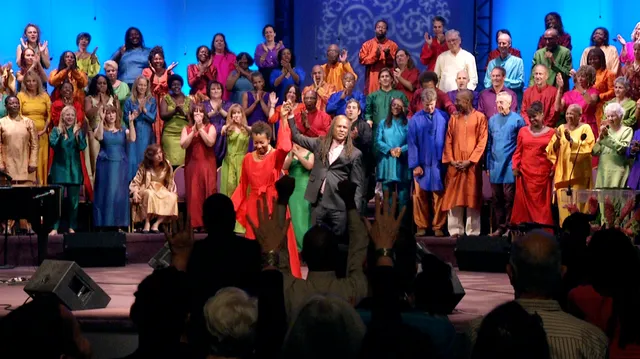
For those who have trouble understanding what the Agape movement is all about, we need to go back to Agape's roots, which began with the Science of Mind by Ernest Holmes. We are deeply rooted in the spiritual practices of meditation, prayer, spiritual reading, life visioning, and service. Recommended books draw from the wisdom of Howard Thurman, Joel Goldsmith, Martin Luther King Jr., as well as the deep mysticism of Buddhism, the Sufis, Christianity, and many others. To truly benefit from these spiritual teachings, it is recommended to dig deeply beyond the Sunday services and take some classes and workshops. Actually do the spiritual practices of meditation, prayer, spiritual readings, life visioning, and service. There is a point where everything begins to make sense. Agape ancient wisdom teachings have moved beyond the original basis of the Science of Mind; however, it is still beneficial to understand the roots of the Science of Mind in order to understand the foundations of the Agape movement. The Google AI synopsized these teachings as follows: The historical metaphysical basis of the "Science of Mind" movement primarily draws from the New Thought philosophy, which posits that the mind, through its thoughts and beliefs, has the power to directly shape reality, essentially believing that our thoughts are the primary creative force in our lives, aligning with a concept of a unified, all-pervasive "Universal Mind" or "Divine Mind" that we can access through our own consciousness; this is often described as a form of idealistic monism where the mind is seen as the fundamental reality, with the physical world being a manifestation of our thoughts and beliefs.
Key elements of the metaphysical foundation of Science of Mind:
Mind-Body Connection: A strong emphasis on the interconnectedness of mind and body, where thoughts directly influence physical well-being and circumstances. Creative Power of Thought: The belief that our thoughts have the power to manifest our desired reality through the laws of attraction and positive thinking. Universal Mind: The concept of a universal consciousness or "God" that is accessible to all individuals, acting as a source of infinite potential and creative energy.
Historical influences on Science of Mind:
Emersonian Transcendentalism: The philosophy of Ralph Waldo Emerson, which emphasized the inherent divinity and creative potential within each individual. Phineas Quimby: Considered the "father of New Thought," Quimby developed the concept of mental healing and the idea that disease is primarily caused by negative thoughts. Mary Baker Eddy: Founder of Christian Science, which also emphasizes the healing power of positive thought and the mind's ability to overcome physical limitations.
Important aspects of the Science of Mind philosophy:
Affirmations: The use of positive statements to consciously reprogram the mind and attract desired outcomes. Visualization: The practice of mentally picturing desired results to bring them into manifestation. Spiritual Law: The belief that universal laws govern the creation of reality, including the law of attraction, the law of cause and effect, and the law...
Read moreI've waited many years before posting this review.
I began attending Agape in the late 90s. By then, I was happily involved in Unity Church of Christianity as well as Ernest Holmes Science of Mind churches and teachings.
I'd started on the path to become a minister with Unity; when I moved to Los Angeles and started attending Agape (as well as a few similar-teaching churches) I considered becoming an Agape-ordained minister.
Overall, I've found the energy of the Agape staff, employees, representatives, volunteers, et al, elitist and at odds with each other.
Mostly I've enjoyed the music, meditation, dancing and good vibes. I've heard Jesus spoken of … yet never understood why there were no Jesus visuals.
In 2006, at the end of a public service while people were hugging, Reverend Michael Bernard Beckwith kissed me on the lips . At the time, this man didn't even know my name. We'd barely spoken to each other.
This was not appropriate. Yet neither was I scared to attend church. There had been other instances at all the churches I've attended, where men have been out of bounds--even in 2019.
But until then, no man--and certainly no Senior Minister--had ever touched me inappropriately.
Over the years, I'd witnessed many Agape volunteers showing hostile, aggressive behavior toward attendees - grabbing arms, fighting over seats - emotionally immature. Okay.
Then in 2007, Reverend Nirvana Gayle (now deceased) posed this question to me, "Where do you live?"
This was a week after the earlier incident. .
That's two big-time inappropriate back-to-back behaviors from two of the top Agape ministers.
I had an Agape Revelation
Seven or eight years later, I hear that Reverend Michael Bernard Beckwith has been cheating on his wife Rickie Byars Beckwith for a number of years; this is the real reason why Tim Mcafee-Lewis was hired to be the Associate Director of the Agape Music Ministry and the Agape International Choir--so Rickie Byars Beckwith could travel with her "husband" Dr. Michael Bernard Beckwith.
This revelation made a lot of sense and simultaneously, I felt sickened.
There have been many betrayals (of all kinds) within the Agape staff and practitioner community.
Sure, we're all human and it happens.
I'm happily no longer involved with Agape.
Rickie Byars Beckwith is divorcing Michael Bernard Beckwith (the divorce may...
Read moreAgape was a gateway for me on my spiritual path. I stopped attending in 2008. My main reason for not continuing I realized is I never felt "safe" there. My best way to describe Agape is "hootenanny". It's a big show. And people come for the show and to hook up (in every sense of the word). Men there are often on the prowl and it's couched in the guise of "spiritual" lest you must accept my extra long hug (yuk). Women often walk around in revealing clothes that aren't appropriate for anything with the word "spiritual" attached. There is a lot of ego floating around. It starts at the very top (The Rev) and trickles down. For all the years I attended it always felt "off". Then I realized it was my own inner guidance and sense of discernment that left me feeling that way. It felt inauthentic to me. Lots of talk about how you are beautiful and "life is good" blah blah blah. But there is no real grounding in how to achieve a good life. It's called a practice which Agape sadly does not promote. But if they did promote anything it would come with a big price tag (literally). And they have questionable people coming to speak and hawk their wares (psychics and shysters). Agape is like spiritual junk food - you go and it may feel good for the moment but it doesn't last. That's because it isn't rooted in anything except talk. But everyone is working out their own karma and on their own path. This may be fine for some, but not...
Read more