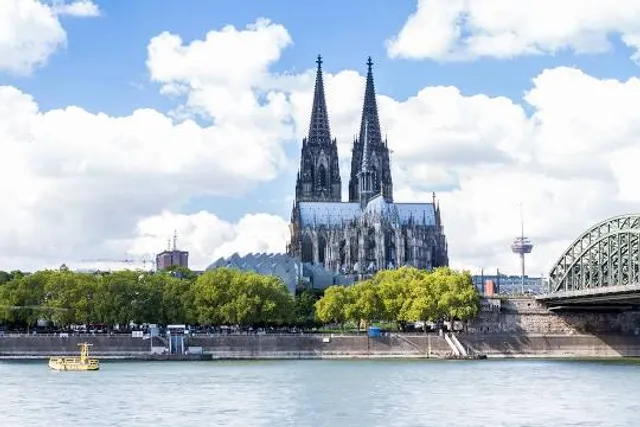
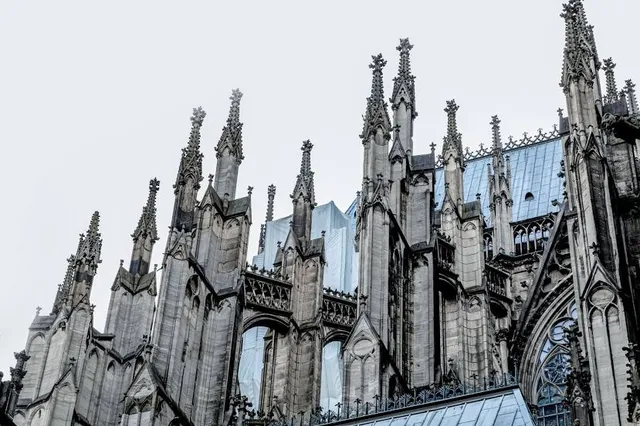
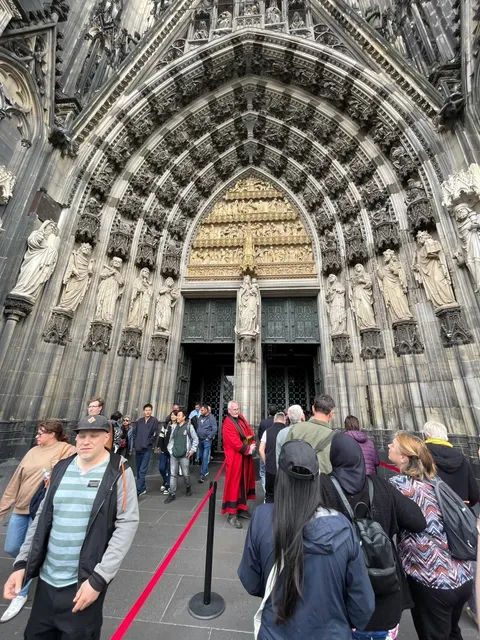
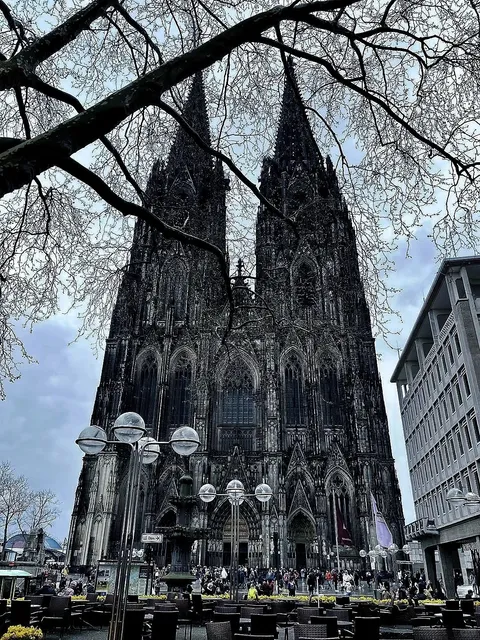
The Cologne Cathedral, or Kölner Dom, stands as a breathtaking testament to Gothic architecture, soaring majestically above the city of Cologne on the banks of the Rhine River. Its twin spires, reaching 157 meters into the sky, were the tallest structures in the world upon their completion in 1880, and they still dominate the skyline today, symbolizing the endurance of faith and the rich cultural heritage of Germany.
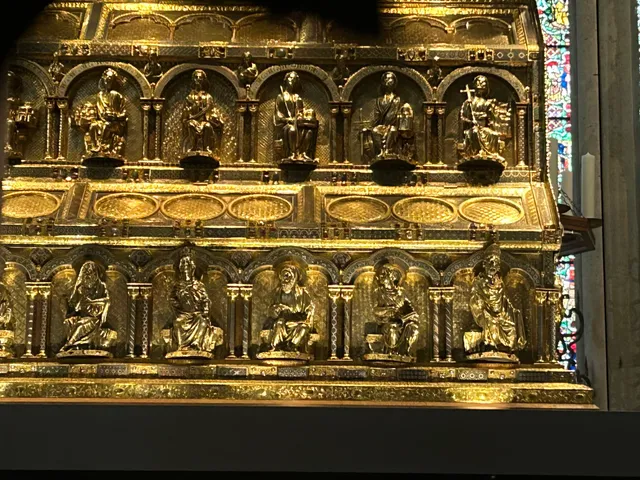
Construction of this awe-inspiring cathedral began in 1248, initiated by Archbishop Konrad von Hochstaden, who sought to create a structure worthy of housing one of Christianity’s most sacred relics—the Shrine of the Three Kings. This golden reliquary, said to contain the bones of the Three Wise Men who visited the infant Jesus, is the cathedral’s most venerated treasure. Crafted in the 12th century, it is a masterpiece of medieval goldsmithing, encrusted with precious stones and intricate carvings, and draws pilgrims from around the world.
The cathedral’s interior is a serene forest of soaring columns and pointed arches, leading the eye heavenward toward the stunning stained glass windows. Among these, the magnificent Richter Window, designed by the contemporary artist Gerhard Richter, stands out. Installed in 2007, it features a vibrant mosaic of 11,500 colored glass squares, blending tradition with modern artistry in a breathtaking display of light.
Although the relics of the Maji gets its due attention, another treasure within the cathedral, the Gero Cross, a colossal crucifix dating from around 970 AD shouldn’t be missed. This remarkable piece is not only a profound expression of Christian devotion but also one of the oldest surviving monumental crucifixes in Europe. It contains a relic of the True Cross, the biggest extent portion found anywhere, making it an object of deep reverence.
The cathedral is also home to the Milan Madonna, a beautiful 13th-century statue of the Virgin Mary, whose serene expression and flowing robes capture the essence of maternal grace. Nearby, the Choir of the Eleven Thousand Virgins houses the relics of Saint Ursula and her companions, martyred according to legend in the early Christian period. Their story is depicted in the cathedral’s intricate carvings and stained glass, offering visitors a glimpse into the rich tapestry of Christian lore.
The depictions of the Way of the Stations of the Cross in Cologne Cathedral are uniquely special and form an integral part of the cathedral’s rich artistic heritage. These Stations of the Cross, known in German as Kreuzweg, are a series of fourteen images that depict the Passion of Christ, from his condemnation by Pontius Pilate to his entombment. Unfortunately, the seventh station at the moment is partially hidden by a newly built up stage and the tenth is of an entirely different artificial style.
The Cologne Cathedral, designated a UNESCO World Heritage site in 1996, is more than just an architectural marvel; it is a living monument to the faith, artistry, and history of the region. Each stone, each piece of art, and each relic within its hallowed walls tells a story that spans centuries, inviting all who enter to contemplate the divine and the enduring human spirit.
For me, it was a much more spiritual experience than visiting even St. Peter’s or St. Paul’s. You should...
Read moreThey say some places aren't just built — they're born. Cologne Cathedral is one of them. I didn’t just walk into a church that day; I stepped into a living breath of stone, glass, gold, and centuries of unanswered prayers echoing through the arches.
From the outside, it looms like a gothic titan, scarred with soot from centuries past, yet standing with quiet defiance. Two spires pierce the sky like needles stitching heaven and earth together. But it's only when you enter that you realise: this isn't architecture, it's a heartbeat.
And here’s the part no guidebook will ever tell you — because not even the closest priest knows this. If you stand directly under the nave at noon, with the light filtering through the stained-glass windows, close your eyes, and breathe — you’ll feel something shift inside. As if the stones remember something your soul has forgotten.
The moment I saw the Shrine of the Three Kings, encased in gold, I didn’t just feel awe — I felt small in the best way possible. It’s said to contain the relics of the Magi, and while many debate it, one quiet part of me just believed. Not because I was told, but because that room didn’t feel like it belonged to time.
Few know this: beneath the mosaic floor in front of the high altar lies a coded constellation, invisible unless you know where to stand. It was supposedly laid out to reflect a celestial map on the night of the cathedral's foundation. Forgotten even by scholars, this sacred geometry wasn’t just decoration — it was intention.
The stained-glass windows are not just “beautiful.” They are stories in frozen light. I found myself staring at one where Mary holds Jesus’ body in a still moment of unbearable grief — and even though I’m no art critic, it hit me: this wasn’t just colour on glass. This was human pain, preserved like relics behind a kaleidoscope of fire.
Even the choir stalls, often overlooked, are carved with scenes that almost whisper if you lean close enough. One tiny figure — I won’t say where — is said to be the hidden likeness of the master builder himself, who carved himself into God’s house in secret, fearing man’s vanity, yet longing to be remembered.
Oh, and something many miss: the organ pipes suspended along the nave wall aren’t just musical instruments. Legend says one of them — just one — never echoes the same note twice. It’s as if the cathedral itself improvises a different sigh every time someone new walks in.
You don’t pay to enter Cologne Cathedral — and honestly, I think that’s divine justice. But I’d gently urge anyone who visits to offer a donation at the entrance. Because this place doesn’t just preserve history — it breathes it into us. And it deserves to be held by many more hearts in centuries to come.
This wasn’t a tourist visit. This was a reckoning. A stillness. A conversation I didn’t know I needed to have.
And in the silence, under the bones of saints and the shimmer of holy glass, I remembered: the soul doesn’t just live in us — sometimes, it waits for...
Read moreCologne Cathedral – A Testament of Faith and Human Devotion
Standing tall on the banks of the Rhine River in Germany, the Cologne Cathedral (Kölner Dom) is a breathtaking symbol of faith, endurance, and architectural mastery. Its construction began in 1248 and was finally completed in 1880, taking more than 600 years to reach the form we see today. The cathedral was originally built to house the relics of the Three Wise Men, making it one of Europe’s most important pilgrimage destinations.
The twin spires, rising 157 meters high, make it one of the tallest cathedrals in the world. The intricate Gothic carvings, pointed arches, and stained-glass windows create an atmosphere of peace and spiritual reflection. Despite heavy bombings during World War II, the structure miraculously survived — a living reminder of hope and resilience.
Inside, the light filtering through colorful glass feels like a reminder of divine illumination. The Shrine of the Three Kings, made of gold and silver, represents humanity’s ancient quest to seek the truth and the Creator’s guidance.
🌙 A Reflection from the Islamic View
From an Islamic perspective, such magnificent creations remind us of Allah’s power and human dedication to express faith through art and architecture. As the Qur’an says:
“Travel through the land and observe how He began creation.” (Surah Al-‘Ankabut, 29:20)
Seeing the Cologne Cathedral is to witness how people across time devoted their efforts in seeking closeness to the Divine, even if through different paths. Islam teaches us to respect all places where the remembrance of God is made and to see beauty as a reflection of His greatness.
💬 Visitor Impression
“Standing before the Cologne Cathedral, I felt the same awe that any believer feels in front of the signs of the Creator’s magnificence. The harmony, detail, and strength of the structure remind us that faith — no matter in which language or land — is a universal light that unites humanity in reverence of one God.”
⭐ Rating: 5/5 Must-see: The spires, stained-glass windows, Shrine of the Three Kings, and...
Read more