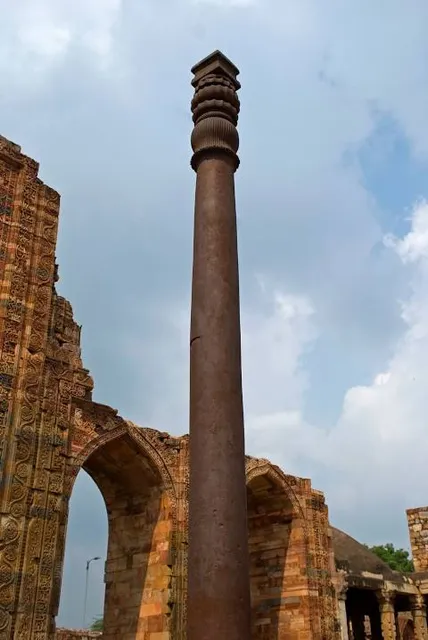
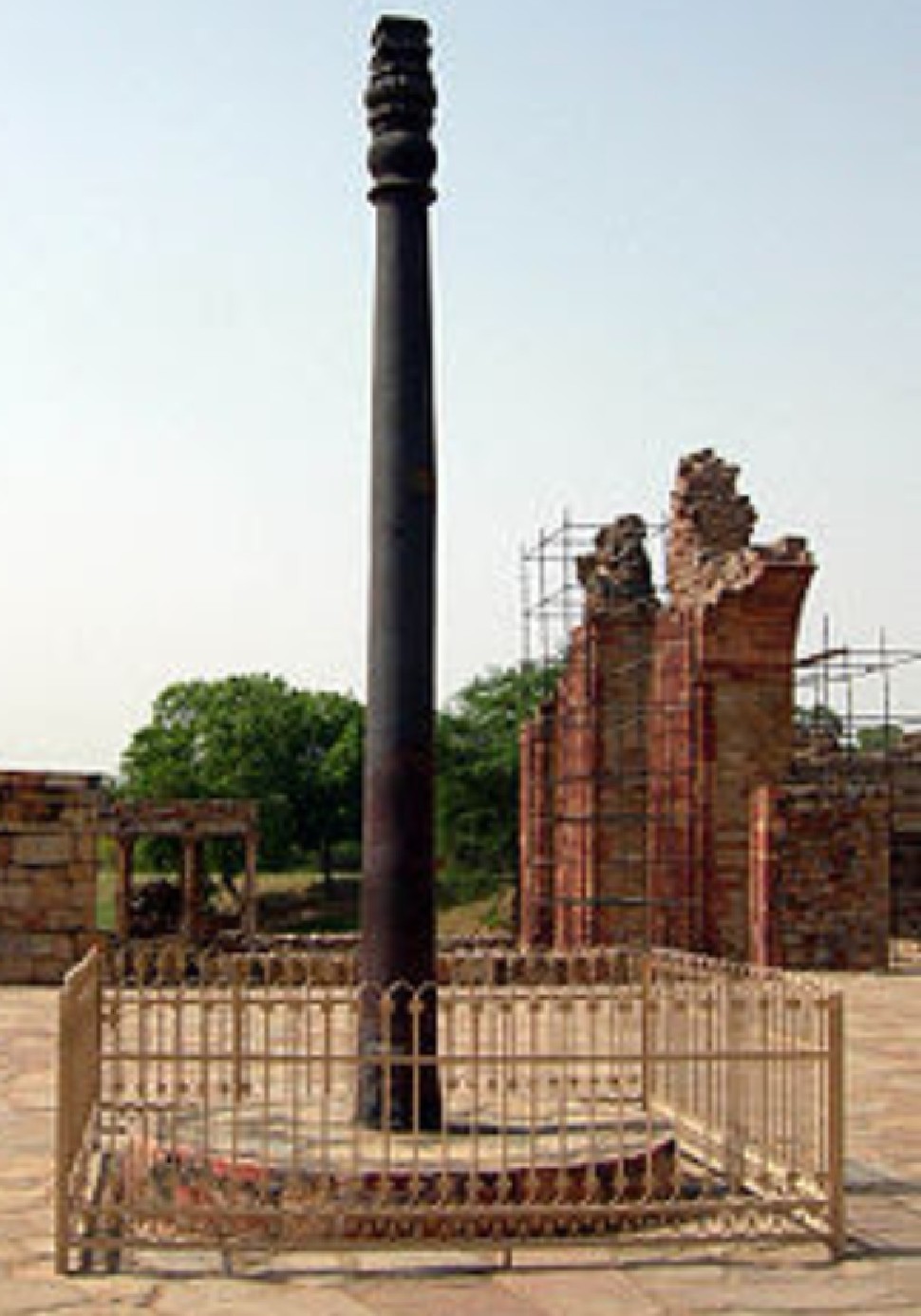
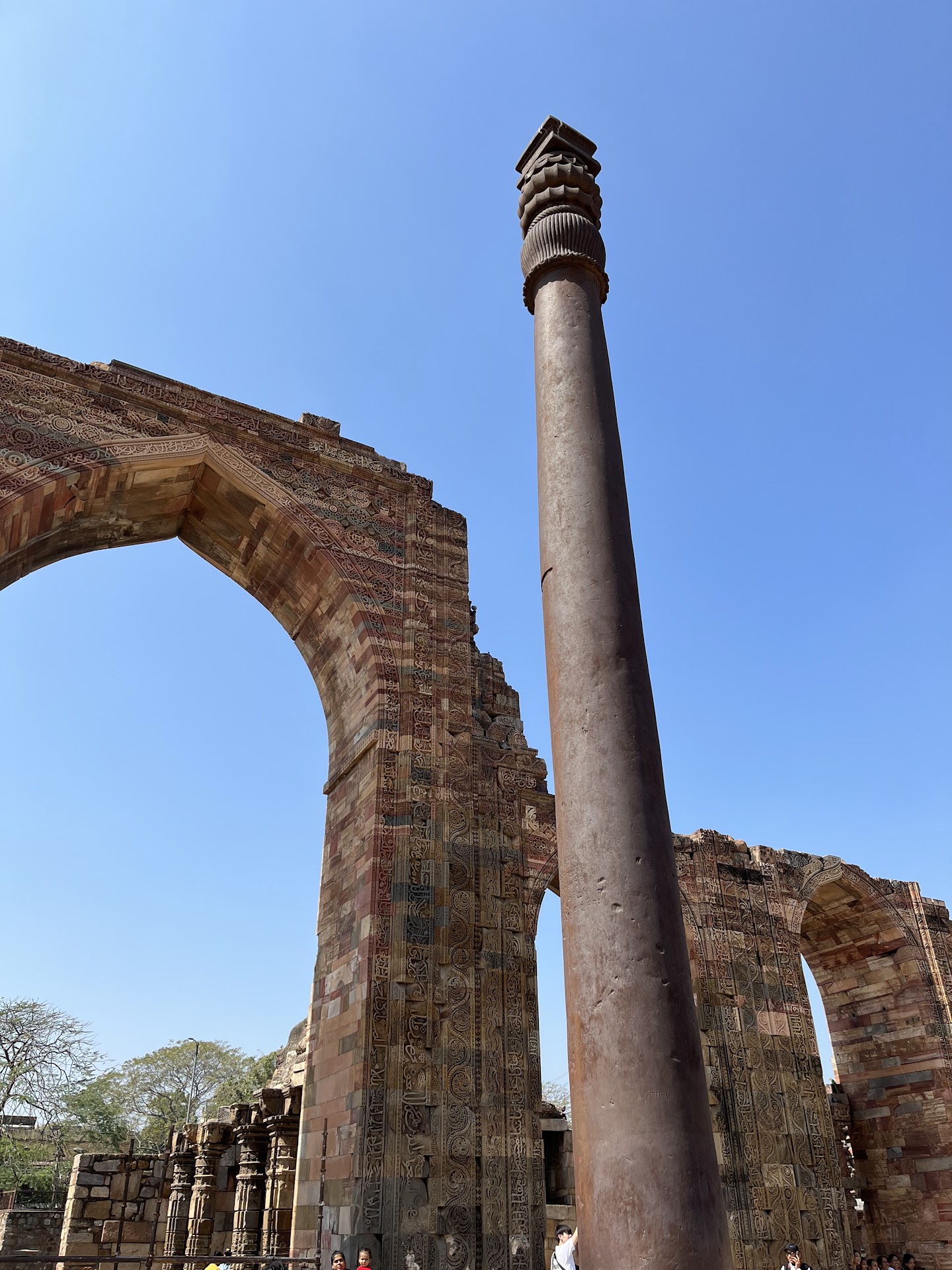
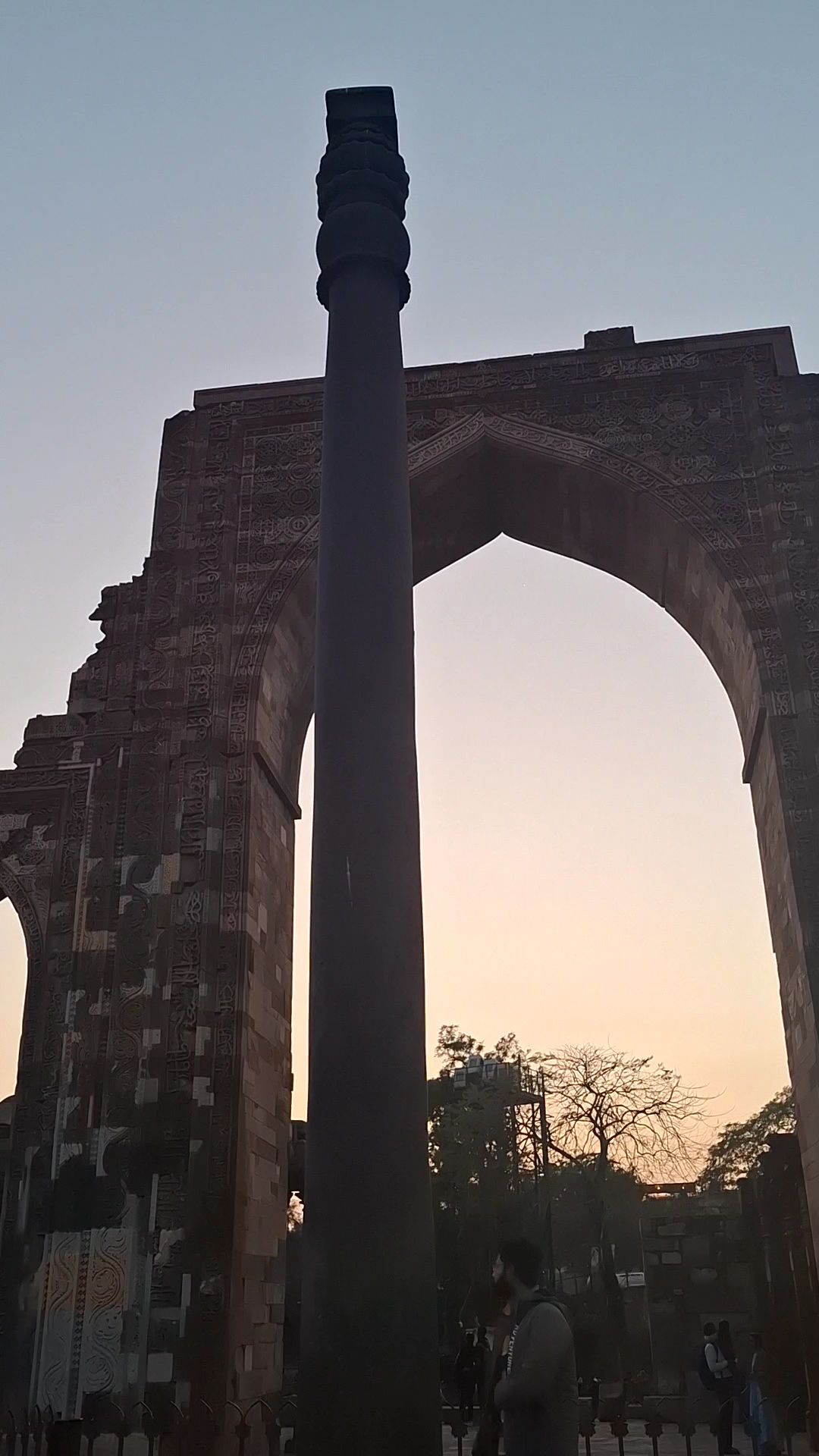
The iron pillar of Delhi is a structure 23 feet 8 inches (7.2 metres) high with 16 inches (40.64 cm) diameter that was constructed by Chandragupta II (reigned c. 375-415 CE), and now stands in the Qutb complex at Mehrauli in Delhi, India. It is famous for the rust-resistant composition of the metals used in its construction. The pillar weighs over three tonnes (6,614 lb) and is thought to have been erected elsewhere, perhaps outside the Udayagiri Caves, and moved to its present location early in the Delhi Sultanate. While the pillar was certainly used as a trophy in building the Quwwat-ul-Islam mosque and the Qutb complex, its original location, whether on the site itself or from elsewhere, is debated.
ORIGINAL LOCATION
According to the inscription of king Chandra, the pillar was erected at Vishnupadagiri (Vishnupada). J. F. Fleet (1898) identified this place with Mathura, because of its proximity to Delhi (the find spot of the inscription) and the city's reputation as a Vaishnavite pilgrimage centre. However, archaeological evidence indicates that during the Gupta period, Mathura was a major centre of Buddhism, although Vaishnavism may have existed there. Moreover, Mathura lies in plains, and only contains some small hillocks and mounds: there is no true giri (hill) in Mathura.
Based on paleographic similarity to the dated inscriptions from Udayagiri, the Gupta-era iconography, analysis of metallurgy and other evidence, Meera Dass and R. Balasubramaniam (2004) theorized that the iron pillar was originally erected at Udayagiri. According to them, the pillar, with a wheel or discus at the top, was originally located at the Udayagiri Caves. This conclusion was partly based on the fact that the inscription mentions Vishnupada-giri (IAST: Viṣṇupadagiri, meaning "hill with footprint of Viṣṇu"). This conclusion was endorsed and elaborated by Michael Willis in his Archaeology of Hindu Ritual, published in 2009.
The key point in favour of placing the iron pillar at Udayagiri is that this site was closely associated with Chandragupta and the worship of Vishnu in the Gupta period. In addition, there are well-established traditions of mining and working iron in central India, documented particularly by the iron pillar at Dhar and local place names like Lohapura and Lohangī Pīr (see Vidisha). The king of Delhi, Iltutmish, is known to have attacked and sacked Vidisha in the thirteenth century and this would have given him an opportunity to remove the pillar as a trophy to Delhi, just as the Tughluq rulers brought Asokan pillars to Delhi in the 1300s.
Relocation
It is not certain when the pillar was moved to Delhi from its original location. Alexander Cunningham attributed the relocation to the Tomara king Anangpal, based on the short pillar inscription ascribed to this king.Pasanaha Chariu, an 1132 CE Jain Apabhramsha text composed by Vibudh Shridhar, states that "the weight of his pillar caused the Lord of the Snakes to tremble". The identification of this pillar with the iron pillar lends support to the theory that the pillar was already in Delhi during Anangpal's reign.
Another theory is that the relocation happened during the Muslim rule in Delhi. Some scholars have assumed that it happened around 1200 CE, when Qutb al-Din Aibak commenced the construction of the Qutb complex as a general of Muhammad of Ghor. Finbarr Barry Flood (2009) theorizes that it was Qutb al-Din's successor Iltutmish (r. 1210–1236 CE), who moved the...
Read more
Subscribe
Ask the ChatbotGames & QuizzesHistory & SocietyScience & TechBiographiesAnimals & NatureGeography & TravelArts & CultureMoneyVideos
ContentsAsk the Chatbot a Question
Iron Pillar of Delhi
pillar, Delhi, India
Actions
Written by
Jennifer Murtoff
Fact-checked by
The Editors of Encyclopaedia Britannica
Article History
Table of Contents
Ask the Chatbot a Question

Iron Pillar of Delhi
Iron Pillar of Delhi, at the Quṭb Mīnār complex, Mehrauli, Delhi.
Iron Pillar of Delhi, pillar rising above the central courtyard of the Qūwat-ul-Islām mosque in the Quṭb Mīnār complex in Mehrauli, Delhi, that is famous for being relatively rust-free despite having been created more than 1,600 years ago, about 400 ce. The six-ton pillar was made during the Gupta period, likely at Udayagiri in what is now the state of Madhya Pradesh. Other accounts, however, mention Mathura as the likely place where the Iron Pillar originally stood. At the time it was first erected the decorative seven-part capital that tops the column may have held a figure of Garuda, a bird in Hindu mythology that bore the god Vishnu in the sky. Some researchers believe that the Iron Pillar was moved from Udayagiri to Delhi on the orders of the sultan Iltutmish in the 13th century. Others believe that it was moved to a temple in Lal Kot, Delhi, by the Tomara king Anangapala in 1050 and was moved to its current position near the mosque about 1191. Originally made for a temple of Vishnu, the pillar currently adorns the grounds of the first mosque on the Indian subcontinent and is considered one of the most important objects in Indian history.

Delhi: Quṭb Mīnār complex
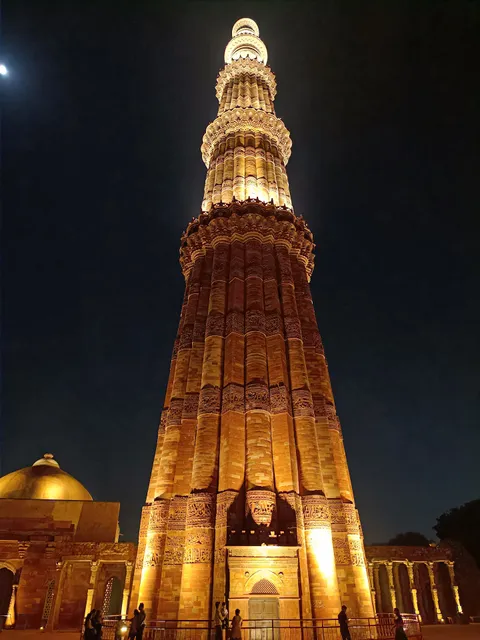
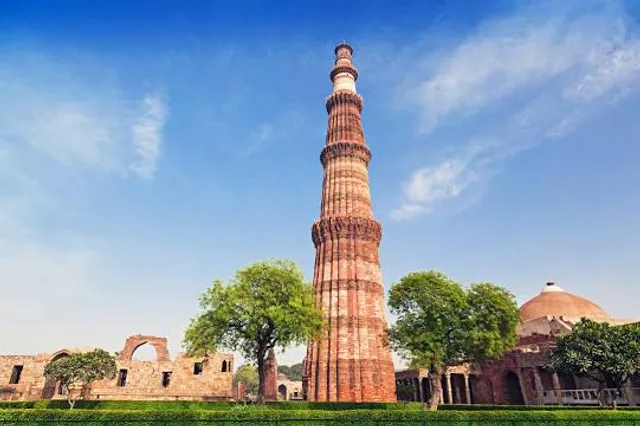
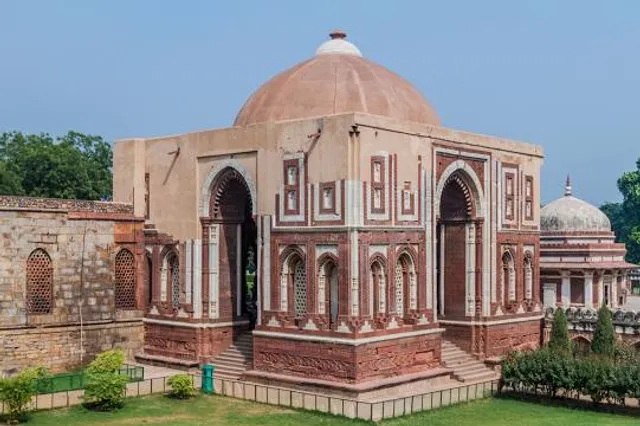
Quṭb Mīnār (1199)—a minaret built for the Muslim ruler Quṭb al-Dīn Aibak—and the Alai Darwāza domed gateway (1311) at the Qūwat-ul-Islām mosque, Delhi.(more)
The pillar measures a total of 23.5 feet (7.2 meters) tall, counting the portion that is belowground. The cylindrical portion above ground level measures 17 feet (5.2 meters) from a stone platform, likely added in 1871 or 1872. This cylindrical portion tapers from a diameter of 16.7 inches (42 cm) at the bottom (above ground level) to a diameter of 11.85 inches (30 cm) just under the decorative capital. The bottom 2 feet (0.6 meters) of the 17-foot cylindrical portion has a rough surface with hammer marks. Evidence suggests that the pillar was initially buried deeper than it is at present. One piece of evidence in support of this is the rough portion visible at the bottom of the pillar. It has been argued that the rough texture is not an unintended defect but instead was designed to help the pillar grip to the ground, suggesting that this portion was originally underground. The base of the pillar appears to be flat, with eight small projections spaced evenly around the circumference that jut into a sheet of lead. The lead sheet lies on top of a dressed stone slab on the original floor of the temple.
The iron pillar is not rusted because it was made of 98% wrought iron. Due to the presence of high amounts of phosphorus (as much as 1 percent against less than 0.05 percent in today's iron) and the absence of sulphur/magnesium in the iron are the main reasons for its remaining rust-free...
Read moreSymbol of great in depth knowledge of metal science.
The Iron pillar of Delhi, also known as Ashoka Pillar, is 23 feet 8 inches high (7.2 metres) with 16 inches diameter structure, was constructed by a "King Chandra", probably Chandragupta I , and is currently standing in the Qutb complex at Mehrauli in Delhi, India.1It is famous for the rust-resistant composition of the metals used in its construction.
The pillar has attracted the attention of archaeologists and materials scientistsbecause of its high resistance to corrosionand has been called a "testimony to the high level of skill achieved by the ancient Indian iron smiths in the extraction and processing of iron".3 The corrosion resistance results from an even layer of crystalline iron hydrogen phosphate hydrate forming on the high-phosphorus-content iron, which serves to protect it from the effects of the Delhi climate.3]
The pillar weighs over 6,000 kg (13,000 lb) and is thought to have been erected in what is now Udayagiri and reused by one of the Guptamonarchs in approximately 402 CE, though the precise date and location are a matter of dispute.[5]
The height of the pillar, from the top of its capital to the bottom of its base, is 7.21 m (23 ft 8 in), 1.12 m (3 ft 8 in) of which is below ground. Its bell pattern capital is 1.07 m (3 ft 6 in) in height, and its bulb-shaped base is 0.71 m (2 ft 4 in) high. The base rests on a grid of iron bars soldered with lead into the upper layer of the dressed stone pavement. The pillar's lower diameter is 420 mm (17 in), and its upper diameter is 306 mm (12 in). It is estimated to weigh more than six tonnes(13,228 lb).
The pillar was manufactured by the forge welding of pieces of wrought iron. In a report published in the journal Current Science, R. Balasubramaniam of the IIT Kanpur explains how the pillar's resistance to corrosion is due to a passive protective film at the iron-rust interface. The presence of second-phase particles (slag and unreduced iron oxides) in the microstructure of the iron, that of high amounts of phosphorus in the metal, and the alternate wetting and drying existing under atmospheric conditions are the three main factors in the three-stage formation of that protective passive film.[33]
Lepidocrocite and goethite are the first amorphous iron oxyhydroxides that appear upon oxidation of iron. High corrosion rates are initially observed. Then, an essential chemical reaction intervenes: slag and unreduced iron oxides (second phase particles) in the iron microstructure alter the polarisation characteristics and enrich the metal–scale interface with phosphorus, thus indirectly promoting passivation of the iron[34. The second-phase particles act as a cathode, and the metal itself serves as anode, for a mini-galvanic corrosion reaction during environment exposure. Part of the initial iron oxyhydroxides is also transformed into magnetite, which somewhat slows down the process of corrosion. The ongoing reduction of lepidocrocite and the diffusion of oxygen and complementary corrosion through the cracks and pores in the rust still contribute to the corrosion mechanism from...
Read more