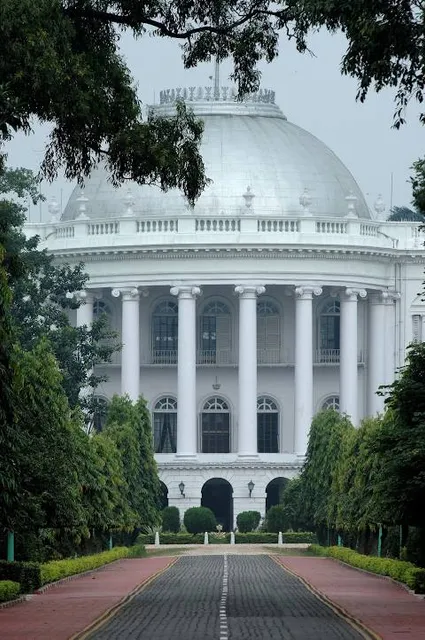
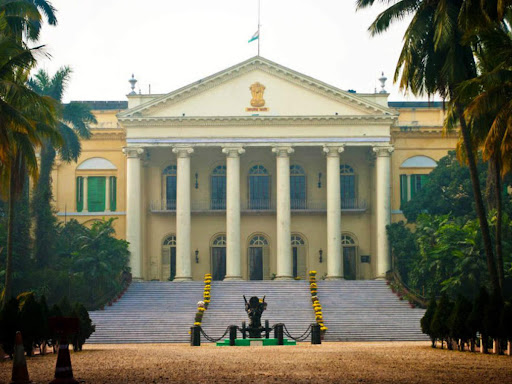
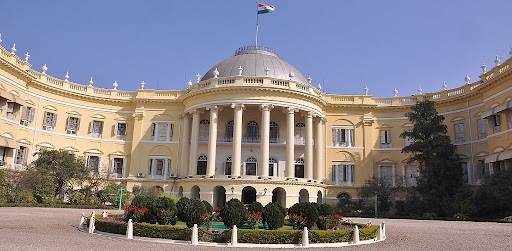
Raj Bhavan is the official residence of theGovernor of West Bengal, located in the state' capital city Kolkata. Built in 1803, it was known as Government House in the pre-independence days.Later after the transfer of power from the East India Company to the British Crown in 1858 it became the official residence of the Viceroy of India, shifting here from the Belvedere Estate. With the shifting of capital to Delhi in 1911 it became the official residence of Lieutenant Governor of Bengal. Since independence in 1947 it serves as the official residence of the Governor of West Bengal and came to be known as the Raj Bhavan, a name it shares with the official residences of other states' governors. Government House, South Front, photographed bySamuel Bourne
In the early nineteenth century Calcutta (Kolkata) was at the height of its golden age. Known as the City of Palaces or St. Petersburg of the East, Calcutta was the richest, largest and the most elegant colonial cities of India.It was during this time that one of Calcutta's finest colonial structures, Government House (later Raj Bhavan), was constructed.
Before 1799, the Governor-General resided in a rented house, called Bukimham House, located in the same location. The land belonged to Mohammad Reza Khan, a Nawab of Chitpur.It was in 1799 that the then Governor-General of India, The 1st Marquess Wellesley, took the initiative of building a palace, because he believed that India should be ruled from a palace and not from a country house. Lord Wellesley wanted to make a statement to the imperial authority and power and so the building was done on a grand scale.
After 4 years construction it was completed at a colossal cost of £63,291 (about £3.8 million in today’s estimate). Wellesley was charged for misusing of East India Company’s fund and was finally recalled back to England in 1805. Although Wellesley lost his job, he does have the credit of giving Kolkata one of its finest colonial mansions.
In 1892, the Otis Elevator Company installed the first elevator in India at the Raj Bhavan.
Kedleston Hall
Designed by Capt. Charles Wyatt and on the lines of the Curzon’s family mansion of theKedleston Hall of Derbyshire,the Raj Bhavan follows a Neoclassical style with distinct Baroque overtones. In a strange coincidence, a 100 years after its construction started, the most illustrious son of the Curzon family,George Nathaniel Curzon came to occupy the Raj Bhavan as the Viceroy of India. Lord Curzon described the Government House as “without doubt the finest Government House occupied by the representative of any Sovereign or Government in the world.”
Since the days of Lord Wellesley the Raj Bhavan had undergone several changes. In 1860s the Viceroy Lord Elgin added the metallic Dome. Lord Curzon brought electricity and lift (popularly known as the ‘Bird Cage Lift”) to Raj Bhavan. The tiny ornamentally designed “Bird Cage Lift” operates to this day.
Arched Gate of the Raj Bhavan
The plan comprises a central core with four radiating wings. The state rooms located in the central core are accessed from the outside by a flight of grand steps on the north. On the south is another portico surmounted by a colonnaded verandah with a dome above. The four wings accommodate the various offices and residential quarters along with four sets of staircases. The plan of the wings allows for a great deal of natural ventilation in the spaces while also permitting views across the gardens. The entire compound is surrounded by a balustradedwall with a grand arched gateways.
The Raj Bhavan covers an area of 84,000 sq. ft. and is surrounded by a compound covering an area of 27 acres.The Raj Bhavan has 6 gate ways one each on North & South and 2 each on East & West. The 4 gates on the East & West have a grand arch ways topped with a lion. The minor archways on the side are topped with Sphinx. Sadly these 4 colossal gates hardly provide a good view of...
Read moreThe Raj Bhavan is not just a heritage building, it is Kolkata's outstanding landmark evoking the past and sublimating it.Raj Bhavan, Kolkata, the erstwhile Government House, used to be the seat of British Imperial power.
Built in the years 1799-1803 when Marquis Wellesley was the Governor General, this historic and magnificent building was designed on the lines of Kedleston Hall in Derbyshire, the ancestral house of Lord Curzon who later lived here as the Viceroy and the Governor General exactly 100 years after Wellesley.
This three-storied building with a magnificent central area consisting of large halls has curved corridors on all four sides radiating to detached wings, each constituting a house in itself. Raj Bhavan, Kolkata, was built over 1799 and 1803.
Governor General Lord Wellesley took up residence in Government House, as it was then called, in 1803, even before the last of the artisans had vacated the mansion. Such was his impatience to live in a home worthy of a ruler of the British Empire in India. The magnificent edifice of Kolkata's Raj Bhavan, or the Government House, was completed on January 18, 1803. Twenty-three Governors-General and, later, Viceroys lived in this house, until the capital shifted to Delhi in 1912.
In keeping with Lord Metcalfe's imperial vision, this meticulously structured building was specially created away from the rest of the metropolis, magnificently proportioned amidst acres of formal gardens. Tall intricately patterned wrought iron gates with massive lions perched atop reiterated the same regal majestic message. The 'plebeian' and the 'common man' were to be kept out of what was the abode of the Governor General, the symbol of the power and might of the Monarch and the Throne.
The total area occupied by the Raj Bhavan is 27 acres. The Raj Bhavan building has 84,000 sq.ft of floor space. The residential suites are in the four corners of the second floor while the main suite - the Prince of Wales suite-used by visiting dignitaries, on the first floor North West. In the ground floor the central area is called the Marble Hall. The first floor central area consists of the Throne Room, Banquet Hall and the Blue Drawing and Brown Dining Rooms. On the first floor, North East corner has the Council Chamber, in which major Government decisions were made during British rule. The second floor has the Governor's apartments and the Ball Room.
The Government House retained this awe-instilling quality even after the departure of the last British incumbent, Sir Frederick Burrows, and the assumption of office by the first indian Governor, the illustrious Shri C. Rajagopalachari in 1947. But the imposing gates began to open for a steadily increasing stream of visitors from all classes. The following Governors have held office after India's independence (commencing from the date against their name):
Chakravarti Rajagopalachari - 15.08.1947 Dr. Kailash Nath Katju - 21.06.1948 Dr. Harendra Coomar Mookerjee - 01.11.1951 Shrimati Padmaja Naidu - 03.11.1956 Shri Dharm Vira - 01.06.1967 Shri Shanti Swarup Dhawan - 19.09.1969 Shri Anthony Lancelot Dias - 21.08.1971 Shri Tribhuvan Narayan Singh - 06.11.1977 Shri Bhairab Datt Pande - 12.09.1981 Shri Anant Prasad Sharma - 10.10.1983 Shri Uma Shankar Dikshit - 01.10.1984 Professor Saiyid Nurul Hasan - 12.08.1986 Shri T. V. Rajeshwar - 02.03.1989 Professor Saiyid Nurul Hasan - 07.02.1990 Shri K. V. Raghunatha Reddy - 14.08.1993 Dr. A. R. Kidwai - 27.04.1998 Justice Shri Shyamal Kumar Sen - 18.05.1999 Shri Viren J. Shah - 04.12.1999 Shri Gopalkrishna Gandhi - 14.12.2004 Shri M. K. Narayanan - 24.01.2010 Shri Keshari Nath Tripathi - 24.07.2015 Shri Jagdeep Dhankhar - 30.07.2019 Dr. C.V. Ananda Bose...
Read moreRaj Bhavan, Kolkata, is the official residence of the Governor of West Bengal, India. Here are some key points about Raj Bhavan:
Location: Raj Bhavan is located in the city of Kolkata, the capital of West Bengal. It is situated on the southern edge of the Maidan, a vast urban park in the heart of the city.
Historical Significance: The building has historical significance and was originally known as the Government House during British rule. It served as the official residence of the Governor-General of India until the capital moved to Delhi in 1911.
Architectural Style: Raj Bhavan is an impressive colonial-era structure designed in the Neoclassical architectural style. It reflects the grandeur and architectural tastes of the British colonial period.
Governor's Residence: After India gained independence, the building became the official residence of the Governor of West Bengal. It is a symbol of the state's connection to its colonial past.
Grounds and Gardens: Raj Bhavan is set in extensive grounds with well-maintained gardens. The lush greenery and open spaces provide a serene environment.
Public Areas: While certain areas of Raj Bhavan are reserved for official and private use, some sections are occasionally opened to the public during specific events or tours.
Cultural Events: Raj Bhavan often hosts cultural events, state functions, and ceremonies. It serves as a venue for important government and diplomatic gatherings.
Preservation of Heritage: Efforts are made to preserve the heritage and historical significance of Raj Bhavan. The building and its surroundings contribute to Kolkata's architectural and cultural legacy.
Visitor Information: The public may have limited access to certain areas of Raj Bhavan during designated times or events. Visitors are usually required to follow specific protocols and security measures.
Governor's Role: The Governor of West Bengal resides at Raj Bhavan and performs constitutional duties, including the swearing-in of the Chief Minister and the Council of Ministers.
Architectural Heritage Walks: Raj Bhavan is sometimes included in architectural heritage walks in Kolkata, allowing people to appreciate its historical and architectural significance.
Colonial Legacy: The architecture and history of Raj Bhavan reflect the colonial legacy of Kolkata and India, making it a notable landmark in the city.
Visitors interested in touring Raj Bhavan or learning more about its history and architecture should check with the authorities for specific guidelines and visiting hours. Access to certain areas may be restricted due to security and privacy...
Read more