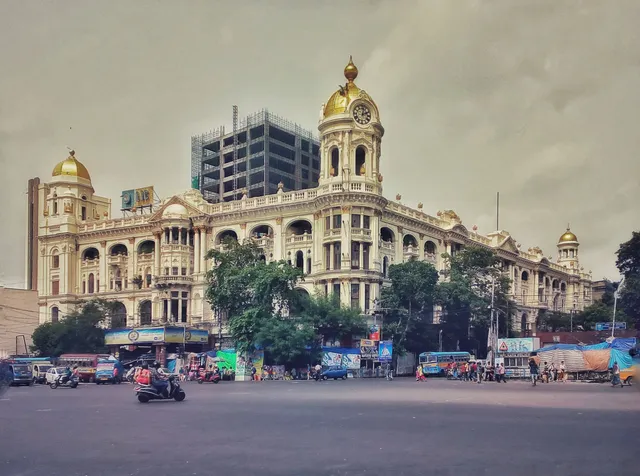
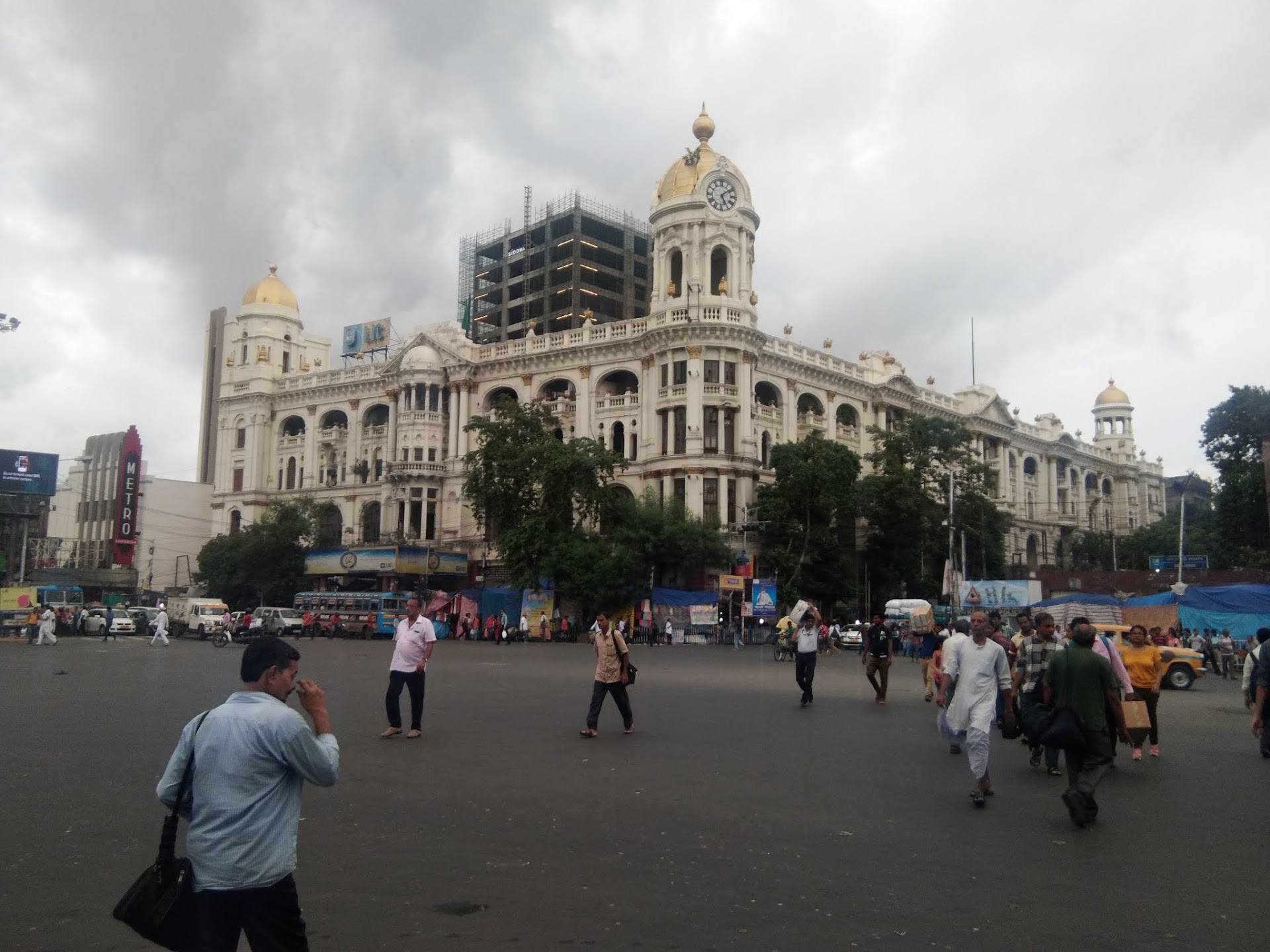
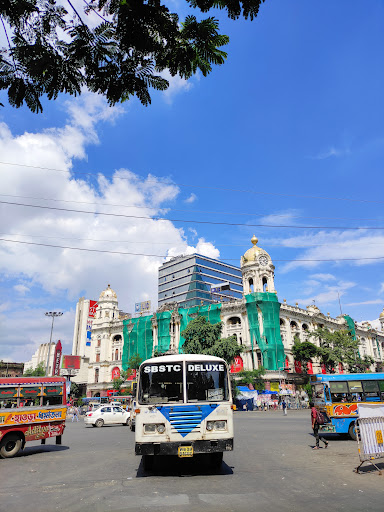
On the eastern side of Esplanade stands a spectacular building in Baroque style, complete with domes, pediments, balconies & clock tower. Known as the Metropolitan Building it once housed Calcutta’s (Kolkata’s) leading departmental stores run by the famous Whiteway, Laidlaw and Co. Whiteaway, Laidlaw & Co (nicknamed ‘Right-away & Paid-for’ because it operated on cash payments only, no credit) was ‘the’ colonial emporium or department store in India and became a household name throughout the East; it was founded in Calcutta by two eponymous Scotsmen in 1882 and also had branches in Bombay, Madras, Lahore and Simla as well as further afield in Colombo, Burma, the Straits Settlements and in Shanghai. The Whiteway, Laidlaw & Co.’s departmental stores in Calcutta was considered the poshest and classiest department store this side of the Suez.
This elaborate, ‘wedding-cake’ structure was purpose-built by Calcutta-based contractors Mackintosh Burn & Co as the headquarters of Whiteaway, Laidlaw & Co; its architecture, sheer size and prominent corner position were intended to attract buyers to enter its doors. The ground floor and the first floor were occupied by the department store itself. Given the size of the building, the floor space was huge. The second and third floors accommodated offices and apartments; the offices were known as Victoria Chambers. Catering almost exclusively to British tastes and clientele (as well as to the Bengali elite with Anglophile tastes), after Independence in 1947, most Anglo-Indians as well as British military and civilian staff left India to return ‘Home’ leaving venerable firms like Whiteaway, Laidlaw high and dry. The building was later acquired by the Metropolitan Life Insurance Co which renamed it as Metropolitan Building. Victoria Chambers was also renamed as Satchindananda Chambers. Today the Metropolitan Building is owned by the Life Insurance Corporation of India and the old department store area on the ground floor is now occupied by the Big Bazar, a popular Indian departmental stores, known for its low prices and promotional offers. The upper floors are occupied by innumerable tenants residing in box like quarters.
Since 2003 the Metropolitan Building has undergone several repairs and was given a dazzling white faced but the interior of Metropolitan Building is what was neglected. As a matter of fact, it was torn apart. The precious Italian marble had been removed from the floor even before repairs began. The fire sprinkler inside, meant to fight fires, was removed.
The stained glass roof of the atrium had collapsed quite some time ago. Now, there is a huge abyss in the floor which has been barricaded. The corridors around this floor are in a shambles, too. Yet expensive woodwork was replaced although it was not protected from the seeping water.
What’s worse, the balconies, ornamental work and urns, which were restored a few months ago, have already started chipping and cracking. The new material does not hold. Absence of the original design did make restoration a tough job. The portico on the Chowringhee side of the building is being rebuilt. Concrete pillars were erected after it collapsed, but their look is nothing approaching the original granite finish design.
Suddenly in 2010, Metropolitan Building was repainted. Without structural repairs that are urgently needed. And to grotesque effect. The building has always been a pristine white. Now it is being capped with gold — on its cupolas, the procession of urns on the terrace and the acanthus on top of each Corinthian column.
Ganesh Pyne was “aghast” at Metropolitan Building being imparted a golden glow. “We have no convention of painting the exterior of such a building in gold. People will rubbish it,”...
Read moreBefore Independence, the Esplanade region in Calcutta was monopolised by the British and other Europeans. A massive palatial construction on the eastern corner of Esplanade often attracted attention in those days. The much-anticipated elaborate ‘wedding cake’ structure was completed in 1905 and unveiled as a departmental store named Whiteway Laidlaw & Co, adding another feather to British pride. However, Bengal at that time was the hotbed of widespread turmoil following ‘Bongo-Bhango’ movement (partition of Bengal). Rabindranath Tagore composed his famous Banglar maati Banglar joland went around the city tying rakhito Muslims as a gesture of unity.
The majestic Whiteway building was constructed by Calcutta-based contractors, Mackintosh Burn & Company. The massive Corinthian pillars, beautiful arcade, huge domes and clock towers – were all very impressive and attracted widespread attention. Europeans and Englishmen who landed in the city harbor were mesmerized by the splendid structure. The ground and first floors of the building housed the departmental store. The second and third floors accommodated office and apartments; the area earmarked for office space was named Victoria Chambers. A grand tea room had a pride of place in the building, one that could give Harrods and Mitsukoshi tea rooms a run for their money. Norman Watney came to Calcutta and after witnessing the retail store, wrote, ‘Whiteway had acquired the distinction of being solely for those with small purses and had a large clientele of junior officers. Others in a more senior position used to go down the road about a quarter of a mile away to the Army & Navy Stores.’
The outlet operated only on cash transaction and credit transactions were totally banned. Englishmen frequented the store to splurge money on knick-knacks. Finally, after Independence in 1947, Metropolitan Insurance Company took full charge of the edifice and Whiteway Laidlaw Co was re-christened as Metropolitan Building. A large area of this building was let out to American Library and in one of its apartments lived the ‘rebellious’ scion of the Tagore clan, Subho Tagore. He consciously tried to distance himself from the illustrious family he was born into. In fact, he had once written, ‘Do you live in Jorasanko? 'How is poet Tagore related to you?’ I’ve heard he is my father’s uncle But I have nothing to do with him.’ Who would have thought that Maharshi Debendranath’s grand son and Writendranath’s son, Subhagendranath aka Subho Tagore would choose his residence in a place that was once owned by the British and reeked of Englishmen’s pride? The building that was officially inaugurated in the same year when Rabindranath was protesting against Partition of Bengal and penning his famous lyrics, Banglar maati banglar jol, later became Subho...
Read moreThe Metropolitan Building in Kolkata, located at the intersection of Jawaharlal Nehru Road and S. N. Banerjee Road in the Esplanade area, holds significant historical and architectural importance. Originally constructed in 1905 as the Whiteway Laidlaw & Co. department store, it was a prominent commercial hub during the British colonial era, often described as a "Harrods of the East." Here’s a concise overview of its historical significance:Colonial Commercial Legacy: Built for the British firm Whiteway Laidlaw & Co., it was one of Kolkata’s first major department stores, catering primarily to the European elite and affluent Indians. It symbolized the city’s role as a commercial center of British India. The building’s grand architecture, with its Edwardian Baroque style, reflected the opulence of the colonial period, featuring a large atrium, high ceilings, and ornate detailing.
Architectural Significance: Designed by British architects, its elegant facade, arches, and domes are reminiscent of early 20th-century British retail architecture. It stands as a testament to Kolkata’s cosmopolitan character during the Raj era. The building’s design influenced other commercial structures in Kolkata, blending European aesthetics with local functionality.
Post-Independence Role: After India’s independence in 1947, the building was taken over by the Life Insurance Corporation of India (LIC) and renamed the Metropolitan Building. It served as LIC’s regional headquarters, marking its transition from a colonial retail space to a key administrative center in independent India. Its continued use preserved its structure, unlike many other colonial buildings that fell into disrepair.
Restoration and Cultural Importance: In the early 2000s, the building faced neglect, but a major restoration by LIC in 2004-2008 revived its original grandeur. The restoration aimed to preserve its heritage while adapting it for modern use. Today, it houses LIC offices, commercial spaces, and a heritage gallery showcasing its history, making it a point of interest for tourists and history enthusiasts.
Proximity to Other Landmarks: Located near Esplanade’s key sites like the Raj Bhavan, New Market, and the Sahid Minar, it is part of Kolkata’s colonial heritage precinct, reinforcing its historical context within the city’s British-era administrative and commercial hub.
The Metropolitan Building remains a symbol of Kolkata’s layered history, bridging its colonial past with its modern identity, and stands as a reminder of the city’s evolution from a British trading post to a...
Read more