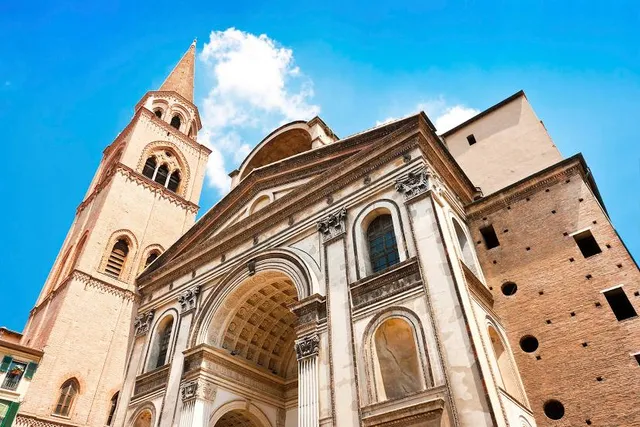
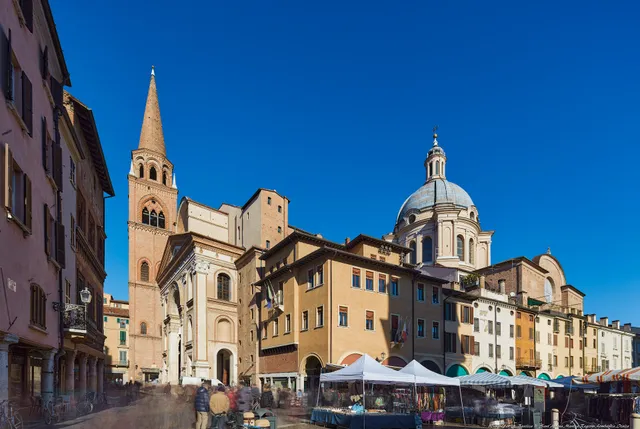
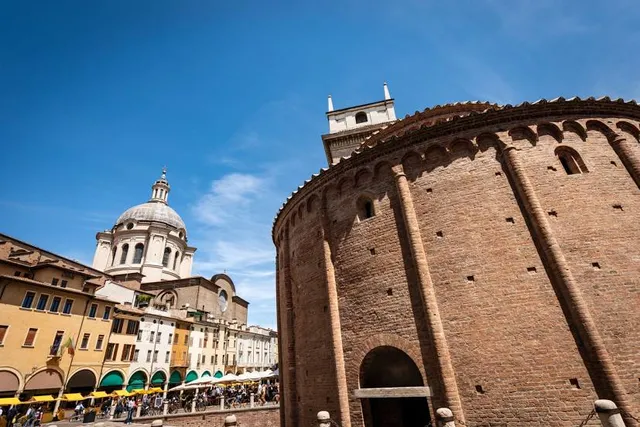
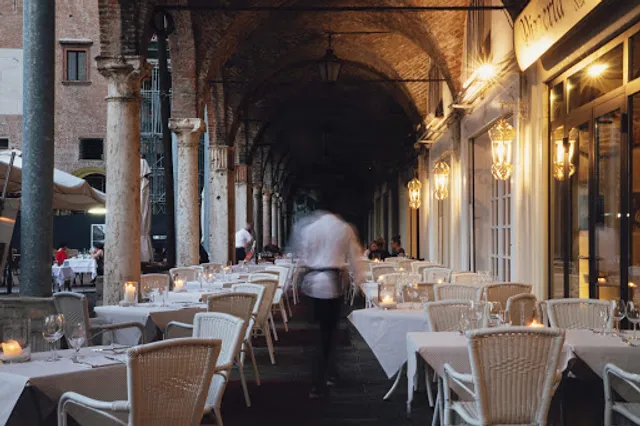
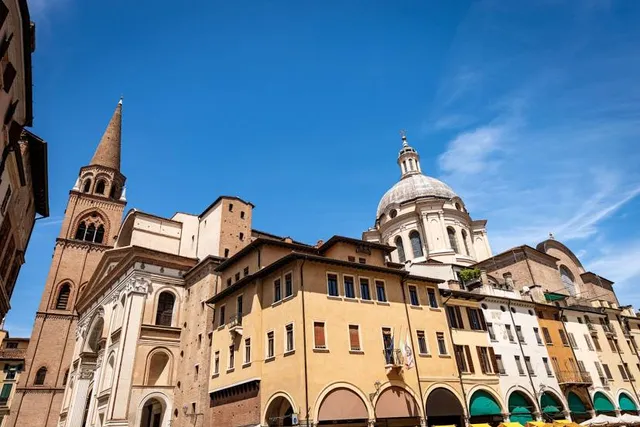
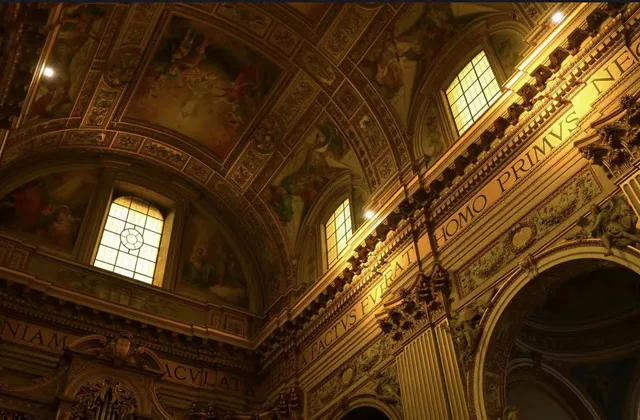
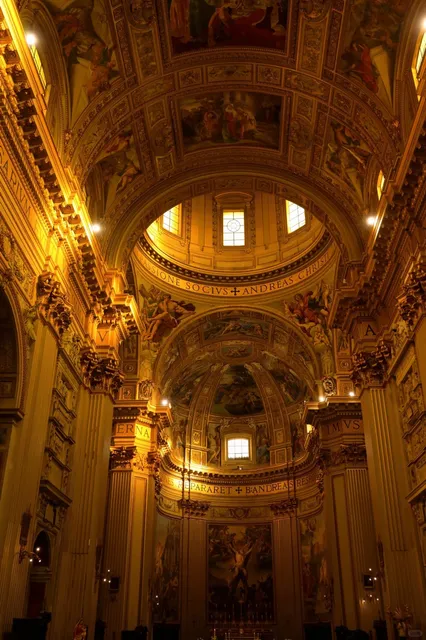
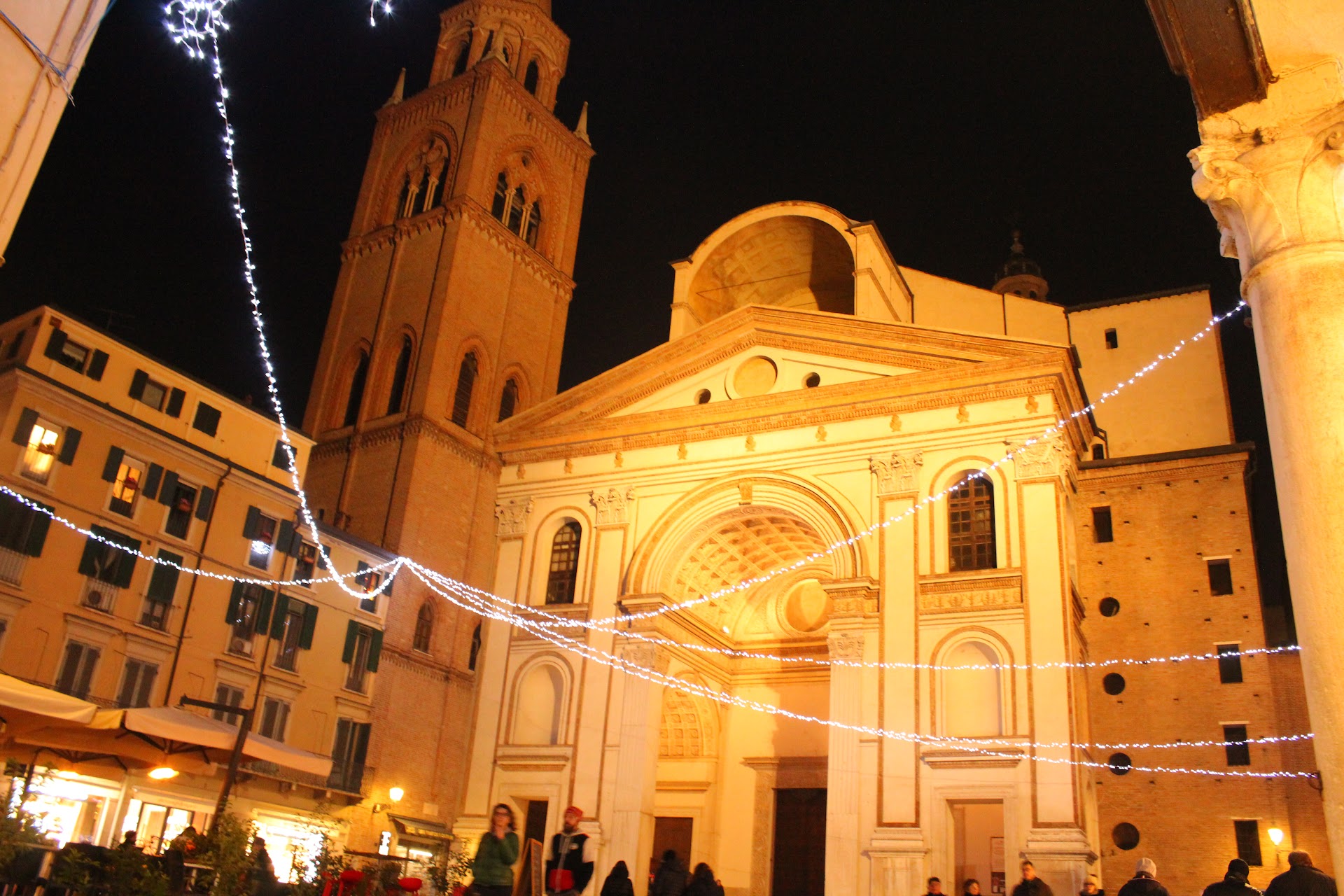
Mantova's compact historic centre consists of 4 adjoining medieval squares that have always been the centrepoint of Mantovian life since the Gonzaga family ruled over the city for more than 3 centuries. Add to these 4 squares, the atmospheric narrow cobbled streets, alleyways and arcaded passageways that lead from one to the other like mysterious hide-aways and you are in for hours of discovery. The Duomo and the Palazzo Ducale on Piazza Sordello are both a manifestation of impeccable medieval architecture. The unique Rotunda of San Lorenzo and the adjacent Astronomical clock Tower on Piazza Erbe are both unique with regard to brickwork craftsmanship of the greatest quality. But nothing within the medieval centre is as elegant and inspirational both with regard to architecture and interior decor as the Basilica of Sant'Andrea on Piazza Mantegna, its Baroque dome and Tower visible from anywhere within the medieval quarter and beyond. After examining the beauty of its outstanding front elevation and its huge single-nave facade, take the steps from Piazza Mantegna and enter the Basilica, the main opus of the architect Leon Battista Alberti. Surprised by the huge uncluttered space of the nave, I looked around to find myself in an art museum of the finest quality. No space, neither on the huge arcaded ceiling nor on the walls or the pilasters is left undecorated. Every inch inside is filled in with delicate fresco work that seems to be stucco at first glance. As I made myself closer, I could notice the detailed designs of the artwork that covers the entire pilasters and the walls. The picture paintings high up on the walls and the dome are the work of Mantegna and his school: a marvellous depiction of mannerism, colour and detailed perspective. Lit up by sunlight that enters through the large windows on the nave, every detail is clearly visible and distinguishable. After feasting your artistic appetite on such extraordinary beauty, go around the church to see more artworks in the side chapels. Kept closed by iron gates for protection and darker than the nave, they cannot be enjoyed fully. The first chapel on the left as you enter contains the tomb of Mantegna himself. This chapel is purposely kept in complete darkness but insert a €1 coin in the slot machine and the chapel lights up for you to enjoy. The marvellous paintings here are attributed to Mantegna himself or to his son Francesco. Being a working church and often used for evening music concerts, be here in the morning outside service hours when it is usually possible to visit. Entrance is free. Piazza Erbe, Piazza Mantegna, Corso Umberto I, Via Roma and the neighbouring cobbled streets of the medieval quarter are full of bars, cafeterias and restaurants, all ready to serve you Mantovian specialities and full meals at reasonable prices. Sit at a table outside ( supply always exceeds demand) and enjoy the food and...
Read moreLa basilica concattedrale di Sant'Andrea è la più grande chiesa di Mantova. Opera di Leon Battista Alberti nello sviluppo dell'architettura rinascimentale, venne completata molti anni dopo la morte dell'architetto, con modi non sempre conformi ai progetti originali. Ha la dignità di basilica minore. Nella cripta si conservano due reliquiari con terra intrisa di sangue di Cristo, che avrebbe portato il soldato romano Longino. Proprio per questo fu sede dal 1608 dell'Ordine militare del Sangue di Gesù Cristo. Un primo edificio religioso preromanico dedicato a Sant'Andrea sorse nel 1046 per volere di Beatrice di Lotaringia, madre di Matilde di Canossa, in seguito alla scoperta della reliquia del Sangue di Cristo, avvenuta nell'804. L'oratorio, terminato nel 1055, sorse sulle rovine dell'Ospedale di Sant'Andrea e contiguo al monastero, edificato dal vescovo Itolfo nel 1037. Con il rinvenimento di una seconda reliquia nel 1049, il monastero benedettino fu ricostruito. Unici resti attualmente visibili sono il campanile gotico e un lato del chiostro. La chiesa venne infine ristrutturata definitivamente a partire dal 1472, su progetto di Leon Battista Alberti su commissione del signore di Mantova Ludovico II Gonzaga (e del figlio Francesco, cardinale), che voleva farne un simbolo del proprio potere sulla città e del prestigio della casata.
Lo scopo della nuova costruzione era quello di accogliere i pellegrini che giungevano durante la festa dell'Ascensione, durante la quale veniva venerata una fiala contenente quello che si ritiene il sangue di Cristo, portato a Mantova, secondo la tradizione, dal centurione Longino. La reliquia, molto venerata a partire dal Medioevo ma soprattutto nel XV secolo, e portata in processione per le vie della città il Venerdì santo, è oggi conservata proprio nei Sacri Vasi custoditi all'interno dell'altare situato nella cripta della basilica.
I lavori iniziarono intorno al 1460 e proseguirono fino alla morte di Alberti. La costruzione venne portata avanti a fasi alterne e rimase a lungo interrotta, tanto che per il completamento dell'edificio si dovette aspettare fino al XVIII secolo. Tuttavia le cappelle risultavano compiute nel 1482 e la facciata risultava completata nel 1488. Questioni storiografiche molto dibattute sono, pertanto, sia la ricostruzione del progetto originario di Alberti, sia la fedeltà a tale progetto di quanto realizzato. Alcuni studiosi attribuiscono ad Alberti lo schema generale e la facciata ma non la definizione dei particolari, mentre altri affermano che quanto costruito nel XV secolo, e in particolare fino alla morte del committente nel 1478, corrisponda al progetto albertiano. Il tecnico incaricato di seguire i lavori durante la prima fase costruttiva fu Luca Fancelli, che disponeva un modello ligneo fornito da Alberti, utile in fase di realizzazione. Fancelli, che seguiva anche i lavori per la chiesa di San Sebastiano e che aveva conosciuto Alberti a Roma, era probabilmente in grado di seguirne le intenzioni progettuali, anche se non risultano documentati disegni di dettaglio forniti da Alberti.
I lavori furono interrotti intorno al 1494 e ripresero solo nel 1530. La cupola, alta 80 metri e con diametro di 25 è una delle più grandi d'Italia. Venne aggiunta nel 1732 da Filippo Juvarra, che si ispirò a quella borrominiana della basilica di Sant'Andrea delle Fratte a Roma. Durante il periodo di occupazione francese, diverse opere d'arte vennero portate in Francia essendo oggetto di spoliazioni napoleoniche. Tra esse, si ricorda l'Adorazione dei pastori con San Longino e San Giovanni Evangelista, anche Giulio Romano decorava la cappella dei Sacri Vasi nella Basilica di Sant'Andrea. Oggi la tela è al Louvre.
L'imponente campanile gotico ospita 5 campane ottocentesche, delle quali la maggiore, del peso di 2555 kg, è stata fusa dalla ditta Cavadini di Verona.
Le forti scosse del terremoto dell'Emilia del 20 e 29 maggio 2012 hanno provocato danni alla cupola...
Read moreAn absolutely magical minor basilica which is a must for any visitor to Mantua. Built in the Renaissance style it is literally covered with frescos and paintings. Incredibly impressive from the moment you walk in the door. Definitely overshadows the Cathedral – unfortunately! Ensure you allow enough time to visit it SLOWLY. On top of the usual features in many basilicas, there is an octagonal balustrade coving the altar in the crypt where a relic of the Precious Blood of Jesus is kept. According to Catholic tradition, it was brought to Mantua by the Roman centurion Saint Longinus (the one who opened Christ’s side with a lance), who had scooped up the earth containing the blood. The sacred vessels, containing the relic are carried in procession through the city on Good Friday. A beautiful place to pray and reflect – make the most of your time. Unfortunately the crypt was closed when I visited and nobody was available to open it. (Visit by reservation only on weekdays; Open Saturday 10:30 – 11:30 & 3pm – 5:30pm; Sundays 3pm – 5:30 pm). For people who believe, it will be a spiritual highlight, for non-believers it can still be a historical and...
Read more