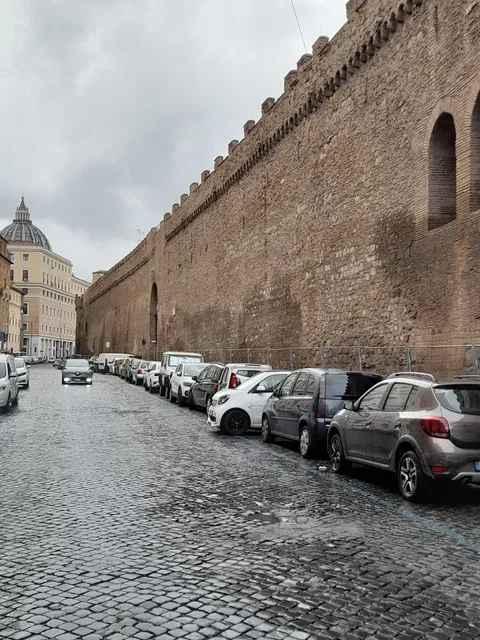
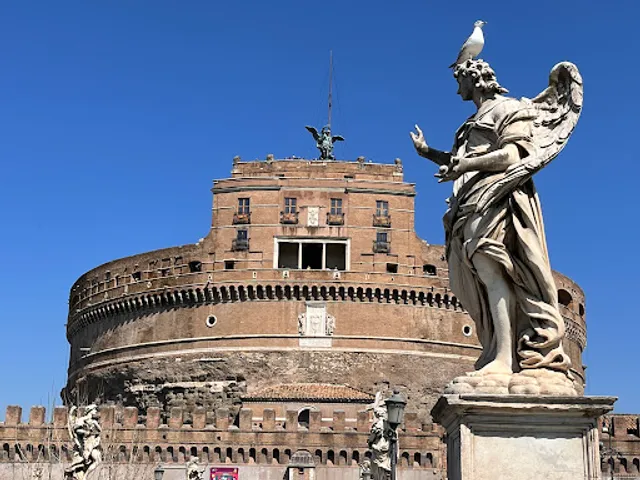
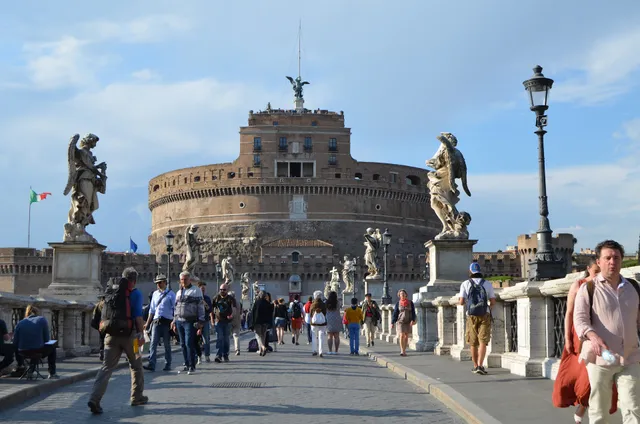
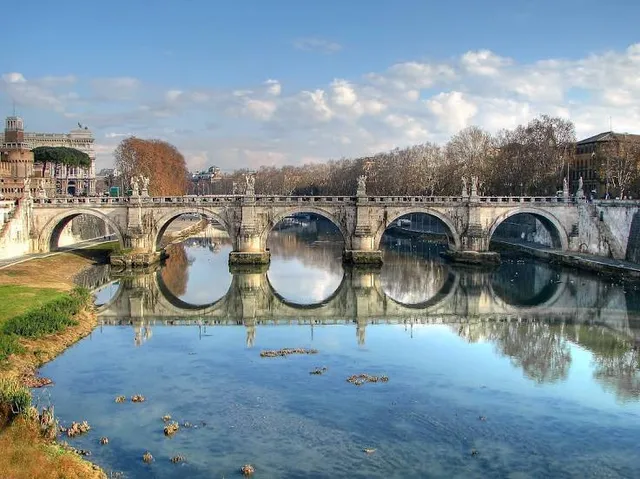
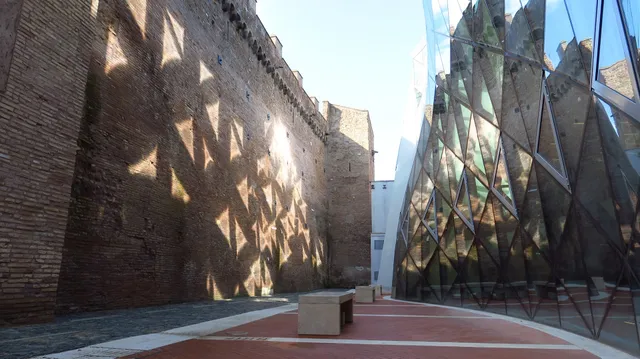
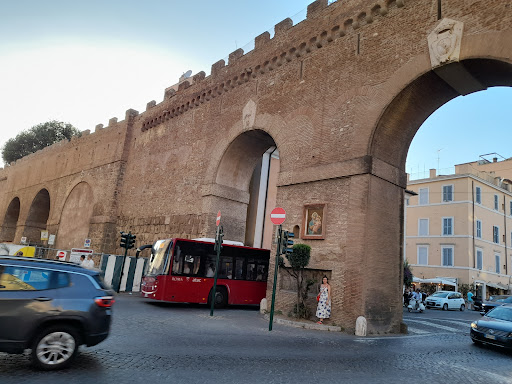
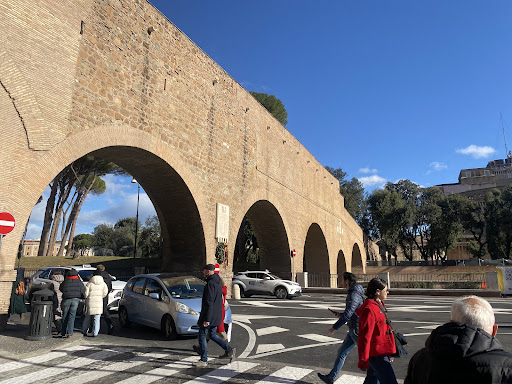
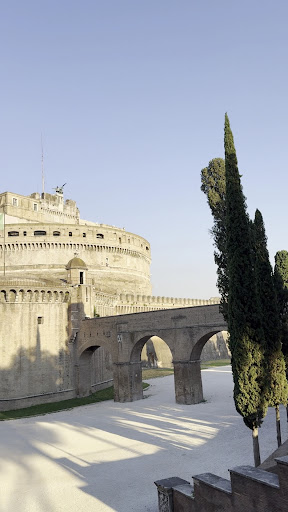
Er Coridore de Borgo (the Corridor of Borgo), as the Romans of papal Rome used to call it, is also known as Passetto di Borgo, or Passetto. It corresponds to that raised and fortified section of the Vatican Walls that from the Apostolic Palace of the Vatican, starting from behind the colonnade by Bernini runs along via dei Corridori and via Borgo Sant'Angelo and ends in Castel Sant'Angelo.It was part of a defensive structure that ran from the foot of the Vatican Hill to the Mausoleum of Hadrian, to protect the military camp that the barbarian Totila set up in this area of the city around 547. The building, modest in elevation and irregular in layout, was built with large roughly squared blocks, partly still visible near Porta Castello. Around 852, Pope Leo IV (847-855) built a city wall, about 5 meters high, equipped with a walkway, to protect the basilica of St. Peter and the nearby buildings. To erect it, he exploited, where possible, the pre-existing structure that was later used for the construction of the Passetto as we know it today.Some scholars say that the Passetto was built around 1277, during the pontificate of Niccolò III, the pope who transferred the papal residence from the Lateran Palace to the Vatican. Others believe that the works began with Boniface IX between 1389 and 1404, and ended with Baldassarre Cossa, or the antipope John XXIII (1410-1415).Over the centuries, it was modified and renovated several times and by several popes, including Niccolò V (1447-1455), Sixtus IV (1471-1484), and Alexander VI (1492-1503), with the addition of paths for patrols, battlements, watchtowers, fortifications, and elevations.The Passetto had the purpose of controlling the area of the underlying Borgo and repressing any riots, thanks to the elevated position from which to easily throw arrows or shoot. Lead in secret prisoners of importance to the dungeons of Castel Sant'Angelo. Perhaps, it is precisely that stretch that an illustrious prisoner like Beatrice Cenci walked in chains and in complete secrecy, before her execution, in 1599. Mainly, the Passetto was intended to provide a quick escape route for the pope, in case of enemy aggression or attacks on his person. The pope could escape from the Vatican and take refuge among the thick and well-protected walls of the Castle.Its strategic importance emerged more in the darkest and most painful periods for Rome and for the Church, such as in the year 1494, when Pope Alexander VI Borgia traveled 800 meters in length to find refuge in Castello, during the invasion of Rome from part of the militias of Charles VIII of France. Or in 1527, when Clement VII Medici (1523-1534) found refuge in Castel Sant’Angelo, during the Sack of Rome perpetrated by the Lanzichenecchi of Charles VIII. The pope was saved by the broken bonnet, running along the narrow passage, while the courtiers and the nobles who accompanied him protected him with a dark cloak, to prevent the white robe from becoming an easy target. The Swiss guards fought bravely to favor the pope’s retreat but were murdered. Even today, those walls are marked by the numerous arquebus shots fired by German mercenaries.This is the last great enterprise linked to the Passetto, which with the end of the 16th century, saw its defensive function wane, but not the interest in the anecdotes it evokes.Among these, we remember one of the most curious: it is said that Rodrigo Borgia (Pope Alexander VI) used it to reach the apartments where he met his lovers. From this story, a very particular custom was born, namely the one whereby, walking 77 times back and forth along the 800 meters of the Passetto, just over 60 km, men were able to recover their lost...
Read moreThe Passetto di Borgo is a fortified walkway built in 1277 during the papacy of Nicholas III to connect Castel Sant’Angelo with the Vatican. This elevated corridor served as an essential defensive structure, allowing the Pope to retreat swiftly to the safety of the fortress during times of crisis. Its robust walls and strategic design provided a secure escape route, highlighting the delicate balance between spiritual authority and the political realities of medieval Rome.
The structure played a decisive role during pivotal historical events, most notably the Sack of Rome in 1527. When Charles V’s troops invaded the city, Pope Clement VII used the Passetto to flee from the Vatican to Castel Sant’Angelo, where he sought refuge. This dramatic escape underscored the walkway’s importance as a symbol of resilience and the Papacy’s ability to endure external threats amidst chaos and violence.
Over the centuries, the Passetto became an enduring testament to Rome’s layered history, blending elements of defense, religion, and urban transformation. Its proximity to the bustling Borgo district, once a vital buffer between the Vatican and the rest of the city, reflects the dynamic interplay between sacred and secular realms. While originally built for survival, it now stands as a monument to a time when the security of the Church was constantly at risk.
Today, the Passetto di Borgo has been carefully preserved and integrated into Rome’s modern landscape, maintaining its historical significance while attracting visitors from around the world. Its ancient arches and sturdy walls tell stories of ingenuity and perseverance, reminding us of the city’s ability to adapt while preserving its rich heritage. The juxtaposition of its medieval architecture with the surrounding urban environment encapsulates Rome’s unique ability to bridge past...
Read moreEL PASSETTO EL PASADIZO SECRETO DE LOS PAPAS EN ROMA Roma es una ciudad cargada de historia, mires a donde mires siempre hay un lugar, un edificio o unas ruinas que en algún momento del tiempo, constituyeron algo importante. Este es el caso del “Passetto di Borgo”, pasadizo secreto que comunica el Vaticano con el Castel Sant’Angelo desde hace más de 700 años. La hegemonía del Imperio Romano y la influencia de la Iglesia Católica, en gran parte de su historia han sido el centro del poder de las civilizaciones europeas El Passetto di Borgo, es un pasadizo de 800 metros de largo que comunicaba los palacios vaticanos, con una de las almenas del Castel Sant’Angelo. Desde el exterior, pasa por una muralla o acueducto que recorre paralelo a la Vía dei Corridori y al Borgo Sant’Angelo. Pero su interior es una galería que en su tiempo permitiría al Papa desde la Santa Sede llegar al amurallado Castel Sant’Angelo en caso de invasiones, evitando exponerse al exterior. El pasadizo forma parte de la muralla de la defensa del Vaticano, fue construido a mediados del siglo VI, con la muralla defensiva ante tropas invasoras por parte de Totila, rey del pueblo germánico de los Ostrogodos, que saqueó Roma en dos ocasiones. La muralla fue reconstruida varias veces, y la más importante, fue la ordenada por el Papa León IV. Quien accedió al pontificado luego de que el Vaticano hubiese sido saqueado y arrasado por los Sarracenos, en el año 846. En esa época la primera basílica de San Pedro, se hallaba a afuera de la muralla de la ciudad de Roma construida por el emperador Aureliano. Era un blanco fácil para cualquier invasor, sabedor de las riquezas que atesoraba. De ese primer y único amurallamiento, queda solo alguna muestra, siendo el Passetto el único remanente de la fortificación. Hacia el año 1494, Carlos VIII de Francia desarrollo una gran operación de asedio porque pretendía deponer al Papa Alejandro VI, esta es la primera vez se usó el pasadizo, permitiendo al Papa refugiarse en el castillo durante las hostilidades del monarca francés. En el año 1277, tras el nombramiento del Papa Nicolás III, se habilitó el pasadizo a través de la muralla. A lo largo de los siguientes siglos la Santa Sede pasaría por diferentes estados y el Passetto no volvería a tener relevancia hasta el regreso de la curia papal a la ciudad, de Roma luego del exilio en la ciudad francesa de Avignon. La segunda vez fue en la ocasión cuando Carlos V de España invadió Roma y el papa Clemente VII uso el pasadizo para refugiándose en el Sant’Angelo durante 7 meses. Solo dos Papas se vieron ante la necesidad de usarlo para ocultarse en el castillo, Alejandro VI y Clemente VII, asediados por Carlos VIII de Francia y Carlos V de España, respectivamente. En esta época se modificó la muralla, sumando un plano superior descubierto con alameda cubriendo la galería y dejando el pasadizo existente. El pasadizo continuaría sufriendo modificaciones, como lo ordenado por Urbano VIII en 1630. Pero hacia el 1870 entra en desuso, por perder el Vaticano la titularidad de Castel de Sant’Angelo a favor del estado italiano. Actualmente el Passetto se abre al público dos meses al año en verano, lo que permite recorrerlo casi por completo, restando únicamente los últimos 80 metros. Los años y las circunstancias han transformado una necesidad estratégica para resguardo de la vida del Papa en una curiosidad y atracción...
Read more