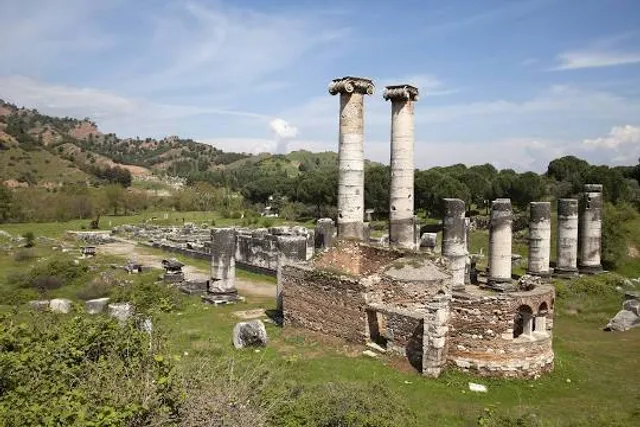
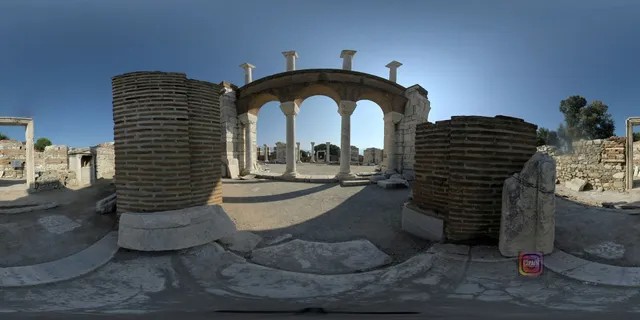
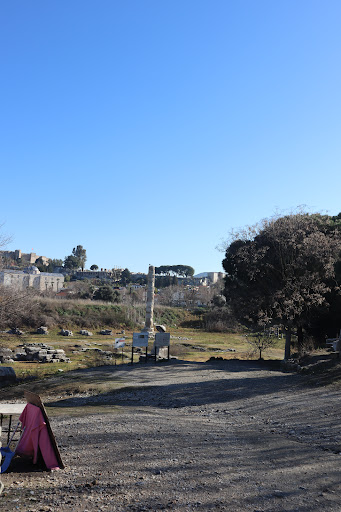
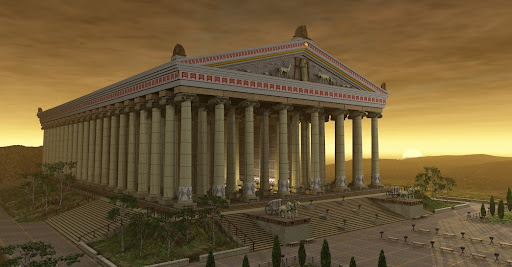
The Temple of Artemis is known as one of the Seven Wonders of the ancient world. It has been built in the areas of Ephesus on a flat area which has over the centuries turned into a swamp. If you visit Ephesus today, you can only see the ruins of the foundations of this marvelous construction of the Hellenistic Age, entirely made of marble and full of sculptured columns' capitals and shafts. The most beautiful remaining of this temple are today exhibited in the London British Museum.
The oldest remaining found date back till the 6th century BC. It was surrounded by 36 huge columns, later enlarged upon the orders of the Lydia King, Kreisos, during the 6th century BC. Most of the exhibits in the London British Museum belong to this period.
The new Artemis has been rebuilt in the 2nd century BC. Located on top of the previous one, it had tremendous dimensions: 127 columns of each 17,5 meters high. Unfortunately this one has also been destroyed by fire, reconstructed and again demolished by earthquakes, rebuilt and at last looted by Goths one year later. The statue of many-breasted Artemis was the symbol of the temple but also of abundance, hunting and wild life. The genuine statue of Artemis, removed during the fire, is today exhibited in the Ephesus Museum. Many copies of this statue found during the latest excavations date back from the Roman period.
Mythological Info
Artemis was also called Cynthia, from her birth place, Mount Cynthus in Delos. She was Apollo's twin sister, daughter of Zeus and Leto. She was one of the three maiden goddesses of Olympus: the pure maiden Vesta, gray-eyed Athena who cares but for war and the arts of the craftsmen, and Artemis, lover of woods and the wild chase over the mountain.
She was the Lady of Wild Things, Huntsman-in-chief to the gods, an odd office for a woman. As a huntress her favorite animal was the stag, because its swiftness gave the best opportunity for her method of capture, which was by her silver bow and arrows and speed of foot.
As Phoebus was the Sun, she was the Moon called Phoebe and Selene (Luna) representing the evening and night, carrying a torch, and clad in long heavy robes, with a veil covering the back of her head. Neither name originally belonged to her.
Phoebe was a Titan, one of the older gods. So too was Selene, a moon-goddess, indeed, but not connected with Apollo. She was the sister of Helios, the sun-god with whom Apollo was confused.
She was worshiped in Athens, Corinth, and Thebes as goddess of strict upbringing, of good fame, of upright mind, and of sensibility in the affairs of ordinary life. She chased and fired her arrows at all wild and unchecked creatures and actions.
In the later poets, Artemis is identified with Hecate. She is "the goddess with three forms", Selene in the sky, Artemis on earth, Hecate in the lower world and in the world above when it is wrapped in darkness. Hecate was the Goddess of the dark of the Moon, the black nights when the moon is hidden. She was associated with deeds of darkness, the Goddess of the Crossways, which were held to be ghostly places...
Read moreThe temple of Artemis was in Ephesus of today's Turkey. It is noteworthy that it took 120 years to complete, initially started by King of Lydia, Croesus. The temple was built of marble and limestone, materials transported from nearby hills. Some 120 marble columns supported the main section of the temple. Each column was 20 meters high. The enormous boulders were moved there by pulleys and connected with metal pins. After the completion of the roof, artists decorated the building with wonderful sculptural performances. In the middle of the temple was the marble statue of Artemis. The temple was one of the largest in the classical world, much larger than the Parthenon that was later built in Athens. The base of its foundations was 131 meters long and 79 meters wide. In 356 BC. the temple was destroyed by fire. The fire was made by Herostratos, who wanted to become famous. By coincidence, Alexander the Great was born on the day of the temple's destruction. Later, Alexander visited Ephesus and ordered that the temple be rebuilt in the same place. The temple of Alexander survived until the 3rd century AD. century. With the passage of time the mud flooded the port of Ephesus and the city collapsed insignificant! The Goths then plundered the temple and the floods ended the disaster. The spectacle of the miracle was so impressive that Antipatros says: "I have seen the impressive Babylon with its hanging gardens, the statue of Zeus, the Colossus of Rhodes, the Great Pyramid and the Mausoleum of Halicarnassus, but when I saw her house Artemis arrived as the clouds, the other masterpieces lost their shine and then I exclaimed: In addition to Mount Olympus, the Sun never looked at something so huge. Today, there are few boulders of the foundations and a single restored column left by the temple in Ephesus. My rating would be excellent if the Turkish authorities were to better preserve the archaeological site with restorations, and by stripping off the waters that sweep in the area of the...
Read moreArtemis Tapınağı, (Yunanca: Artemision; Latince: Artemisium) aynı zamanda Diana Tapınağı olarak da bilinir. Tanrıça Artemis'e ithaf edilmiş tapınak Efes'te Milattan önce 550 yıllarında tamamlanmıştır. Tapınak tamamen mermerden inşa edilmiştir. Dünyanın yedi harikasından biri sayılan tapınaktan geriye bugün sadece bir iki mermer parçası kalmıştır. Türkiye'deki antik kent Selçuk İzmir'de bulunmaktadır.
Tapınak Lidya Kralı Kroisos tarafından başlatılmış 120 senelik bir projenin eseridir. Dünyanın yedi harikasını derleyen Sidon'lu Antipader tapınağı şöyle tarif etmiştir.
Mağrur Babil'in üstünde savaş arabaları için yol olan duvarını ve Alpheus'taki Zeus heykelini ve asma bahçeleri gördüm ve Güneşin kolosusunu ve yüksek piramitlerin devasa işçiliğini ve Mausolos'un engin mezarını; ama Artemis'in bulutlar üzerine kurulmuş evini gördüğümde diğer tüm harikalar parlaklıklarını kaybetti ve dedim ki "İşte! Olimpus'un dışında, Güneş hiç bu kadar büyük bir şeye bakmadı. (Antipater, Yunan Antolojisi [IX.58])
Bizanslı Philon ise tapınak için şunları yazmıştır:
Kadim Babillilerin kudretli işçiliğini ve Mausoleus'un mezarını gördüm. Ama bulutlara doğru yükselen Efes'teki tapınağı gördüğümde, diğerlerinin tümü gölgede kalmıştı.
Artemis, Ay tanrıçası olarak Titan Selene'in yerini alan Apollon'un kardeşi bakire avcı Yunan tanrıçasıdır. Efesli Artemis ise oldukça farklıdır. Efesli Artemis'in (Efesya) bir Anadolu tanrıçası olan Kibele'nin bir kültü olduğu sanılmaktadır.
Anadolu'nun ana tanrıçası Kibele'nin Efes'e nasıl geldiği ve orada Artemis adıyla kültünün nasıl başladığı bilinmemekle beraber Kibele'nin çeşitli evreler geçirerek Artemis haline geldiği kabul ediliyor.
Yunan tanrılarının aksine daha çok yakındoğu ve Mısır tanrıları gibi vücudu, altından ayaklarının çıktığı ve bacaklara doğru gittikçe incelen, sütun benzeri bir bölümle kaplıdır. Çok memeli Tanrıça (37 adet) Efes'te basılmış paraların üzerinde başında Kibele'nin bir özelliği olan duvar gibi bir taç ile resmedilmiştir. Paraların üzerindeki resminde, kolları birbirine geçmiş yılan ya da Ouroboros yığınlarından oluşan bir asaya dayalı durmaktadır. Aynı Kibele gibi Efes'teki tanrıçaya da megabyzae adı verilen hierodüller ve kore'ler hizmet etmekteydi.
Ayrıca Bennett'in bahsettiği muhtemelen milattan önce üçüncü yüzyıldan kalma bir adak yazıtı Efesli Artemis'i Girit ile ilişkilendirmektedir:
"To the Healer of diseases, to Apollo, Giver of Light to mortals, Eutyches has set up in votive offering (a statue of) the Cretan Lady of Ephesus, the Light-Bearer."
Yunanlar'ın birleştirme adetleri, tüm yabancı tanrıları kendi anlayabilecekleri bir şekilde Olimpus panteonunun bir biçimi halinde asimile etmiştir. Efes'te İyonyalı yerleşimcilerin "Efes'in Hanımı" için yaptıkları Artemis özdeleştirmesinin cılız olduğu çok açıktır.
Tapınağın üç evreden oluştuğu sanılmaktadır. A evresi Artemisium olarak adlandırılan tapınaktan önce orada yaklaşık MÖ 7. yüzyılda yapılmış bir sunaktır. B evresi daha sonra bunun üzerine yapılmış olan tapınak, C evresi ise yangından sonra yapılan restorasyondur.
Tapınağın içi ve içindeki sanat hakkındaki tanımlamaların ve hemen hepsi tarihçi Plynus'un anlattıklarına dayanmaktadır. Pliny tapınağı 115 metre uzunluğunda ve 55 metre eninde neredeyse tamamen mermerden olarak tanımlamıştır. Tapınak her biri 18 metre olan 127 İyonik stilde kolondan oluşmaktadır.
Artemis Tapınağı içinde birçok sanat eseri vardı. Ünlü Yunan heykeltıraşlar Polyclitus, Pheidias, Cresilas, ve Phradmon tarafından yapılmış heykellerle, tablolarla ve altın ve gümüşle bezenmiş kolonlarla donatılmıştı. Sanatçılar en güzel heykeli yaratmak için birbirleri ile yarışırlardı. Bu heykellerin büyük çoğunluğu Efes şehrini kurduğu söylenen Amazonlar'ın heykelleridir.
Pliny ayrıca, Mausolos'un mozolesi üzerinde de çalışan Scopas'ın tapınağın kolonlarındaki kabartmaları oyduğunu söyler.
Atinalı Athenagoras, Efes'teki baş Artemis heykelinin yaratıcısı olarak Daedalus'un öğrencisi Endoeus 'un...
Read more