Kia ora whanau,
If you're a visitor to Whangārei, Nau mai, haere mai-Welcome!
Thanks to all the volunteers that worked tirelessly since the Hundertwasser Art Centre with Wairau Māori Art Gallery was proposed by the mayor of Whangarei Stan Semenoff back in 1993 more than 30 years ago. The resilience and determination of these volunteers that gave their time to raise funds, lobby the government, promote and rally the local community through challenging and often controversial times and through successive governments was extraordinary. Through sheer determination, passion and overwhelming community support, construction began in June 2018. This was testament to the perseverance of the volunteers and community united with a vision and purpose.
"If enough people dream the same dream, it becomes reality"
The name Whangārei has multiple meanings in Māori. There are many tribes from Whangārei including, Ngare Raumati, Ngāi Tāhuhu, Te Parawhau, Patuharakeke, Ngāti Kahu, Ngā Manuhiri, Te Ākitai, and Ngātiwai.
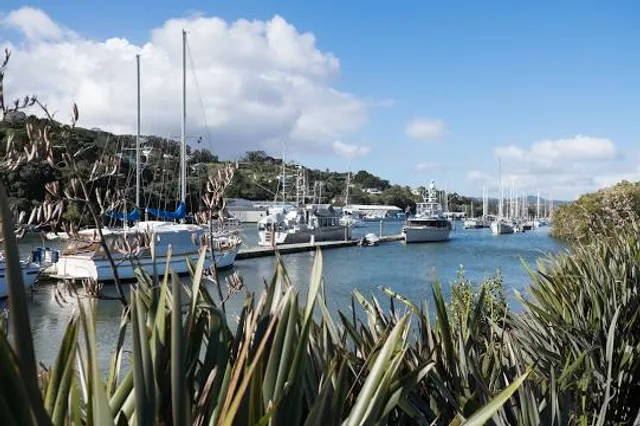
Ngātiwai named Whangārei as Whangārei-te-rerenga-parāoa, which means "the gathering place of whales" Another interpretation is that the harbour was "a meeting place for chiefs"
This is a poignant reminder of Hundertwasser's philosophy and close connection with nature and his lifelong love of the sea. Hundertwasser told a journalist when his boat the Regentag first visited Auckland "I want show that it is possible to live in a better world" Hundertwasser embarked on a "peace treaty with nature" "Recycling and self sufficiency are two of Hundertwasser's basic requirements to restoring paradise"
"What gave Hundertwasser's varied work cohesion was his tireless exploration of new ways to coexist with the natural world"
Hundertwasser shares his knowledge through his art and architecture. It reflects his philosophy for restoring paradise.
The Māori proverb "Whaowhia te kete mātauranga" means; "Fill the basket of knowledge"
It's a reminder to keep learning and growing your knowledge throughout life.
The proverb tells the story of Tāne, the forest lord who ascended to the highest heaven to receive three baskets of knowledge given to him by lo Matua Kore. The three baskets are:
Te kete aronui: The basket of pusuit , which contains knowledge that can help humanity.
Te kete tuauri: The basket of light, which contains knowledge of ritual memory, prayer and spiritual communication.
Te kete tuetea: The basket of darkness, which contains knowledge of evil.
The proverb encourages people to draw on their intuition, intellect and other sources of wisdom to empower themselves.
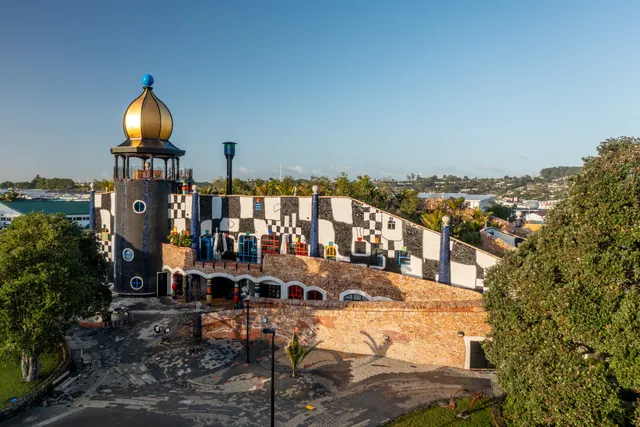
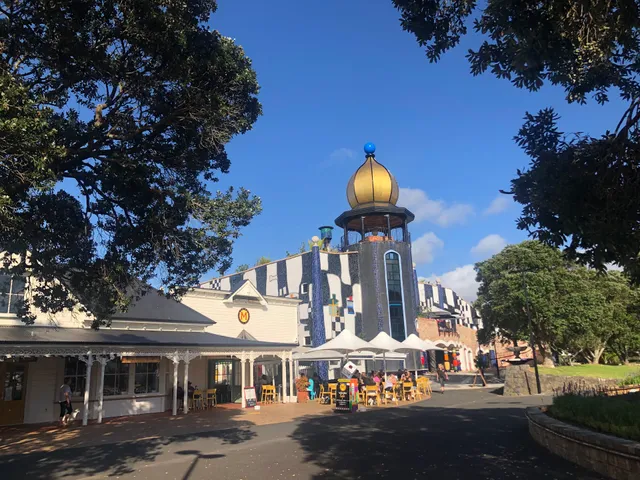
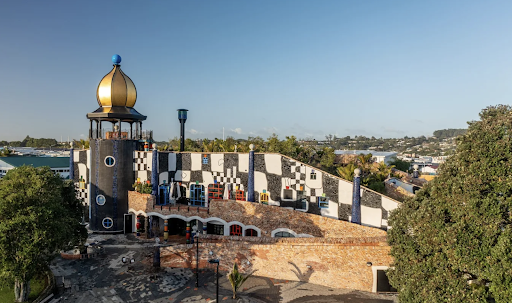
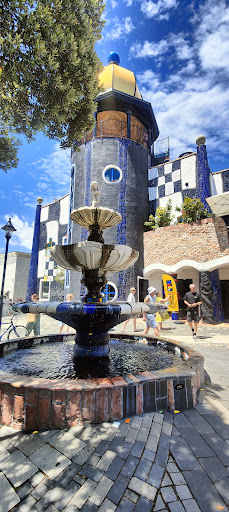
Hundertwasser didn't live to see his greatest gift, Whangārei's Hundertwasser Art Centre with Wairau Māori Art Gallery. It opened in February 2022, after years of controversy and delay. With it's planted roof, golden onion dome and exhuberant tiled exterior, the building is vintage Hundertwasser and one of only two museums in the world dedicated to his work.
"More than that it was conceived as a place to encourage independent creativity and to celebrate European and Māori culture"
Hundertwasser was an inspiration and visionary and his legacy will continue in a place he loved, where he set down his deepest roots in Aotearoa, a place he called "The Promised Land"
He died on 19 February 2000. According to his wish he was buried in harmony with nature on his property in the Kaurinui Valley in the Far North in the Garden of the Happy Dead under a Tulip tree.
Whangārei proudly has the only Hundertwasser Art Centre and Wairau Māori Art Gallery in the Southern Hemisphere. This is Hundertwasser's legacy, a taonga and a treasure for all to enjoy.
Purea nei e te hau Horoia e te ua Whitiwhitia e te rā Mahea ake ngā pōraruaru Makere ana ngā here
E rere, wairua, e rere KI ngā ao o te rangi Whitwhiti e te rā Mahea ake ngā pōraruaru Makere...
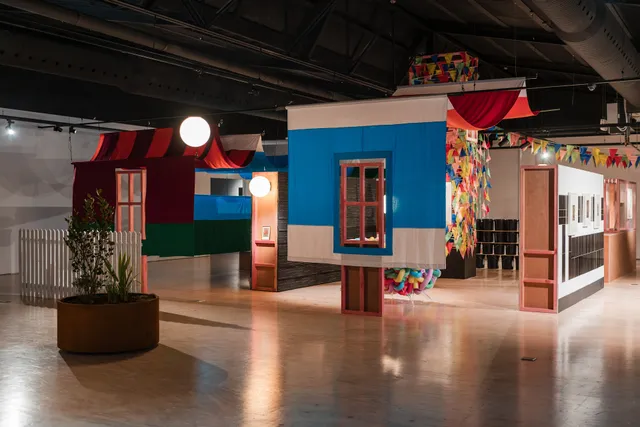
Read moreHundertwasser Art Centre with Wairau Māori Art Gallery is an original Hundertwasser architecture project. Absolute rationalism, geometric straight lines and the uniformity of modern architecture is abandoned in favour of new values like uniqueness, romanticism, individuality, creativity, especially creativity in harmony with nature. Hundertwasser created houses in which the creativity of nature meets human creativity. In keeping with his philosophy, the Hundertwasser Art Centre restores territories to nature with spontaneous vegetation, tree tenants and an afforested roof.
German architect Heinz M. Springmann and Grant Harris of HB Architecture in New Zealand brought to life Hundertwasser’s vision. Skilled artisans, craftspeople, engineers, builders, technical experts and community leaders worked together for two years to realise the unique structure. Led by Hātea Art Precinct Trust, they overcame a series of impossible obstacles along the way, including a construction cost overrun and the impact of Covid-19.
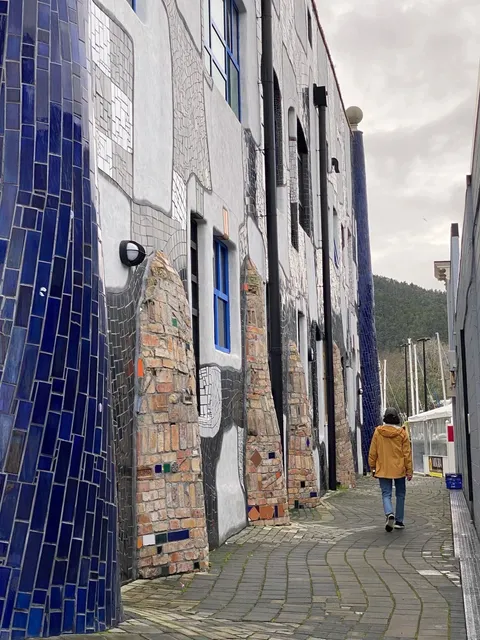
Ecological sustainability is a central tenet of the construction, which alongside enduring new materials from New Zealand and Europe, uses 40,000 recycled bricks, 1600 cubic metres of recycled native timber of the original building, 5,000 recycled pavers and 3,000m2 of locally crafted tiles.
Alongside his famous public toilets in Kawakawa, the Hundertwasser Art Centre is the only other example of Hundertwasser’s architecture in the southern hemisphere.
The launch of the Hundertwasser Art Centre realises a shared dream that has transformed the lives of everyone who participated in its creation. The visionary architectural project was made possible through the commitment of a determined community over many years of fundraising and it is supported by the Hundertwasser Non-Profit...
Read more11/10. My partner and I had an absolute ball here. The staff were next level genuinely welcoming and approachable, everyone from the reception, gallery staff to the staff member on the roof, it was really every single staff member. We missed the guided tour but through the staff, we felt as though we didn’t miss anything. They had incredible knowledge of the art, the artist, the building and even the vegetation which added another layer to what we saw and read. The art was as incredible as the building and it felt as though you got a fantastic grasp of the artists mind and range of talents throughout his life and all the different media he used throughout the exhibition. It was well curated as you could see different things from different angles and distances from the artworks and see themes across his bodies of work. The use of the coloured foiled also gave it an interactive feel. I would even go again as I imagine you would see more and more the more you visit. It does cost $21 per adult to enter if you’re from out of town like we are but...
Read more